
How a US Grocery Retailer Improved Pricing Decisions Using Real-Time Competitor Data
Summary
At RetailGator, we partner with retailers to turn raw web data into competitive advantage. This retail price monitoring case study follows one of our clients, a mid-sized US grocery retail chain operating across several states, that was struggling to keep its pricing competitive in a market where rivals adjusted prices daily. By using our real-time competitor price monitoring solution, the retailer gained the grocery price intelligence it needed to make faster, smarter pricing decisions. Within months, the client saw improved margins, better price perception among shoppers, and a measurable lift in category sales. This case study outlines how we helped them get there.
Client Requirement
The client came to RetailGator with a clear but demanding objective: they needed accurate, up-to-date pricing intelligence on thousands of SKUs sold by their direct competitors. Their existing process relied on manual price checks and periodic spreadsheets that were often days or weeks out of date by the time they were reviewed.
Specifically, the client wanted competitor price monitoring across multiple online grocery platforms and regional chains, the ability to monitor promotions and discounts as they happened, and structured, clean data that could feed directly into their internal pricing engine. They also wanted basic inventory monitoring to track competitor stock availability, along with retail pricing analytics segmented by geography, since pricing dynamics varied significantly between their store regions.
Challenges
Several challenges stood in the way of delivering this at scale. First, grocery retail involves an enormous and constantly shifting product catalog. Prices change frequently, promotions appear without warning, and matching products across competitors requires careful handling of inconsistent product names, sizes, and packaging descriptions.
Second, many competitor websites employed anti-scraping measures, dynamic content loading, and frequent layout changes, making reliable retail data scraping technically difficult. Any interruption in data flow would leave the client’s pricing team working blind.
Third, the client needed accuracy at speed. Stale or incorrect data could lead to pricing errors that damaged either margins or customer trust. Finally, the sheer volume of data covering tens of thousands of product-competitor combinations updated daily demanded a robust, scalable infrastructure that the client’s internal team was not equipped to build on its own.
Solutions RetailGator Provided
RetailGator designed a customized, end-to-end data pipeline tailored to the client’s needs. We began by building a resilient retail data scraping framework capable of collecting competitor pricing, promotional, and availability data from all target sources on a daily and, for priority categories, near real-time basis.
To solve the product-matching challenge, we implemented an intelligent matching layer that aligned the client’s SKUs with competitor listings using product attributes, sizes, and brand identifiers, dramatically reducing false matches. Our team handled anti-bot obstacles and site changes proactively, ensuring consistent grocery price intelligence without gaps. Alongside pricing, our inventory monitoring capability flagged when competitors ran out of stock on key items, opening short-term opportunities to capture demand.
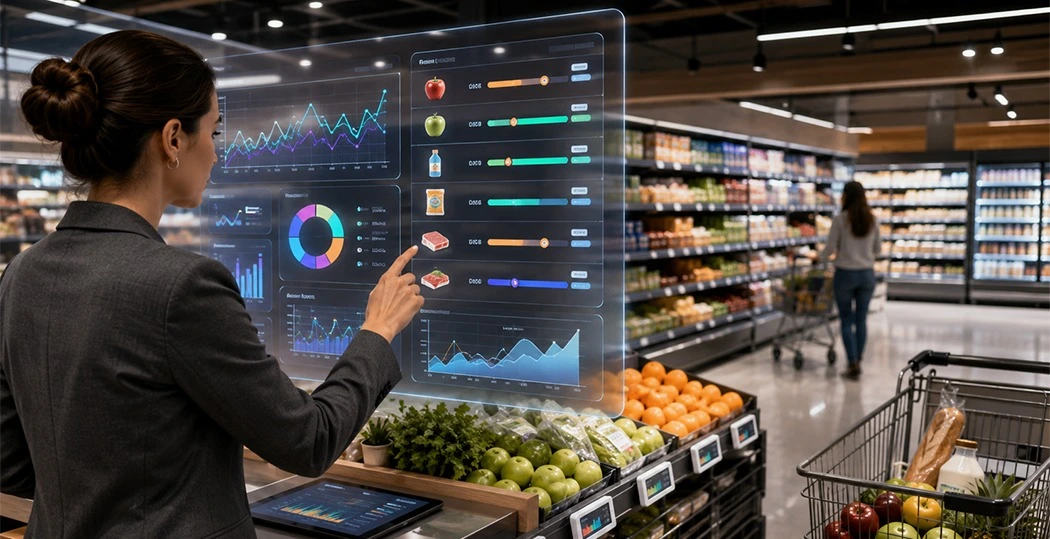
We delivered the data in a clean, structured format through automated feeds that integrated directly with the client’s internal pricing systems. Data was tagged by region, category, and competitor, giving the pricing team the granularity they had asked for. We also built in quality-assurance checks to validate accuracy before each delivery, and provided a retail pricing analytics dashboard for the client’s analysts to visualize price gaps and trends at a glance.
Impact
The results were significant and measurable. With real-time competitor price monitoring flowing into their pricing engine, the client reduced the time spent on manual price checks by more than 80%, freeing their team to focus on strategy rather than data gathering.
More importantly, the retailer could now respond to competitor price changes and promotions within hours instead of weeks. This agility allowed them to protect margins on key value items while remaining competitive on price-sensitive staples. Over the first two quarters, the client reported an improvement in gross margin on monitored categories and a noticeable lift in unit sales on products where they closed competitive price gaps.
Shoppers responded to the more consistent, competitive pricing, and the client’s price-perception scores improved in customer surveys. The pricing team also gained confidence, backed by reliable retail pricing analytics rather than guesswork.
Conclusion
This retail price monitoring case study demonstrates how the right data, delivered accurately and on time, can transform a core business function. By partnering with RetailGator, the grocery retailer moved from reactive, manual pricing to a proactive, data-driven strategy that strengthened both profitability and customer loyalty.
At RetailGator, we believe competitive intelligence should be a growth lever, not a bottleneck. Through reliable competitor price monitoring, grocery price intelligence, and inventory monitoring, we remain committed to helping retailers of every size harness real-time web data to make sharper decisions and stay ahead in an increasingly dynamic market.