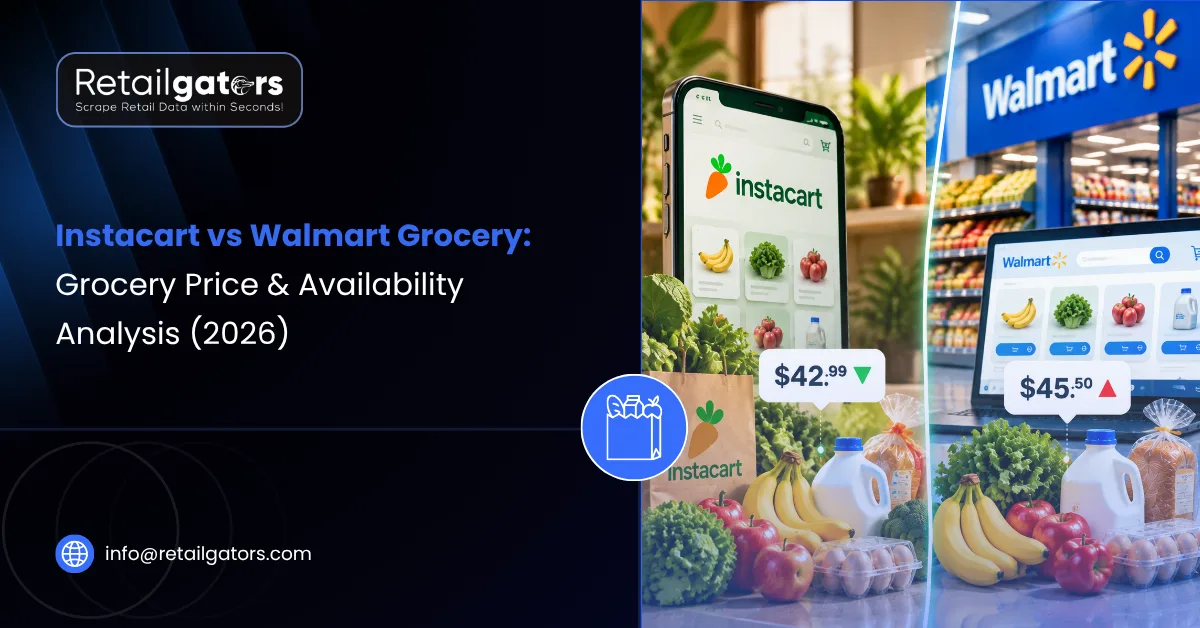
A shopper adding a gallon of milk and a dozen eggs to their cart rarely stops to think about which platform quoted the better price — but pricing and category teams at grocery brands and retailers think about little else. The same SKU can carry two different prices, two different stock statuses, and two different delivery windows depending on whether it’s pulled up through Instacart or Walmart Grocery, and neither number is wrong. They’re just reflecting different operating models. For teams trying to build a reliable grocery inventory monitoring practice around either platform, understanding that difference matters more than picking a favorite.
The instinct is to frame this as a head-to-head: which platform is cheaper, which one has better stock, which one wins. That framing doesn’t hold up well in grocery, where prices shift by store, by zip code, and sometimes by the hour. The more useful question is what each platform’s data actually tells you, and how that data fits into a grocery price comparison or availability-tracking program that a business can actually run week over week.
Instacart vs Walmart Grocery Data Comparison: What Actually Changes?
Instacart and Walmart Grocery start from genuinely different foundations. Instacart is a marketplace layer sitting on top of thousands of partner retailers — Kroger, Costco, Publix, Aldi, and many regional chains among them — so the prices and stock levels a shopper sees depend on which store is fulfilling that particular order. Walmart Grocery, by contrast, is Walmart’s own first-party grocery operation, pulling directly from Walmart’s own store and fulfillment inventory rather than aggregating across outside retailers.
That structural difference shows up immediately in pricing data. On Instacart, price often includes a service fee and sometimes a markup over in-store shelf price, layered on top of whatever the underlying retailer is charging that week. On Walmart Grocery, the price shown is generally closer to Walmart’s own shelf or online price, since there’s no intermediary retailer relationship involved. A grocery price comparison that treats these two numbers as directly equivalent, without accounting for fee structure, will consistently overstate how expensive Instacart looks.
Availability data diverges just as much. Instacart’s stock signals are only as accurate as what the partner retailer’s inventory feed reports, and that feed quality varies a lot by chain. Walmart Grocery’s availability data comes from Walmart’s own systems, which tends to produce more consistent, store-level accuracy, though it’s still subject to the same real-world stock-out risk any retailer faces during high-demand periods.
Delivery pricing is another area where the two platforms genuinely don’t compare like for like. Instacart’s delivery pricing depends heavily on which retailer is fulfilling the order, the shopper’s membership status, and order size. Walmart Grocery’s delivery and pickup fees follow Walmart’s own fee schedule, which tends to be more predictable across a given market. None of this means one platform is more expensive across the board — it means the fee structures need to be normalized before a comparison means anything.
Instacart Grocery Data: What Businesses Can Analyze
Instacart’s marketplace model makes it a useful source for understanding how a product performs across many retailers at once, rather than just one.
Product listings and pricing on Instacart reflect what a specific partner store is charging that day, which means the same national brand product can show several different prices depending on which retailer fulfills the order — useful for spotting where a brand is priced aggressively or conservatively across a region.
Delivery pricing and service fees are worth tracking separately from item price, since Instacart’s total basket cost is shaped as much by fees and minimum order thresholds as by the price of individual products.
Stock availability signals tell you whether a specific item is in stock at a specific partner store on a specific day, which is a strong proxy for how well that retailer is managing inventory for high-velocity grocery items.
Store and retailer information — which partner is fulfilling a given listing — adds context that’s easy to overlook but matters for competitive analysis, since Instacart’s own margin and the underlying retailer’s pricing strategy are two separate things layered into one number.
Promotions and substitution behavior, where visible, can reveal how partner retailers handle stock-outs, since Instacart’s substitution suggestions often hint at what a retailer considers a comparable product.
Put together, Instacart data is strongest for understanding grocery price and availability across a wide set of retailers in a single sweep, rather than deep detail on any one chain.
Walmart Grocery Data: What Businesses Can Analyze
Walmart Grocery data tells a narrower but often cleaner story, since it’s coming from a single retailer’s own systems rather than an aggregated marketplace.
Product pricing reflects Walmart’s own online grocery price, which in most markets tracks closely with in-store shelf pricing, making it a more direct benchmark for national price comparisons than a marketplace-layered price would be.
Availability and stock status are reported at the store level, so businesses tracking a specific market can get a reasonably accurate read on whether a product is actually on Walmart’s shelves, not just theoretically in the catalog.
Delivery and pickup pricing follow a defined fee structure, which makes it easier to model total basket cost consistently across regions compared to a marketplace where fees vary by fulfilling retailer.
Product categories and private-label data are particularly relevant on Walmart Grocery, given how large a share of Walmart’s grocery assortment runs through its own private-label brands — tracking price and placement of these lines is a common use case for competitive category analysis.
Promotions and rollback pricing are a defining feature of Walmart’s pricing approach, and tracking how often and how deeply specific categories go on rollback gives a clearer read on Walmart’s competitive posture than a single price snapshot would.
Where Instacart data is broad across many retailers, Walmart Grocery data is deep on one retailer — which makes it a stronger fit for benchmarking specifically against Walmart’s own pricing and stock behavior.
Instacart vs Walmart Grocery for Price & Delivery Comparison
This is usually where grocery pricing teams run into trouble, because comparing “Instacart price” to “Walmart Grocery price” without adjusting for fee structure produces numbers that look precise but aren’t measuring the same thing.
The cleanest approach separates item price from delivery pricing entirely. Item price comparisons should account for the fact that Instacart pricing often reflects a specific partner retailer’s markup on top of shelf price, while Walmart Grocery pricing is closer to a direct read of Walmart’s own price. Comparing a $4.99 item on Instacart against a $4.49 item on Walmart Grocery doesn’t necessarily mean Walmart is cheaper on the underlying product — it might just mean the Instacart price includes a markup the Walmart number doesn’t carry.
Delivery pricing needs its own comparison layer, since minimum order thresholds, membership programs, and per-order fees change the total basket cost more than most people expect. A business trying to understand where its own delivery pricing sits competitively needs to model total cost — item price plus delivery fee plus any service charge — rather than comparing sticker prices in isolation.
Historical price tracking adds another dimension that a single snapshot can’t provide. Grocery pricing on both platforms moves with promotions, seasonal demand, and supply conditions, so a price comparison run once a month will miss most of the actual movement. Retailers and brands that track pricing consistently over time can see which categories are more promotion-driven on one platform versus the other, and adjust their own pricing strategy accordingly.
None of this supports a claim that one platform is the cheaper option across the board — the answer changes by category, by region, and by which specific retailer is fulfilling the Instacart order that day.
Grocery Inventory Monitoring: Availability Signals That Matter
Price gets most of the attention, but availability data is often the more operationally useful signal for grocery brands and category teams, since a product that’s out of stock generates zero revenue regardless of how well it’s priced.
Stock-out patterns on Instacart tend to reflect the fulfilling retailer’s own inventory management more than Instacart’s platform itself, which means tracking availability across several partner retailers for the same product can reveal which chains are consistently under-stocking a category. That’s valuable information for a brand deciding where to focus replenishment conversations.
Walmart Grocery’s availability data, coming from a single retailer’s system, tends to be a cleaner signal for understanding demand spikes at the store level — a product that goes in and out of stock repeatedly in a specific market is usually telling you something about local demand that a national sales report would smooth over.
Substitution behavior is worth watching on both platforms. When a specific item is unavailable, the substitute a shopper is offered says something about how the platform or retailer ranks comparable products, which has real implications for brands competing for shelf visibility during stock-out periods.
Together, price and availability data support the kind of grocery intelligence that goes beyond a single week’s snapshot — showing which products are chronically under-stocked, which categories see the most promotional volatility, and where a brand’s own competitive position is strongest or weakest by platform.
Instacart vs Walmart Grocery Comparison Table
| Data Area | Instacart | Walmart Grocery | Business Use |
| Pricing source | Partner retailer price plus service fee/markup | Walmart’s own online grocery price | Grocery price comparison |
| Delivery pricing | Varies by fulfilling retailer and membership | Set by Walmart’s own fee structure | Total basket cost modeling |
| Availability data | Reflects partner retailer’s inventory feed | Reflects Walmart’s own store-level stock | Grocery inventory monitoring |
| Retailer scope | Aggregates many partner grocery chains | Single retailer (Walmart) | Market-wide vs. retailer-specific analysis |
| Promotions | Set by individual partner retailers | Walmart rollback and promotional pricing | Promotion tracking |
| Private label visibility | Varies by partner retailer | Strong (Great Value and other Walmart brands) | Category and private-label benchmarking |
| Substitution behavior | Platform-suggested substitutes on stock-outs | Store-level substitution logic | Shelf competition analysis |
| Best fit for | Broad, cross-retailer price and stock scanning | Deep, single-retailer benchmarking | Supermarket data strategy |
Which Grocery Data Should Your Business Track?
The right mix depends on what decision the data is meant to support, not on which platform seems more comprehensive on paper.
If the objective is a broad grocery price comparison across many retailers in a region, Instacart’s marketplace structure gives a wider net in a single pull, since it touches multiple partner chains at once rather than one retailer’s catalog.
If the objective is benchmarking specifically against Walmart’s pricing and promotional strategy, Walmart Grocery data is the more direct source, since it reflects Walmart’s own pricing decisions without a marketplace layer sitting on top.
If the objective is grocery inventory monitoring to catch stock-outs before they hurt sales, both platforms are worth tracking, but for different reasons — Instacart surfaces stock issues across several retailers at once, while Walmart Grocery gives a cleaner single-retailer read that’s easier to correlate with local demand.
If the objective is category or private-label analysis, Walmart Grocery’s depth on its own private-label lines makes it a strong primary source, with Instacart data layered in to see how those same categories are priced and stocked across competing chains.
If the objective is a full market view of delivery pricing and total basket cost, combining both sources is close to necessary, since neither platform’s fee structure alone represents what the broader delivery grocery market looks like.
Why Automated Grocery Data Collection Matters
Grocery pricing and stock levels move faster than most categories, and manual tracking simply can’t keep pace. A price or stock check done once a week is already outdated by the time it’s reviewed, given how often grocery promotions rotate and how quickly high-velocity items can sell through.
Scale is the first constraint that manual collection runs into — checking prices and stock for a meaningful basket of SKUs across two platforms, in multiple markets, isn’t something a person can sustain reliably. Frequency compounds it, since grocery pricing on both Instacart and Walmart Grocery can change within the same day, particularly around weekly promotional cycles. Consistency suffers too, since manual data collection is prone to formatting differences and missed fields when done by different people at different times.
Historical tracking is where the gap becomes most visible. Without a structured, repeated collection process, there’s no reliable price or availability history to analyze against — just scattered snapshots that are hard to compare meaningfully over time. That history is what turns a data point into a genuine supermarket data program capable of spotting trends before they show up in sales figures.
As with any structured collection effort, this work needs to stay within the applicable terms of the source platforms and relevant legal requirements — a consideration worth confirming on a source-by-source basis rather than assuming a single approach applies everywhere.
How RetailGators Supports Grocery Intelligence
Once a grocery brand or retailer has worked out which signals actually matter for its objective, the remaining challenge is usually operational: collecting that data consistently, at scale, without building the infrastructure internally.
RetailGators works with grocery brands, retailers, and category teams on exactly that layer, supporting structured collection of pricing, availability, and promotional data across grocery and supermarket platforms, including Instacart, Walmart Grocery, and other major delivery and pickup services covered under its broader quick commerce data scraping coverage.
Beyond raw collection, RetailGators supports the analysis layer that pricing and category teams actually use day to day — pricing intelligence for tracking price movement and promotional patterns over time, and live price crawling for teams that need near-real-time visibility rather than periodic snapshots. Data is delivered in whatever format fits the existing workflow — CSV, Excel, JSON, or scheduled API feeds — at a frequency the business defines.
Grocery brands and retailers building out a price and availability tracking program across Instacart, Walmart Grocery, or a wider set of delivery platforms can talk through their specific requirements with RetailGators and work out a collection approach that fits how their team actually uses the data.
Conclusion
Instacart and Walmart Grocery aren’t competing for the same title — they’re two different windows into the grocery market, one aggregating across many retailers and one reflecting a single retailer’s own pricing and stock decisions. A grocery price comparison that ignores that distinction will produce numbers that look authoritative but aren’t measuring the same thing underneath.
The more useful approach treats each platform’s data for what it actually is: Instacart for breadth across retailers, Walmart Grocery for depth on a single major chain, and both together for a fuller read on price, availability, and delivery cost across the grocery market. Teams that structure their tracking around that distinction — rather than chasing a single “which platform wins” answer — tend to make sharper pricing and inventory decisions as a result.
If your team is working out what a grocery inventory monitoring or grocery price comparison program should actually track across Instacart and Walmart Grocery, RetailGators can help structure the data collection around the decisions you’re trying to make.