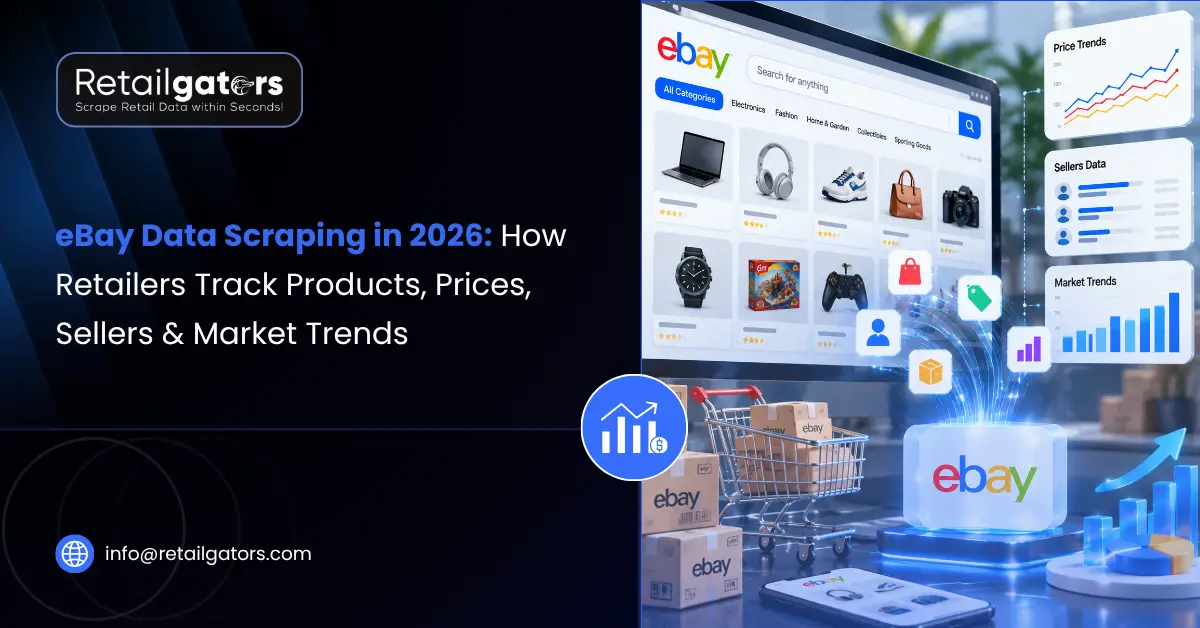
You may be surprised to learn that eBay is one of the largest publicly accessible sources of online commercial marketplace data. By the end of 2025, the platform had around 135 million active buyers and nearly 2.5 billion live listings across more than 190 markets, generating around $79.6 billion in full-year gross merchandise volume. For sellers, resellers, and analysts tracking pricing, demand, and competitor activity, this is a vast, constantly changing stream of market data.
The challenge is turning that public information into structured, usable data at scale. eBay doesn’t provide every product, pricing, or competitor insight as a ready-to-use export, and automated data collection can face technical and operational challenges. This article explores the key eBay data worth scraping, practical ways to extract it, common challenges, and how human oversight can help maintain data quality and accuracy.
Whether you sell on eBay, compare prices across marketplaces, or build pricing intelligence for clients, the objective remains the same: clean, current, and structured data that supports confident decisions, not a collection of incomplete or poorly parsed web pages.
What is eBay Data Scraping?
eBay product data scraping refers to the automated process of extracting structured data from eBay’s publicly accessible web pages, including product listings, search results, customer reviews, and auction records. It matters because eBay is a dynamic marketplace with hundreds of thousands of products, and data changes every second, so manual tracking cannot keep up.
eBay operates in more than 190 markets and offers a vast range of products including electronics, fashion, outdoor equipment, furniture, collectibles, and more. In the first quarter of 2025, eBay reported $18.8 billion in Gross Merchandise Volume (GMV), up 2% year over year. By the third quarter, revenue reached $2.82 billion, up 9%. These numbers reflect a marketplace with massive commercial activity, and that activity generates data that businesses can use.
Without automated eBay data scraping, accessing this information at scale would require a large team of analysts to browse pages, manually copy numbers into spreadsheets, and struggle to keep information current. Scraping eliminates that roadblock.
How Does eBay Web Scraping Work?
An eBay scraper works like most others: it sends automated HTTP requests to pages, retrieves the HTML content, and parses it to extract specific data fields.
The process starts with a structured workflow. First, a scraper identifies the target URLs, whether those are search result pages, category pages, or individual product listings. Then it sends requests that mimic standard browser behavior. It then parses the returned HTML using techniques like CSS selectors or XPath to isolate the exact data points needed.
At business levels, this process also involves proxy rotation to avoid IP restrictions, CAPTCHA handling for uninterrupted access, and JavaScript rendering for pages that load content dynamically. RetailGators manages these complexities behind the scenes, delivering clean, structured datasets to clients without their technical involvement.
What eBday Marketplace Data Can Retailers Scrape?
eBday marketplace data is generally rich because the platform mixes fixed-price and auction formats, new and used goods, and individual and business sellers in the same catalog.
The variety is exactly what makes the data valuable for competitive research. The fields businesses care about fall into a few groups.
| Data Category | Fields | Common Use |
| Listing Details | Title, item ID, category, condition, item specifics, images | Catalogue building, product matching |
| Pricing | Current price, was/strikethrough price, shipping, sold price, bids | Repricing, margin analysis, arbitrage |
| Demand Signals | Watchers, quantity sold, sold-listing history, time to sell | Demand forecasting, sourcing decisions |
| Seller Data | Seller name, feedback score, feedback %, location, store name | Competitor tracking, supplier discovery |
| Sold/Completed | Final sale price, sale date, format (auction vs fixed) | True market value, pricing benchmarks |
The sold and completed-listing data is the most prized and the hardest to get. Unlike an active price, a sold price shows what buyers actually paid, making it the best proxy for real market value for a used or collectible item. eBay gates deeper access to this history, so it is often the part of a project that needs the most careful handling.
How Retailers Use eBay Product Data for Competitor Analysis
eBay product data gives retailers a detailed view of how competitors build, expand, and adjust their catalogs. By collecting product titles, brands, categories, variants, prices, availability, and listing dates over time, retailers can compare their assortment with competing sellers and identify market changes.
- Competitor Product Assortment: Compare the products, brands, categories, and price ranges offered by competing sellers to understand how their assortment differs from your own.
- New Product Launches: Track newly added listings to identify products competitors are introducing and spot emerging opportunities before they become widely adopted.
- Popular Brands and Categories: Analyze listing volume, sales signals, reviews, and pricing activity to identify brands and categories receiving strong marketplace attention.
- Product Variants: Monitor differences in size, color, model, condition, pack count, and other attributes to understand how competitors structure their product offerings.
- Catalog Changes: Track listings over time to identify products being added, removed, repriced, or replaced, helping retailers understand how competitors are adapting their catalogs to changing demand.
- Product Gaps: Compare competitor catalogs with your assortment to uncover products, brands, or variants missing from your current offering.
When collected continuously, this data turns eBay marketplace data into a historical view of competitor assortment strategy. Retailers can use these insights to refine product selection, identify emerging categories, and respond faster to marketplace changes.
How eBay Price Data Supports Retail Pricing Intelligence
eBay price data gives retailers an open view of how competing sellers price similar products across the marketplace. By tracking current and historical prices, businesses can identify pricing differences, promotional changes, seller-level variations, and shifts in product positioning. An eBay product data API for competitive pricing can connect this marketplace data with internal dashboards, analytics platforms, and pricing workflows, making recurring analysis easier to manage.
Price alone, however, does not always tell the full story. An eBay price monitoring solution for eCommerce brands can combine pricing data with seller information, product condition, shipping costs, and availability. This helps retailers distinguish genuinely lower-priced offers from listings where differences in shipping, condition, or stock availability affect overall value.
For businesses managing large product catalogs, automated data collection can also make pricing analysis more consistent. An eBay price monitoring API for retailers can feed recurring marketplace data into existing systems, reducing reliance on manual exports and spreadsheet-based checks. Historical price records can help teams identify recurring patterns, track competitor price movements, and determine when a product needs closer review.
Key pricing intelligence decisions supported by eBay data include:
- Product Pricing Evaluation: Understand how competitors position products through price, condition, and offer structure.
- Promotion Tracking: Identify discounts and price changes that may influence marketplace demand.
- Competitive Pricing Evaluation: Compare similar products and identify pricing gaps across sellers.
- Seller Comparison: Evaluate how different sellers price the same or similar products.
- Pricing Adjustment Assessment: Use current and historical data to determine when existing prices may need review.
When collected consistently, eBay price data creates a repeatable foundation for retail pricing intelligence. Teams can monitor meaningful price movements, understand the factors behind different offers, and bring marketplace signals into broader pricing workflows. This becomes particularly useful as product catalogs, competitors, and monitoring requirements grow.
How eBay Data Scraping Helps Identify Market Trends
As mentioned, eBay trends shift in no time! Products can move from low demand to high demand because of seasonality, viral content, new releases, or supply shortages. eBay product intelligence helps retailers track changes in prices, listing volumes, and keyword activity to spot emerging opportunities and shifting competition.
Changes in listing volumes can also reveal market conditions. Rising listings may indicate increased competition or excess inventory, while declining listings can signal stronger demand or reduced supply. This data can help sellers identify related product opportunities, validate demand before investing, and spot signs of oversupply or declining interest. With structured trend data, retailers can make timely decisions on inventory, pricing, and product selection.
How eBay Data Helps Sellers Improve Listings
eBay data scraping can help sellers study successful competitor listings and identify patterns that influence visibility and conversions. By analyzing product titles, keywords, pricing, and listing details, sellers can refine their listings to match buyer search intent better.
Product specifics such as brand, model, size, material, and compatibility are equally important. Comparing these fields across competing listings can reveal commonly used attributes and help sellers create more complete, relevant product listings.
Scraping can also provide insights into competitor shipping and return policies, such as free shipping, delivery times, and return windows. Sellers can use these findings to assess which policies may improve buyer appeal while considering their own costs and margins.
Overall, eBay data scraping provides market-based insights that sellers can use to improve listing quality, product discoverability, and conversion opportunities.
How Can You Scrape eBay Product Data Effectively?
To scrape eBay product data effectively, you need a reliable extraction process that handles eBay’s dynamic page structure, anti-bot protections, and the platform’s sheer volume of listings. The right process merges technical infrastructure with smart data management practices.
eBay pages are not static HTML documents. Many elements load through JavaScript, product variants are stored in embedded JSON objects, and search results paginate across hundreds of pages. A basic scraper will miss critical data points. An enterprise-grade solution, like those built by RetailGators, accounts for these complexities.
Important Steps in the eBay Web Scraping Process
The eBay product data scraping process follows a systematic approach that ensures data completeness and accuracy. Each step builds on the previous one to deliver structured, analysis-ready databases.
- Identify Target URLs and Categories: Select the eBay categories, search results, product pages, or seller profiles you want to monitor. This creates a clear scope for data collection.
- Set up the Scraping Infrastructure: Configure the required crawling environment, including proxies, request controls, and other mechanisms needed for reliable data collection.
- Extract and Structure the Data: Parse eBay pages and available embedded data to capture relevant product, seller, pricing, and variant information in a structured format.
- Clean and Validate the Dataset: Remove duplicate records, address missing values, standardize prices and currencies, and verify the accuracy and consistency of the collected data.
- Deliver Data in the Required Format: Export the final dataset as CSV, JSON, Excel, or a database/API feed based on how your business plans to use the information.
Final Thoughts
eBay offers a rich source of product, pricing, seller, and market data, but turning that information into reliable business insights requires scalable collection, accurate processing, and consistent monitoring. RetailGators provides a managed eBay web scraping solution that handles data extraction, validation, cleaning, and delivery at scale.
With a focus on accuracy, scalability, and compliant data practices, we can help businesses track millions of eBay listings, compare competitors, monitor sellers, and identify changing market trends. Whether you need pricing intelligence or structured seller and product data, RetailGators turns marketplace information into business-ready datasets that support smarter, data-driven decisions.