What if you could see what’s selling on Etsy, how much competitors are charging, which sellers are gaining traction, and what customers really think- all without spending hours browsing listings? For e-commerce businesses, these insights can make a huge difference when identifying product opportunities, refining pricing strategies, and staying ahead of market trends.
And the opportunity is significant. As of June 2026, Etsy had around 85 million active buyers and 5.7 million active sellers, with its marketplace gross merchandise sales (GMS) growing 7.5% year over year in Q2 2026. (Source: Etsy) With hundreds of thousands of shoppers and sellers on the platform, Etsy offers abundant market intelligence that businesses can use to understand consumer preferences, track competing products, and uncover emerging trends.
That’s where Etsy data scraping comes in. By automatically collecting product details, prices, seller information, customer reviews, and ratings, businesses can turn marketplace data into actionable e-commerce intelligence. Whether you are benchmarking competitor prices, researching new product categories, or evaluating customer sentiment, structured Etsy data helps you make decisions based on what’s actually happening in the market.
In this blog, we will explain how Etsy data scraping works, which data points matter most, and how businesses can use these insights to sharpen their e-commerce strategies.
What is Etsy Data Scraping and How Does It Work?
Etsy data scraping is the automated process of extracting publicly available data from Etsy’s product listings, category pages, and seller profiles. It helps e-commerce businesses turn marketplace data into actionable intelligence by providing a clearer view of product trends, competitor pricing, seller performance, and customer preferences. Instead of manually browsing thousands of listings, businesses can use automated tools to gather relevant information at scale and make data-driven decisions.
The process typically begins by identifying target products, categories, or sellers based on specific business requirements. Automated scraping tools then collect relevant listing details, including product names, descriptions, prices, discounts, availability, seller information, customer reviews, and ratings. The tool extracts, structures, and validates this information to ensure consistency and usability. Once processed, the data can be delivered through APIs, CSV, JSON, or other formats for further analysis, reporting, and integration with business intelligence systems.
However, effective Etsy data scraping goes beyond simply collecting information. Businesses should follow responsible data collection practices, respect Etsy’s applicable platform policies, and avoid gathering personal or sensitive information. By prioritizing data accuracy, privacy, and compliance, companies can build a reliable foundation for e-commerce intelligence while using marketplace insights to identify opportunities and refine their strategies.
What Data Can You Extract from Etsy?
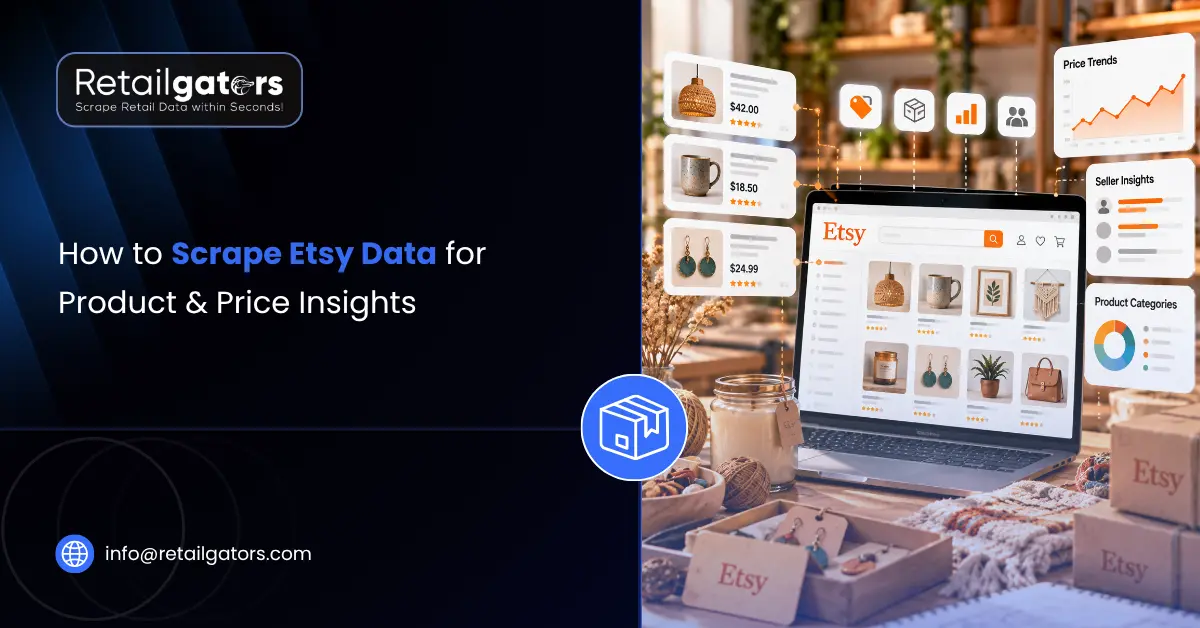
Using the Etsy scraper, data buyers and retailers can extract complete product attributes directly from Etsy search results grids, category taxonomy pages, and listing storefronts.
- Listing Title: The full product headline, styling description, and search keywords.
- Product URL: Canonical Etsy listing URL including unique tracking and item identifiers.
- Image & Video URLs: Multi-resolution image URLs and video preview assets hosted on Etsy’s CDN.
- Merchant Shop Name: The registered artisan brand or seller storefront name.
- Customer Star Rating: Aggregate rating score awarded by buyers.
- Review Count: Total cumulative customer reviews and rating volume.
- Current Selling Price: Active checkout price in local currency.
- Original List Price: Strike through baseline price before promotional discounts.
- Discount Percentage: Active promotional markdown rate.
- Available Color Variants: Array of extractable color choices listed by the maker.
- Badges & Urgency Signals: Special platform status badges indicating buyer demand.
- Sponsored Ad Placement: Boolean indicator identifying whether the listing is a paid sponsored placement or an organic search result.
- Free Shipping Status: Boolean flag identifying free delivery eligibility.
In addition to these catalog fields returned from search and category feeds, RetailGators can extract listing-level sold-count metrics, full customer review text, and store-wide seller metrics when scraping individual listing pages and storefront URL.
How Etsy Data Scraping Supports E-Commerce Intelligence
Unlike other marketplace platforms, Etsy offers unique, custom, and small-batch inventory. This creates a distinct data dynamic where traditional retail tracking models fall short.
Monitoring Competitor Pricing Strategies
Handmade and antique products don’t often come with standard price tags. So, pricing becomes highly subjective and dynamic. Continuous Etsy product pricing monitoring helps platforms track average price floors, target margins, and how top-performing sellers value their craftsmanship.
Understanding Handmade Product Trends
Etsy often sells artisan-made or specialized products; consumer demand shifts quickly based on cultural trends, social media virality, and aesthetic movements. Scraping product categories helps brands spot these micro-trends weeks before they hit mainstream retail channels.
Seller Performance Benchmarking
By scraping Etsy product data, businesses can identify top-tier storefronts and analyze their shipping speeds, response rates, and listing volume. Benchmarking these metrics helps new market entrants understand the operational baselines required to compete.
Tracking Consumer Demand Signals
Review frequency, favorite counts, and inventory changes offer valuable insights into customer demand and buying behavior. By tracking these signals, brands can improve demand forecasting, make informed inventory decisions, and better anticipate shifts in consumer preferences.
How to Scrape Etsy Data?
When it comes to extracting data from Etsy, there are many different ways to do it. With Python, you can collect data from the site yourself. Unless you are comfortable with tech, this process can take time and effort. It can become just as time-consuming as manually copying and pasting the required data.
Another option is to utilize one of the multiple free web scraping tools available. The only drawback with them is that these free tools are unreliable. They can also pose security threats and put you at risk of being hacked.
The easiest and most probably the best option out there is to hire professional Etsy product data scraping service providers. This eradicates the need to learn technical stuff and is also way safer than using a free scraper.
At this point, you might think scraping Etsy data is a hassle-free process that lets you collect all the data you need without any obstacles. But in reality, web scraping Etsy marketplace data comes with several challenges that can make the process frustrating.
What Challenges Do You Face in Etsy Data Extraction?
Extracting data from today’s highly dynamic marketplaces comes with unique technical challenges that demand advanced infrastructure and specialized solutions.
Dynamic Product Listings
The platform relies heavily on JavaScript frameworks. Listings render elements dynamically as the page loads, meaning a basic HTTP request often misses crucial information like variations, stock status, or customer reviews.
Rate Limiting Challenges
Making too many rapid requests from a single source triggers aggressive rate limits. Effective tools must mimic human behavior by pacing requests and managing connection headers cleanly.
Pagination Complexity
Navigating deep search results requires handling infinite scrolls or complex pagination tokens. If your scraper cannot consistently parse pagination loops, it will miss vast portions of the catalog.
Anti-Bot Protection Mechanisms
Etsy utilizes advanced web application firewalls (WAFs) and anti-bot systems to prevent scraping traffic from degrading site performance. Simple scripts will trigger immediate IP blocks or prompt complex challenge screens.
Etsy Data Scraping VS. Manual Marketplace Research
Trying to scale an e-commerce operation using manual copy-pasting is a recipe for operational failure. The difference between manual tracking and a dedicated extraction API is stark:
| Feature | Manual Research | Etsy Scraper |
| Speed | Slow, labor-intensive | Real-time data delivery |
| Scalability | Limited by human hours | Enterprise level scale |
| Accuracy | Prone to human errors | High precision data parsing |
| Automation | None; requires constant manual effort | Fully automated data pipelines |
| Data Freshness | Instantly delayed and stale | Continuous, scheduled updates |
Best Practices for Scalable Etsy Data Scraping
To build a resilient web scraping engine that runs without constant maintenance, professionals should implement these core strategies:
- Schedule Automated Crawling Pipeline: Schedule data collection during off-peak hours to minimize server load, and distribute requests at reasonable intervals to maintain responsible scraping practices.
- Normalize Marketplace Data Structures: Marketplaces frequently update their front-end structures. Implement an abstraction layer to clean, standardize, and normalize incoming data before storing it in your production database.
- Use Rotating Proxy Infrastructure: Distribute requests across a diverse pool of residential and data center IPs to reduce load on individual addresses and maintain stable data collection within applicable rate limits.
- Handle CAPTCHA Detection Efficiently: Integrate intelligent browser automation and verification-handling capabilities into your data pipeline to manage access challenges while keeping the extraction workflow running smoothly.
How Do RetailGators Support Etsy Data Extraction?
RetailGators provides customized web data extraction solutions to help businesses collect and structure Etsy marketplace data. Its workflows can capture product details, prices, seller information, reviews, ratings, and availability across various categories and competitor shops.
The extracted data can be delivered through CSV, JSON, or other formats and integrated into business intelligence, pricing, market research, and analytics workflows. With scalable collection capabilities, businesses can track large volumes of Etsy listings and turn marketplace data into actionable e-commerce insights.
Final Thoughts
Etsy is more than just a marketplace for handmade and artisanal products; it is a valuable source of e-commerce intelligence. By collecting product, pricing, seller, review, and demand data, businesses can uncover emerging trends, benchmark competitors, understand customer preferences, and make more informed pricing and inventory decisions.
However, extracting this data at scale requires reliable infrastructure, accurate data processing, and a responsible approach to collection. RetailGators helps businesses turn Etsy marketplace data into structured, actionable insights through customized data extraction solutions.
Ready to turn Etsy data into a competitive advantage? Explore RetailGators’ customized Etsy data scraping solutions and build a marketplace intelligence workflow tailored to your business.