A brand manager spots a retailer advertising a flagship product $40 under MAP on a Friday afternoon. By Monday, three other sellers have matched the price, the authorized dealer who has been following the rules is asking why they should keep doing so, and nobody can say for certain when the first violation went live. That’s the moment most teams realize they have a MAP policy but not a MAP enforcement process. MAP monitoring tells you a price is wrong. What you do next depends on the evidence you can put in front of someone.
This playbook covers the whole chain: how to detect violations you can trust, how to sort sellers before you react, what solid MAP violation evidence looks like, and which response fits which situation. It also includes a report template you can adapt for your own team. A quick note before we start: this is operational guidance, not legal advice. MAP rules differ by country, and your counsel should review your policy and your enforcement steps.
First, What “Takedown” Actually Means
Brands often assume that if a seller breaks the MAP policy, a marketplace will remove the listing. In practice, that’s rarely how it works. Amazon’s brand protection tools, for example, are built around counterfeits and intellectual property claims, and several brand-protection practitioners point out that advertising below your preferred price doesn’t, by itself, count as trademark or copyright infringement. Other marketplaces generally follow a similar logic: a price you dislike isn’t grounds for removal.
So “takedown” splits into three different paths, and mixing them up wastes weeks. If the violator is an authorized reseller, enforcement runs through your agreement with them: warnings, loss of promotional funds, or reduced supply. If the seller is unauthorized, the first question is where their stock came from, and whether anything about the listing (counterfeit goods, misuse of your trademark, false claims about the product) gives you a legitimate platform complaint. And if it’s only a price problem with no other violation, you’re probably dealing with the seller or your channel partners directly, not asking the platform to step in.
Why does this matter for evidence? Because each path needs a different file. The stronger your documentation is for the path you’ve chosen, the faster things move.
Step 1: Detect Violations You Can Trust
A noisy alert stream kills enforcement programs faster than any legal problem. If your team gets forty alerts a day and half of them turn out to be false, people stop looking. Three things keep detection credible.
Match products properly. A “violation” on a bundle, a different pack size, or a refurbished unit isn’t a violation at all. Your SKU map has to link each retailer’s listing back to your catalog accurately, which is where product matching earns its keep. A violation report built on a mismatched product will collapse the first time the seller disputes it.
Check at the right pace. Prices on marketplaces can change several times in a day. A weekly check might tell you a violation existed at some point, but it can’t tell you how long it ran, which makes it a weak basis for any enforcement decision. Pick a frequency based on how fast your channels actually move, and increase it around sales events.
Compare advertised price to advertised price. MAP covers what a seller publicly advertises, not what a customer pays at checkout after a coupon or cart-level discount. Build your rules around the price visible in the listing, and record separately when a “see price in cart” tactic or a coupon is involved, since those cases need a human to review them.
Step 2: Sort the Seller Before You Act
Before you send anything, you need to know who you’re dealing with. The same listing can be a small mistake from a loyal dealer, a deliberate undercut from a reseller who ignored your policy, or a gray-market seller who bought through a diverted channel.
Unauthorized seller detection starts with a simple comparison: does the seller’s name or ID appear in your authorized list? If it doesn’t, look at the listing for clues, such as quantities that suggest bulk purchasing, packaging that looks different from yours, or stock levels that move in ways your own distributors’ stock doesn’t. A brand protection and counterfeit detection workflow becomes relevant when the listing shows signs of counterfeit goods or trademark misuse rather than just low pricing.
Then trace where the stock came from. Many “unauthorized” sellers are really the downstream end of one authorized account that’s been feeding inventory out the back door. If you can identify that account, a contractual conversation with your own partner will usually do more than a complaint to the marketplace ever will.
What Strong MAP Violation Evidence Looks Like
When a seller disputes a violation, or when legal needs to review a case, the quality of your evidence decides how fast you can move. Thin records lead to back-and-forth. A complete record often closes the matter in one email.
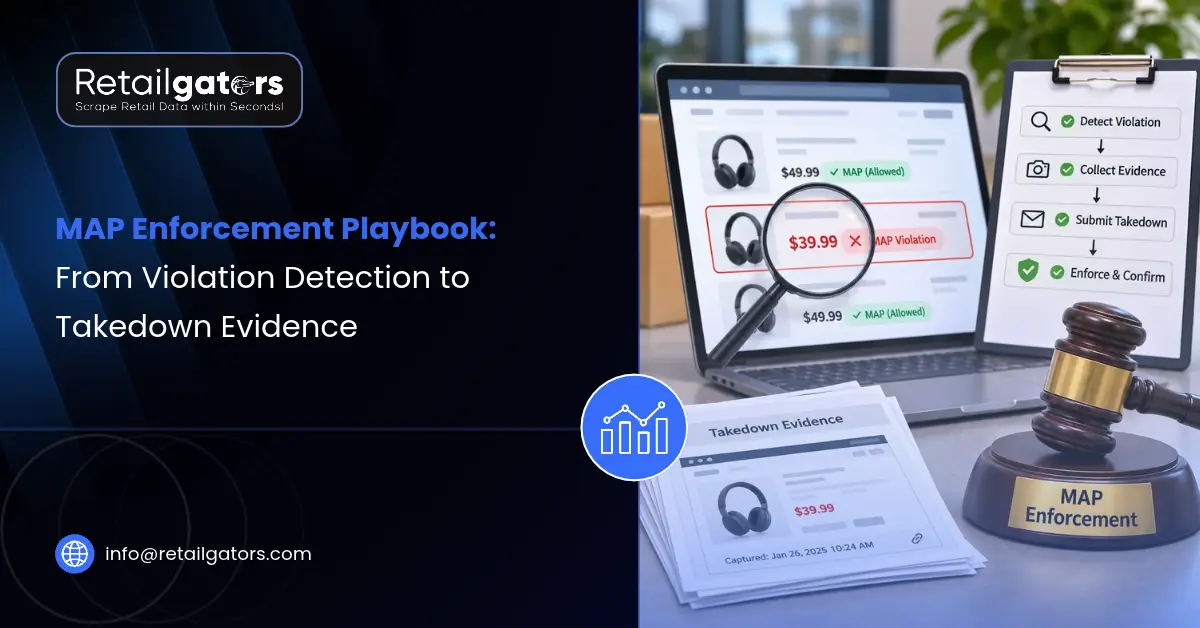
At a minimum, each violation record should hold the listing URL and the seller’s name or ID, along with the product identifiers (SKU, UPC, or marketplace ID), the advertised price and currency, and the MAP price that applied on that date. It should show exactly when the price was captured, ideally with a screenshot of the page displaying the price, so there’s no argument about what a shopper could see. Add the promotion or coupon context, whether the seller is authorized, and the notice history: when you warned them before, which policy version was in force, and what they said.
Repetition matters just as much as a single capture. One price drop on one afternoon is an incident. The same seller breaching MAP on the same product across several weeks is a pattern, and patterns are what justify escalation. Keeping a history per seller, rather than only the latest observation, makes that visible.
Evidence also has a shelf life. A listing that was in violation two weeks ago and has since been corrected tells you something about the seller’s habits but isn’t a live problem. Record what you saw, when you saw it, and whether it’s still true.
Step 3: Match the Response to the Situation
| Situation | What you need | Typical response |
| Authorized reseller, first violation | Dated price capture, MAP in force, seller ID | Friendly notice referencing the policy |
| Authorized reseller, repeated violations | Violation history across dates, prior notices | Formal warning, loss of promotional benefits, or supply review |
| Unauthorized seller, price only | Listing capture, proof the seller isn’t authorized, source tracing | Contact the seller; investigate your supply chain |
| Unauthorized seller, trademark misuse or suspected counterfeit | Listing captures, product details, IP registration, test purchase where appropriate | Platform IP complaint, legal escalation |
| Pattern across several channels | Consolidated violation history by seller and product | Escalate to commercial or legal review |
Apply the same standards to everyone. Brands that warn some resellers and ignore others invite disputes about selective enforcement, and an inconsistent record weakens every future case.
A Sample MAP Violation Report Template
Here’s a simple structure you can copy into a spreadsheet or your case-management tool. The example row is fictional and only shows the format.
| Field | What to record | Example |
| Case ID | Your internal reference | MAP-0142 |
| Date and time captured | Exact capture time, with time zone | 2026-11-04, 14:32 UTC |
| Marketplace / site | Where the listing appears | Example marketplace |
| Listing URL | Direct link | (link) |
| Seller name and ID | As shown on the listing | BrightHome Deals (example) |
| Seller status | Authorized / unauthorized / unknown | Authorized |
| Product and identifier | Your SKU plus UPC or marketplace ID | Model X, SKU 1001 |
| MAP in force | MAP price and policy version that applied | $199.00, policy v3 |
| Advertised price | Price visible on the listing, with currency | $159.00 |
| Gap to MAP | MAP minus advertised price | $40.00 |
| Promotion or coupon context | Notes on coupons, bundles, cart pricing | None |
| Screenshot reference | File name or link to the capture | MAP-0142.png |
| Prior notices | Dates and outcome of earlier contact | None (first occurrence) |
| Action taken | Notice, warning, escalation | Friendly notice sent |
| Status | Open / corrected / escalated / closed | Open |
| Follow-up date | When you’ll re-check | 2026-11-06 |
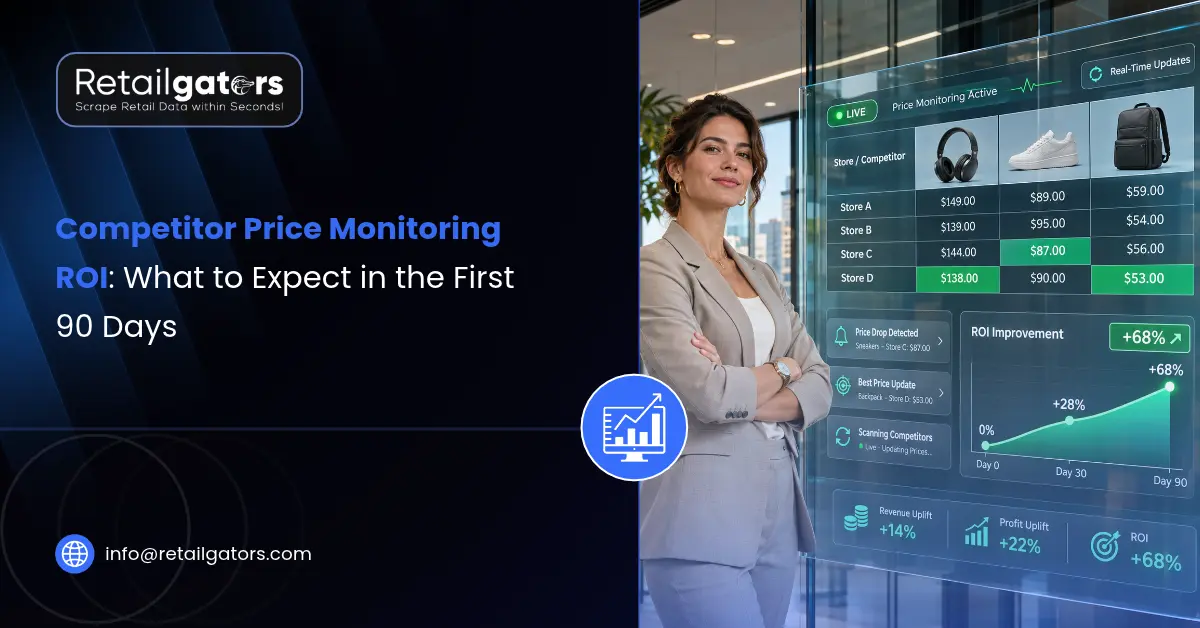
If you’re also building the financial case for enforcement, our guide to competitor price monitoring ROI shows how to measure what price protection is worth to margin.
Where Enforcement Falls Apart
Most breakdowns come from the same small set of causes. Alerts fire on mismatched products, so people stop trusting the system. Evidence gets captured as a number without a screenshot or timestamp, so a disputed case turns into an argument about what the page showed. Policies change without version tracking, so nobody can say which rule applied on a given date. And nobody checks the legal side: in the US, brands typically use a unilateral policy and are careful not to negotiate resale prices with retailers, while in the EU and UK, restricting resale or advertised prices is generally treated as anti-competitive. A process copied from a US playbook shouldn’t be dropped into those markets without advice.
Platform rules change too, so confirm current policies for any marketplace before you rely on a particular complaint route.
Where RetailGators Fits
If you’d rather not build the collection and matching layer yourself, that’s what RetailGators does. Its MAP compliance monitoring page describes tracking listings and seller prices across online channels, mapping SKUs between retailers, flagging violations and unauthorized discounts, and sending alerts to the team responsible. Violation data is organized in one dashboard, so the compliance team works from a single record instead of a pile of screenshots and spreadsheets.
Evidence details, such as capture timing, screenshots, and how seller status is flagged, are worth defining up front. A free pilot run is a practical way to see what real violation records look like for your own products and retailers before you commit.
Conclusion
MAP policy enforcement works when detection is credible, seller status is checked before action, and every case carries evidence that holds up on its own. Marketplaces rarely remove listings over price alone, so strong MAP violation evidence is mostly what lets you work with your reseller or distributor, or build a legitimate IP complaint where one really exists. Start with a clean SKU map, a defined capture routine, and a consistent report format, and the rest gets easier.
If you’d like to see what a MAP violation report could look like with your own products and sellers, talk to the RetailGators team and request the sample MAP violation report template.