Introduction
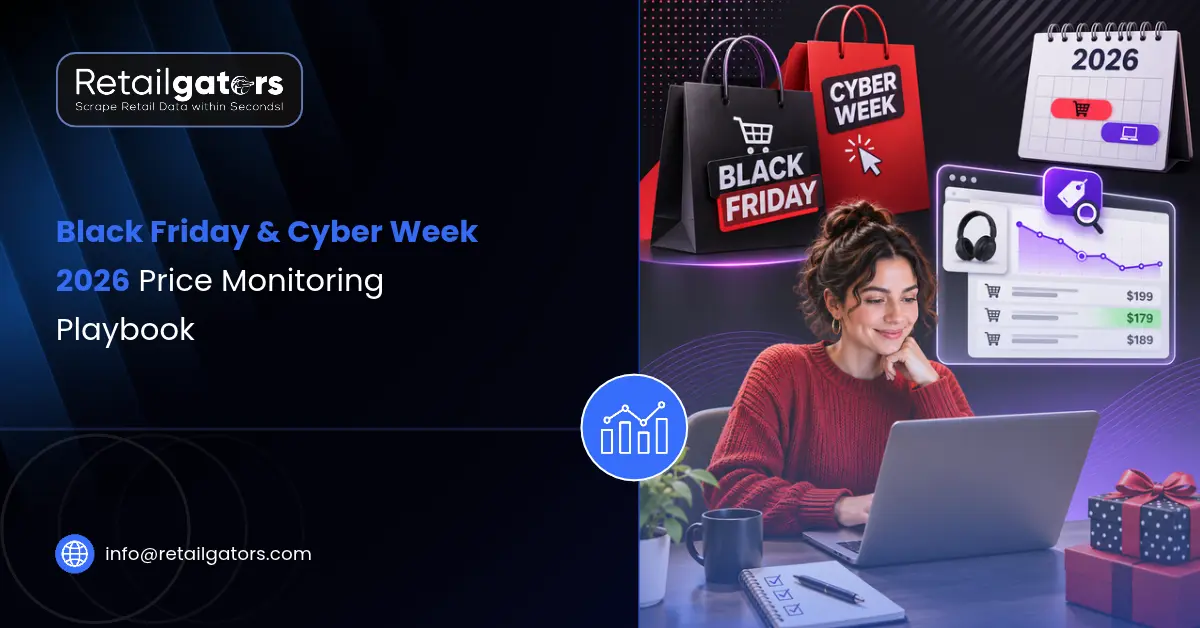
Black Friday and Cyber Week pricing decisions can change within hours, making competitor price monitoring essential for retailers and brands. Track competitor prices, discount types, stock availability, shipping costs, seller details, and product variations to understand how the market is moving. Start collecting baseline prices before Thanksgiving, then increase monitoring frequency for high-priority SKUs as major deals go live.
In 2026, Thanksgiving falls on November 26, Black Friday on November 27, and Cyber Monday on November 30. Retailers that prepare early have more time to identify competing offers, set profitable price floors, and establish rules for responding to sudden price changes.
This Black Friday price monitoring playbook explains how to select products and competitors, set monitoring schedules, configure alerts, and evaluate pricing performance after Cyber Week. It also includes a practical checklist to help your team organize the entire process.
Why Holiday Pricing Moves Faster During Black Friday and Cyber Week
Black Friday pricing no longer starts and ends on a single shopping day. Retailers introduce early promotions, extend discounts across multiple shopping events, and adjust offers as competitors change their prices. This creates a longer period of pricing activity that retailers need to monitor.
The 2025 holiday shopping figures illustrate the scale of this activity. According to Adobe Analytics, U.S. consumers spent $11.8 billion online on Black Friday 2025, a 9.1% increase year over year. Cyber Monday generated another $14.25 billion, while the five-day Cyber Week period reached $44.2 billion.
For pricing teams, these numbers highlight why monitoring should begin before Thanksgiving. A competitor may introduce an early discount, change a product’s promotional price, or run out of stock before the main shopping weekend. Without consistent tracking, retailers risk making pricing decisions using outdated information.
Key Black Friday and Cyber Week 2026 Dates Retailers Should Track
The scale of the holiday weekend explains why pricing discipline pays off so well. Online spending keeps breaking records, yet shoppers are buying more carefully, which means your price needs to be right at the exact moment they look. The table below uses verified 2025 figures from Adobe Analytics and Salesforce, the latest complete data heading into the 2026 season.
| Metric | 2025 Figure | What It Signals for Pricing |
| Black Friday U.S. online sales | $11.8 billion, up 9.1% year over year | Record demand, yet every price is compared instantly |
| Cyber Monday U.S. online sales | $14.25 billion, up 7.1% year over year | The biggest online shopping day ever recorded |
| Cyber Week total (5 days) | $44.2 billion, up 7.7% year over year | Pricing pressure lasts for days, not hours |
| Mobile share, Cyber Monday | 57.5% of sales ($8.2 billion), up 8% YoY | Clear, fast mobile pricing is non-negotiable |
| Deepest Cyber Monday discounts | Electronics peaked at 31% off list price | Benchmark your cuts against category norms |
| Global Cyber Week sales (Salesforce) | $336.6 billion, up 7% YoY | Price competition is now worldwide, not local |
According to Vivek Pandya, lead analyst at Adobe Digital Insights, persistent deals across the week pushed shoppers earlier, to the point where Black Friday now challenges the long-held dominance of Cyber Monday. Salesforce added another signal worth noting: AI and agents influenced 20% of all global orders, driving $67 billion in sales, which means more shoppers are comparing prices through assistants that surface the cheapest option first.
How Does Automated Price Intelligence Actually Work?
Behind every sound pricing decision sits a data pipeline that most shoppers never see. The first job is product matching, where a system confirms that your 55-inch TV and a rival’s listing are truly the same item by comparing identifiers like UPC, GTIN, model number, and specifications, rather than trusting the product title alone. Mismatched products are the most common reason a pricing report quietly misleads a team, so accurate SKU matching matters far more than raw data volume.
Crawl frequency is the next lever. During an ordinary week, pulling competitor prices once or twice a day is usually plenty, but Cyber Week rewards tighter intervals, and many retailers switch to hourly or even sub-hourly checks on their top SKUs while leaving slow-moving products on a lighter schedule. This keeps the data fresh where it counts without burning resources on items that rarely change.
Raw scraped data is seldom clean, which is where validation earns its keep. A dependable workflow filters out obvious errors such as a $9 laptop caused by a formatting glitch, flags sudden swings for a human to review, and reconciles currency, tax, and shipping so every figure reflects the real landed price. Only after that check does the data feed a repricing engine, which applies your rules on its own: hold here, match there, round to a clean price point, and never cross the floor you set. The payoff is real-time competitor price intelligence your team can act on under pressure, instead of a spreadsheet that is already stale by the time anyone opens it.
What Should Retailers Monitor During Black Friday and Cyber Week?
A strong Cyber Week pricing strategy depends less on watching everything and more on watching the right signals often enough to act. The points below cover the data that actually moves pricing decisions when the clock is against you.
- Competitor price changes at the SKU level, captured frequently enough to catch the overnight drops that so often define Black Friday.
- Stock availability across rivals, since a competitor that runs out of a hot item gives you real room to hold or even lift your price.
- Discount depth and promotion type, which help separate a genuine markdown from a thin coupon dressed up as a sale.
- Price history across the full week, a view that exposes fake “sales” built on list prices that were quietly inflated days earlier.
- MAP compliance across your authorized sellers, because unauthorized resellers often undercut the brand and chip away at buyer trust.
- Shipping fees and bundle pricing, both of which change the real amount a shopper pays once they finally reach the checkout page.
A Practical Cyber Week Pricing Example
Picture a mid-sized electronics retailer selling a popular wireless headphone at $199. At 1 a.m. on Cyber Monday, a competitor quietly drops the same model to $179, and traffic begins drifting toward the cheaper listing within the hour. Without monitoring, the team might not notice until sales reports land the next afternoon, long after the lost orders have piled up.
With automated monitoring in place, that price change fires an alert and the pre-set rules take over. Because the product still sits above its $165 floor, the system can match the $179 price on its own, or the retailer can hold at $189 and lean on faster shipping plus a bundled charging case to justify the small gap. Either path plays out in minutes rather than hours, and the retailer protects both the sale and a slice of margin. This one scenario captures the whole point of holiday Black Friday competitor price tracking: speed, clear rules, and a floor you never break.
How to Set Up a Black Friday Price Monitoring System?
Organize the section into six actionable steps.
Step 1: Select the SKUs you want to monitor
Start with products that generate significant sales, have high competitor activity, or contribute meaningfully to category revenue. Prioritize the SKUs that need frequent monitoring instead of treating every product equally.
Step 2: Choose the right competitors
Identify direct competitors, major marketplaces, category specialists, and retailers that regularly offer comparable products. Focus on competitors that influence your pricing decisions.
Step 3: Match competitor products accurately
Use GTINs, UPCs, model numbers, brand names, pack sizes, and product specifications to confirm that listings represent the same product. Avoid comparing different colors, capacities, or product variants.
Step 4: Set the monitoring frequency
Establish a baseline before Thanksgiving. Move to daily checks during early promotions and hourly monitoring for priority products during Black Friday and Cyber Monday.
Step 5: Configure price alerts and business rules
Create alerts for meaningful price drops, new promotional offers, stock changes, and competitor price increases. Establish minimum price floors and decide when your team should match, hold, or review a competitor’s price.
Step 6: Choose how your team receives the data
Decide whether your pricing team needs CSV reports, API feeds, or a centralized dashboard. Ensure the data reaches the people responsible for pricing decisions in a usable format.
Common Black Friday Price Monitoring Mistakes Retailers Should Avoid
Use the following format:
1. Comparing list prices with promotional prices
A competitor’s original list price and its current selling price are not directly comparable. Track both the regular price and actual promotional price to understand the real discount.
2. Ignoring third-party marketplace sellers
Marketplace listings can show different prices from products sold directly by the retailer. Always capture seller information before using competitor data for pricing decisions.
3. Missing member-only and coupon-based prices
Some offers are available only to loyalty members or customers using specific promotional codes. Record the eligibility conditions rather than treating every advertised price as universally available.
4. Matching different product variants or pack sizes
A 128 GB product should not be compared with a 256 GB version. Similarly, single-unit and multipack listings need separate matching rules.
5. Working with outdated competitor data
A price collected several hours earlier may no longer reflect the current offer during a high-activity sales period. Set appropriate refresh frequencies and flag stale records before using them for pricing decisions.
This version directly addresses the brief and naturally reinforces product matching, competitor intelligence, and price monitoring.
Conclusion
Black Friday and Cyber Week pricing decisions require preparation, reliable competitor data, and a clear monitoring schedule. Retailers that establish baseline prices early, track relevant competitor offers, and increase monitoring frequency during major sale days can make more informed pricing decisions.
The process should go beyond collecting product prices. Accurate product matching, promotional details, stock availability, seller information, and shipping costs all contribute to a clearer understanding of the competitive landscape.
If your team wants to prepare for Black Friday 2026 without building an entire monitoring system internally, explore a free pilot with 50 to 100 SKUs across Black Friday and Cyber Week. It is a practical way to evaluate competitor coverage, data accuracy, and monitoring frequency before scaling your requirements.