Introduction
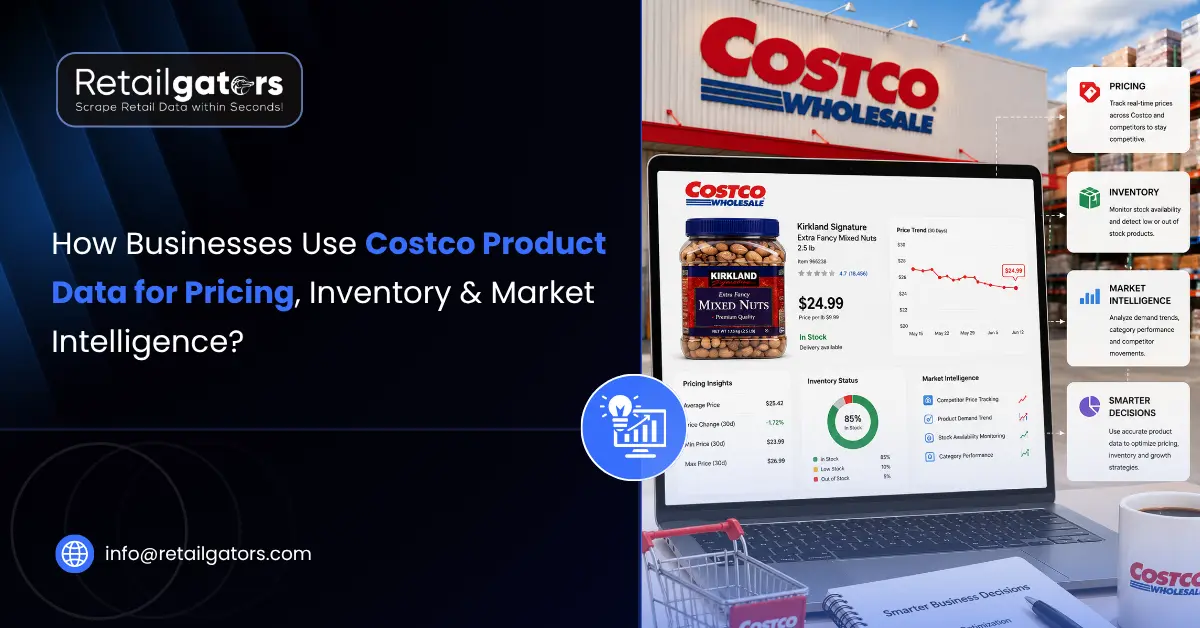
Costco is more than a warehouse retailer. It is a valuable source of retail pricing, inventory, and market intelligence. Businesses that track Costco product data can identify price changes, stock availability, and product rotation patterns before those signals appear in traditional reports.
A Costco price cut often reflects changing demand, supplier adjustments, or competitive pressure, making Costco Product Data Scraping an effective way to capture real-time retail insights. By monitoring pricing trends, inventory movements, and regional availability, companies can improve pricing strategy, inventory forecasting, and competitor analysis.
This blog explains how businesses collect Costco product data, which metrics matter most, and how those insights support smarter retail and e-commerce decisions.
Why Costco Product Data Matters for Retail Intelligence?
Costco is more than a place to buy products in bulk. As one of the largest warehouse retailers in the United States, it operates with high sales volume and relatively thin profit margins, making its pricing and inventory decisions closely watched across the retail industry.
When Costco lowers a price, discontinues an item, or changes product availability, competitors often respond quickly. These changes can signal shifts in consumer demand, supplier costs, or broader competitive strategies, giving retailers an early view of market movements.
Because of this influence, brands, e-commerce sellers, analysts, and retail intelligence firms monitor Costco product data to track pricing trends, identify inventory shortages, and anticipate market changes. These insights help businesses make faster decisions on pricing, promotions, demand forecasting, and competitive positioning.
Several characteristics make its data worth watching:
- A price cut from Costco rarely stays contained. Competitors usually match it within days.
- Watch for products thinning out or disappearing, since that often signals a demand shift before official figures catch up.
- The speed at which items return tells you which products Costco actually prioritizes.
- Online stock moves faster than shelf stock and that gap shows where buyer interest is going.
Analysts, e-commerce operators, and consumer brands treat this as evidence rather than speculation. With it, they anticipate market shifts instead of scrambling to catch up.
Essential Costco Product Data Fields Businesses Should Track
Price alone tells an incomplete story. The real value of Costco product data lies in its range, because a handful of fields, viewed together, expose patterns no single number could. Experienced data teams tend to pull several at once.
The table below outlines the fields companies monitor most often:
| Data Field | What It Reveals | Business Use |
| Product price | Current and historical pricing shifts | Costco pricing intelligence and margin planning |
| Stock status | In-stock or out-of-stock signals | Costco inventory tracking and demand forecasting |
| SKU and product title | Exact product identity and coverage | Catalog matching and assortment analysis |
| Category data | Product grouping and range | Market gap discovery and planning |
| Regional availability | ZIP-based stock differences | Location-level demand mapping |
| Restock frequency | How often items return | Supply chain and logistics insight |
On their own, these fields are fragments. Combined, they explain the reasoning behind Costco’s behavior, which is what gives retail competitor analysis its depth.
How Costco Price Monitoring Improve Retail Pricing Strategy?
Margins live and die on timing. Adjust a price too late, and you either surrender sales or forfeit profit, which is why Costco price monitoring now sits at the core of most pricing operations.
Consistent tracking delivers a few concrete benefits. Teams catch competitive changes as they occur, refine their own pricing and promotions with better accuracy, and defend margins without pricing themselves out of the market.
In practice, that work tends to look like this:
- Daily tracking to identify markdowns before rivals respond.
- Historical comparison to recognize seasonal or repeating price behavior.
- Cross-retailer benchmarking against Amazon, Walmart, and Sam’s Club.
- Promotion planning grounded in evidence rather than assumption.
Companies that build this discipline shift from reacting to anticipating. For many pricing teams, that single change reshapes the entire strategy.
Ready to Turn Costco Data Into Real Business Advantage?
Building an accurate retail intelligence strategy starts with reliable product data. RetailGators helps businesses automate Costco Product Data Scraping, enabling real-time pricing analysis, inventory tracking, and competitive monitoring through structured, high-quality datasets. Visit RetailGators to request a custom solution.
How Businesses Collect Costco Product Data at Scale?
Costco publishes no open API and offers no tidy data feed. Its site runs dynamically, varies by location, and defends itself with anti-bot measures. Gathering data at any real scale, therefore, demands both expertise and proper infrastructure.
Professional teams generally approach it along these lines:
- Read the page structure first. Prices, titles, SKUs, and stock indicators each sit in specific spots, and a scraper has to find them reliably before anything else works.
- Location matters more than people expect. Since availability changes by ZIP code, rotating IPs lets the scraper see what shoppers in different regions actually see.
- Stock changes are the signal worth catching. Knowing the moment an item enters or leaves supply is often more valuable than the price itself.
- Blocks are the constant threat. Measured, human-like request patterns keep the crawler from tripping Costco’s defenses.
- Clean output makes the rest easier. Delivering the data as CSV or JSON keeps analysis simple downstream.
RetailGators handles this entire chain. Rather than repairing broken scripts week after week, clients receive clean Costco product data ready to feed dashboards and pricing engines. Dependable Costco inventory tracking rests on exactly this kind of steady groundwork.
How Fresh Should Your Data Be?
Update frequency comes down to purpose. No single schedule serves every business, though a few sensible patterns hold up well.
- For live pricing dashboards and volatile categories, hourly pulls keep the data current.
- Most pricing teams do well with a daily refresh, which is enough for general stock trends.
- Slower cycles and longer-range planning rarely need more than a weekly check.
Costco price monitoring usually rewards speed. Costco’s prices move between channels quickly, and a lagging refresh leaves you acting on old information. Inventory allows more breathing room, where a daily check usually captures what matters without padding the bill. That daily rhythm is the backbone of dependable Costco inventory tracking, since it keeps the signals current without adding cost. Match the refresh rate to how often you actually decide something, and you have it about right.
Industries That Benefit from Costco Product Data Scraping
The audience for this data extends well beyond any one sector. Different industries draw on the same signals to answer very different questions.
Among the most active users:
- Consumer packaged goods brands monitoring wholesale pricing and channel behavior.
- E-commerce sellers forecasting demand from stock and price movement.
- Retail intelligence firms assembling cross-retailer dashboards for clients.
- Marketplace sellers watching Costco bundles to shield their own listings.
- Supply chain and logistics teams studying restock rhythms for planning.
Each depends on solid Costco pricing intelligence to hold its competitive position. Clean, consistent data sharpens the insight and speeds the decision, which is the everyday benefit of well-run retail competitor analysis.
Transforming Costco Product Data into Actionable Retail Intelligence
The strongest results appear when pricing, inventory, and competitor signals converge into a single view. Isolated data points inform; combined data points explain.
The real insight comes from how these signals interact. Take a price drop that lands at the same time an item goes out of stock, which usually means demand is running hot. Contrast that with a product holding steady on both price and availability, where supply and demand have likely settled into balance. Restock delays deserve attention of their own, especially when they repeat, since a recurring lag can point to a supply problem worth tracking. None of these readings means much alone, but stitched together they sketch a fairly clear picture of the market.
That combined view sharpens Costco pricing intelligence, strengthens Costco inventory tracking, and deepens retail competitor analysis, all drawn from one reliable stream. It is precisely the outcome RetailGators builds for its clients.
Conclusion
Costco deserves to be read as a live source of market intelligence, not simply a warehouse chain. Its pricing, demand, and supply movements surface in real time, and the companies that interpret them well gain ground on those that look away.
Across this article, we examined what to track, why it carries weight, and how businesses apply Costco Product Data Scraping to pricing, inventory, and competitive decisions. The conclusion is straightforward: clean, timely, well-structured data replaces uncertainty with informed action.
Partner With RetailGators for Reliable Costco Data
For organizations ready to establish a dependable data pipeline behind smarter decisions, RetailGators offers the expertise to build it. From Costco Product Data Scraping to full retail competitor analysis, our team delivers clean, structured data you can act on with confidence. Explore the services at RetailGators and begin turning Costco’s retail signals into a durable advantage.