Introduction
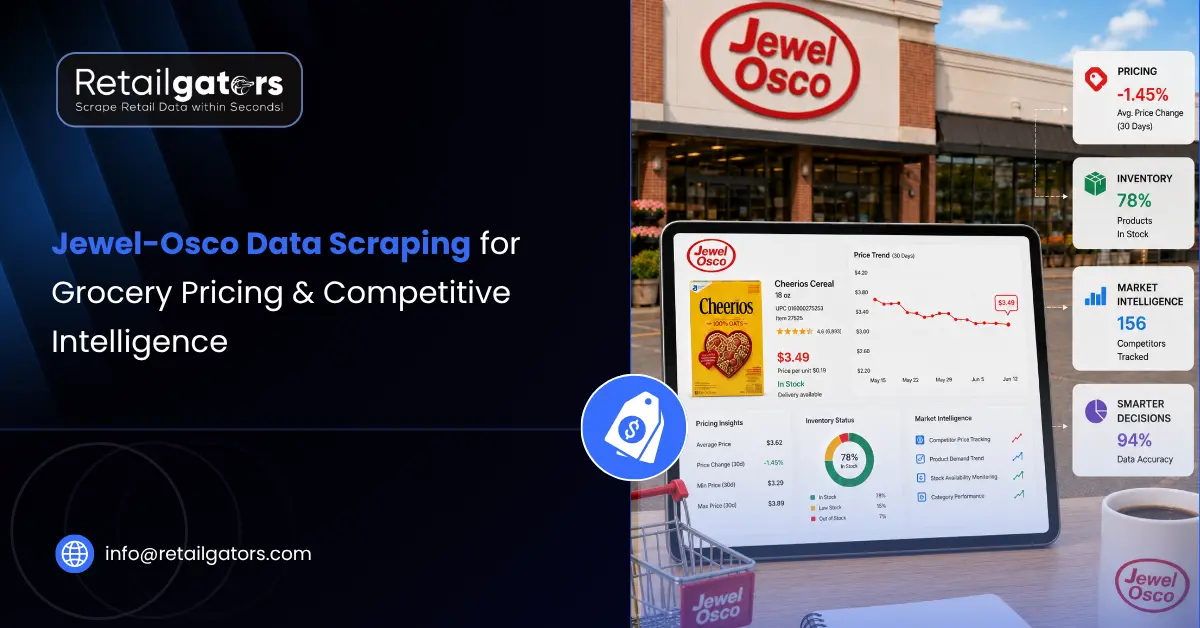
Grocery pricing changes quickly, making accurate competitor data important for retailers and brands. Monitoring product prices, promotions, availability, and assortment manually across a large grocery catalog can be time-consuming and difficult to maintain consistently. This is where Jewel-Osco Data Scraping can help.
By collecting structured Jewel-Osco product data, businesses can track pricing changes, identify promotional patterns, monitor product availability, and compare their offerings with a major grocery retailer. Instead of relying on scattered spreadsheets or occasional manual checks, automated data collection provides a consistent way to organize retail information for analysis.
This blog explores the key data points that can be collected from Jewel-Osco, how retailers can use the information for competitive pricing and inventory analysis, and how often the data should be refreshed. It also covers practical ways to turn grocery data into actionable pricing and merchandising insights.
What Is Jewel-Osco Data Scraping?
Jewel-Osco Data Scraping pulls product information from the Jewel-Osco website and app, then organizes it into rows and columns you can actually work with. Checking prices by hand across thousands of items is not realistic, so automated tools handle the collection instead. Prices, product names, stock status, categories, promotions. These fields can be collected and organized into a structured dataset for further analysis
The reason brands want this is straightforward. They would rather understand the market than guess at it. Accurate Jewel-Osco product data lets you line your prices up against a major competitor and respond before the moment passes. Automation can reduce repetitive manual collection and make it easier to maintain consistent monitoring, and the numbers stay fresh instead of going stale on a shared drive.
Grocery operates on thin margins and constant movement. A single mispriced category can erode profit for weeks before anyone notices. It is precisely this pressure that has turned data collection into an important part of ongoing competitive analysis.
What Jewel-Osco Data Can You Collect?
Here is a sample of the data points teams can collect most often, along with what each one is actually used for. Think of it as a fast reference before we dig deeper.
| Data Field | What It Captures | Why It Matters |
| Product Price | Base price and current sale price | Shows where you sit against Jewel-Osco on any given item |
| Stock Status | In-stock or sold-out state | Helps identify changes in availability and potential stockout patterns. |
| Promotions | Coupons, bundles, weekly deals | Reveals when and how deeply a competitor discounts |
| Category | How products are grouped on-site | Exposes assortment gaps you may be missing |
| Ratings & Reviews | Star scores and shopper comments | Signals which products earn trust and which disappoint |
| Brand | Manufacturer behind each item | Tracks how brand share moves across the shelf |
Every field connects back to a specific business goal. Structured data is easier to validate, compare, store, and analyze than scattered manual records.
How Retailers Use Jewel-Osco Data for Competitive Pricing?
Pricing sits at the center of grocery competition. Watch a competitor chain closely enough, and you start to see the logic behind their moves: how they position products, when they cut prices, how deep those cuts go. Good grocery pricing intelligence replaces hunches with numbers you can defend.
A few ways this plays out in practice:
- Price benchmarking: Match your shelf prices against Jewel-Osco on comparable products.
- Competitor price monitoring: Learn when the discounts land and how aggressive they get.
- Promotion tracking: Move on your prices before significant price differences affect customer consideration.
- Margin protection: Skip the reflex to undercut when there is no reason to.
- Seasonal pricing: Lean on past patterns to time your own offers.
Approached this way, brands stop reacting after the fact and begin planning ahead. The change is significant. Pricing decisions can become more data-driven, using observed competitor prices and promotional patterns as inputs, and a well-run data extraction program is what makes that shift possible at scale.
How Do Inventory and Promotion Data Support Retail Decisions?
Stock levels tell you things prices never will. An item that keeps selling out is signaling real demand. One that lingers on the shelf for weeks might be flagging a pricing problem, a placement problem, or both. This is where grocery inventory tracking earns its keep.
Brands monitor inventory and promotions for a handful of concrete reasons:
- Out-of-stock risk: When an item repeatedly sells out, it is a warning worth acting on before those gaps become lost sales.
- Demand shifts: Patterns across seasons and regions become visible once you track availability over time.
- Competitor promotions: Watching a competitor’s active deals is what allows a brand to evaluate whether a promotional response is appropriate.
- Supply planning: Availability trends can provide an additional input for inventory and replenishment decisions.
- Launch timing: A new product performs best when it arrives at a moment when the shelf has both space and shopper attention.
Promotions add another layer of value. A well-timed offer can move significant volume, but only when you already know what competitors are running. By tracking Jewel-Osco promotions closely, brands avoid being caught off guard by a sudden sale from a rival.
Need structured grocery pricing and product data for competitive analysis? RetailGators can help businesses build scalable retail data collection workflows.
RetailGators helps brands collect accurate, structured, real-time retail data at scale. Visit RetailGators to put reliable market visibility behind your next pricing move.
How Often Should You Scrape Jewel-Osco Data?
The right data refresh rate depends on how quickly prices, promotions, and availability change in your target market. Last week’s price might already be wrong by this morning. How often you refresh depends on what you are chasing, but the guide below covers most situations.
- Hourly/near real-time: dynamic pricing and highly volatile categories
- Daily: competitive price monitoring
- Weekly: promotion and assortment analysis
- Monthly: broader assortment or market trend analysis
Most brands settle on daily or weekly cycles, which tend to balance cost against accuracy effectively. The key is matching the refresh rate to how quickly your particular market moves. Outdated figures weaken every decision built on them, while up-to-date data keeps you a step ahead.
More than many realize, strong grocery price monitoring depends on this timing. When the cadence is right, your insights remain useful rather than losing relevance.
Turning Jewel-Osco Data Into Pricing Intelligence
Data by itself changes nothing. The value shows up in how you use it. Feed clean Jewel-Osco product data into your pricing process and a few real advantages start landing on the bottom line.
Here is where brands put it to work:
- Dynamic pricing: Let prices adjust automatically as the market shifts.
- Margin protection: Find the line where price and profit both hold.
- Assortment planning: Close the gaps where a competitor is winning.
- Promotion strategy: Design offers that genuinely beat what rivals are running.
- Demand forecasting: Use trends to see what shoppers reach for next.
The result is a pricing engine that runs on facts rather than instinct. Over time, the benefits compound: stronger margins, steadier customers, and a firmer hold on market share. This is the true payoff of grocery pricing intelligence when it is applied properly.
The most capable retailers treat data as a long-term asset rather than a one-time purchase. The more history you accumulate, the sharper your forecasts become. This is precisely why leading brands commit to steady, dependable grocery data scraping services rather than occasional manual spot checks.
Conclusion
Grocery retail is highly competitive, and timely market data can help brands make more informed decisions about pricing, promotions, inventory, and assortment. Jewel-Osco Data Scraping provides structured access to product, pricing, availability, promotional, and other retail data that can support these decisions.
The value of collected data depends on more than simply gathering information. Consistent monitoring, accurate product matching, data validation, and the right refresh frequency are essential for turning raw retail data into useful competitive insights. When analyzed over time, this information can help retailers identify pricing patterns, understand promotional activity, monitor availability, and refine their pricing strategies.
For businesses looking to scale grocery price monitoring and competitive analysis, a reliable data collection process provides the foundation for more consistent, data-driven retail decisions.
Take the next step today. Give your pricing team the market visibility it needs to compete. Visit RetailGators and let our specialists help you build a sharper pricing and merchandising strategy from the ground up.