The UK sportswear market is not short of competition. But when it comes to performance, football boots, gym wear, and everyday athleisure, two brands dominate the market: Nike and Adidas.
For shoppers, the choice may feel personal. One customer prefers Nike trainers because they like the fit. Another trusts Adidas for football boots. Someone else buys whichever brand is offering the better deal on Amazon UK that week.
For ecommerce teams, the story is very different.
Behind every product listing, price change, review count, sponsored placement, and stock movement, there is a retail signal. And when those signals are collected properly, they reveal how two of the biggest sportswear brands compete for visibility, demand, and customer loyalty in one of Europe’s most active online retail markets.
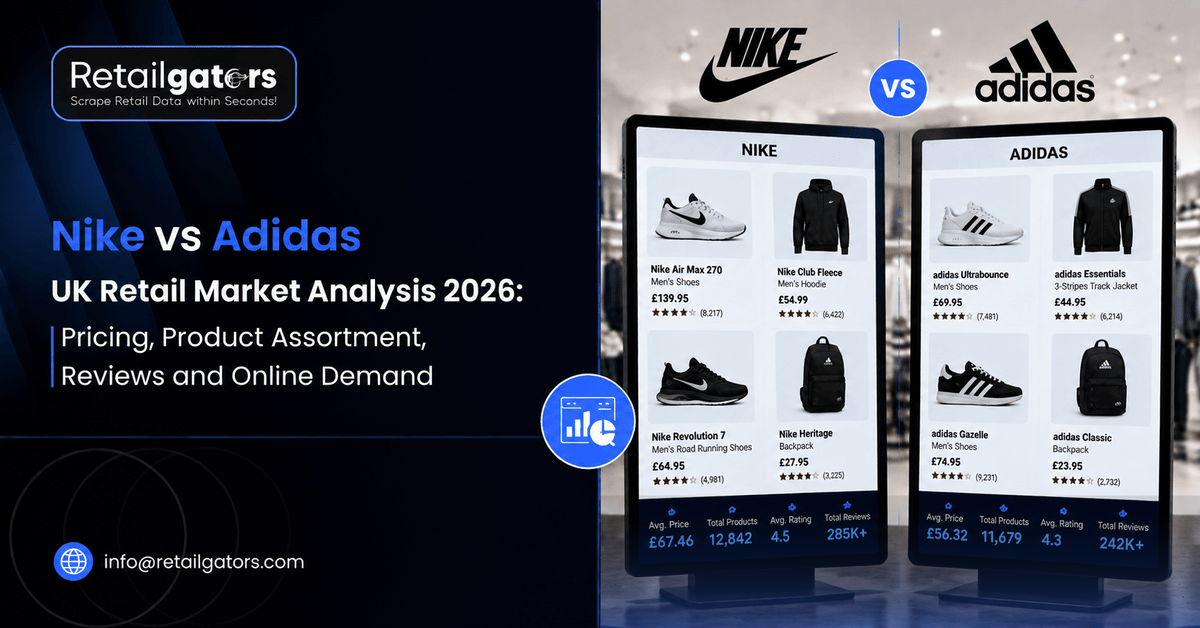
And that’s the reason a Nike vs Adidas UK market analysis is more important than just a brand comparison. This detailed report will provide ecommerce managers, pricing analysts, category leaders, and retail intelligence teams understand how these brands stand up against each other.
And in 2026, that understanding matters more than ever.
The UK Sportswear Market is Moving Faster Than Most Teams Can Track
A few years ago, a category manager could review competitor pricing once a week and still feel reasonably informed. That is no longer enough.
Today, a pair of Nike running shoes is priced differently across online platforms, marketplace sellers, sports retailers, and discount platforms. On the other hand, Adidas may run a promotion on lifestyle trainers while a third-party seller pushes lower-priced stock on Amazon. Reviews may rise quickly on one product while another listing loses visibility. A sponsored product can suddenly appear above an organic bestseller.
The market moves quietly, but it moves constantly.
This creates a real challenge for retail teams. They are not just comparing Nike and Adidas as brands. They are comparing product ranges, price bands, seller behaviour, customer sentiment, stock signals, and demand patterns across multiple digital channels.
That is where sportswear competitor analysis becomes valuable. It turns scattered ecommerce activity into business intelligence.
Nike vs Adidas UK Comparison: Not a Simple Winner-Takes-All Story
People like simple answers. Who wins in the UK: Nike or Adidas?
The honest answer is: it depends on what you measure.
Nike often carries stronger brand heat, higher online visibility, and a premium perception in many categories. Adidas, on the other hand, frequently competes well on affordability, product depth, and customer ratings in selected footwear categories.
A proper Nike vs Adidas UK comparison should not stop at “which brand is bigger.” That type of answer is too shallow for enterprise retail decisions.
A pricing analyst needs to know which brand is more aggressive in lower price bands.
A category manager wants to understand product depth in fashion trainers, football boots, running shoes, t-shirts, shorts, and accessories.
An ecommerce manager needs to see which products attract reviews, which listings are sponsored, and where online demand appears stronger.
A leadership team may want to know whether Nike is winning because of brand power or because its product and pricing strategy is better aligned with current UK demand.
One dataset rarely tells the whole story. However, the picture becomes more when the pricing, product assortment, customer reviews, and traffic signals are studied together.
Pricing: Nike Is Premium, But Adidas Is Accessible
Price is the first thing that people notice. That’s because in sportswear brands, small prices can influence conversion, especially in a market where shoppers are always comparing options side by side.
Since Nike is a renowned brand, it generally offers products with a premium price tag. In many categories, Nike products are positioned at higher price points, especially footwear and performance-led items. This fits the brand’s long-term positioning around innovation, athlete association, and lifestyle status.
Adidas has its own premium products, of course. But across several ecommerce categories, Adidas often shows stronger coverage in accessible price bands. This gives the brand an advantage with shoppers looking for value without leaving the comfort of a globally recognised name.
This is where Nike vs Adidas pricing strategy takes an interesting twist.
Nike does not have to rely on low prices to attract customers. Its brand equity allows it to hold stronger pricing in certain categories. Adidas can compete by offering wider choices at lower-to-mid price points, especially in everyday trainers, socks, slides, sportswear basics, and casual apparel.
For pricing teams, the question is not simply “Who is cheaper?”
The better questions are:
- Where does each brand place most of its products?
- Which categories carry premium pricing?
- How often do sellers discount?
- Are lower prices coming from the brand, retailers, or third-party marketplace sellers?
- Does the price difference justify customer rating and review strength?
This is exactly why sportswear pricing intelligence matters. A price without context is just a number. A price connected with product type, reviews, seller status, stock availability, and demand becomes a decision-making signal.
Product Assortment: The Real Battle Happens at Category Level
A broad brand comparison can hide what is really happening.
Nike takes the crown as the best sports brand, but Adidas excels in some categories. For instance, the fashion trainers from Adidas are their hero product that sells in huge quantities. On the other hand, Nike’s performance running shoes sell like hot cakes! One brand may have more products listed, but the other may have stronger review engagement.
This is why Nike and Adidas product assortment should be studied category by category.
Fashion trainers from Adidas are their best selling pairs of shoes in the UK market. They sit between performance and lifestyle. Customers prefer to buy them for daily use, gym sessions, and brand identity. Both sports brands understand this category very well, but they often approach it differently.
Nike’s fashion trainer range usually leans into premium perception, lifestyle appeal, and recognisable silhouettes. Adidas often brings strong depth across classic styles, court-inspired shoes, slides, and everyday casual footwear.
In football boots, both brands carry strong credibility. UK demand is naturally tied to football culture, club loyalty, grassroots participation, and seasonal sports cycles. Pricing and assortment here can shift around tournament periods, new boot launches, and athlete-led campaigns.
In apparel, the comparison becomes even more layered. T-shirts, shorts, sweatshirts, track bottoms, socks, and accessories may not carry the same emotional weight as hero sneaker models, but they generate consistent marketplace activity. These are often the categories where value, pack size, discounts, and availability can influence purchase decisions quickly.
A serious Nike vs Adidas product comparison should therefore include more than product count. It should consider price range, category spread, seller mix, rating quality, review volume, sponsored visibility, and stock consistency.
Amazon UK: A Marketplace View of Brand Performance
Amazon UK is not the full sportswear market, but it is one of the most useful places to observe shopper behaviour.
On Amazon, brand power meets marketplace reality.
A product may be globally famous, but if the listing has poor content, weak reviews, limited sizes, inconsistent availability, or uncompetitive pricing, performance can suffer. At the same time, a less promoted product can gain traction if it has strong ratings, useful reviews, better availability, and a competitive price.
That makes Nike vs Adidas Amazon UK analysis especially valuable for retail intelligence teams.
Amazon data can help answer questions such as:
- Which products appear most frequently in search results?
- Which categories have the deepest assortment?
- Which listings have the highest review volumes?
- Which products are sponsored?
- Which sellers are active?
- How wide is the price gap between similar products?
- Where are stock or size availability issues appearing?
For ecommerce teams, this type of marketplace intelligence is practical. It is not just “interesting data.” It can guide pricing actions, marketplace content improvements, product positioning, promotion planning, and category expansion.
For example, if Adidas has stronger review ratings in selected footwear models but Nike has higher demand visibility, a retailer may decide to adjust merchandising strategy instead of simply changing price. If Nike has fewer products in a lower price band but stronger review volume, it may signal premium loyalty. If Adidas has deeper assortment below a certain price point, it may indicate a stronger value play.
Those are the insights that spreadsheets often miss.
Reviews: The Customer is Telling the Market What Matters
Customer reviews are one of the most underrated parts of ecommerce analysis.
Most teams look at ratings. Fewer teams study review volume, review velocity, product-level complaints, positive sentiment, sizing comments, durability feedback, delivery issues, and seller-related problems.
In a Nike vs Adidas customer reviews analysis, review data can reveal how customers experience each brand after purchase.
A high review count usually suggests strong historical demand. A high rating may suggest satisfaction, but it needs context. A product with 4.7 stars and 300 reviews is not the same as a product with 4.5 stars and hundreds of thousands of reviews. One shows strong satisfaction in a smaller sample. The other shows long-term marketplace trust.
This matters for pricing too.
A highly reviewed Nike trainer may hold a higher price because customers trust the product. A well-rated Adidas slide may convert strongly because it offers comfort, affordability, and recognisable brand value. A product with strong reviews but frequent sizing complaints may need better product content, not a lower price.
Review data also helps category managers understand product-market fit. If customers repeatedly praise comfort, durability, lightweight design, or style, that language can influence product descriptions, ad copy, and merchandising. If negative reviews mention size inconsistency or poor packaging, operations teams can investigate.
In other words, reviews are not just social proof. They are customer intelligence.
Online Demand: Brand Strength Shows Up in Search, Traffic and Engagement
Online demand is where brand perception becomes measurable.
Nike has long been powerful in digital demand generation. Its direct-to-consumer presence, athlete partnerships, product drops, lifestyle branding, and global campaigns often create strong search and traffic momentum. Adidas also has deep loyalty, especially across football, lifestyle classics, and value-driven categories.
A proper Nike vs Adidas online demand analysis should combine signals from marketplaces, search interest, website traffic, review growth, product visibility, and sponsored placements.
Demand does not always mean immediate sales. Sometimes it means customers are researching. Sometimes it means they are comparing prices. Sometimes it means a product is popular but stock is limiting conversion. Sometimes demand is high because of a campaign, influencer moment, or seasonal sports trend.
This is where Nike vs Adidas brand performance becomes more than a branding conversation. It becomes a data conversation.
Retail leaders can use online demand signals to understand which brand has stronger visibility, which categories are gaining attention, and which products may need pricing or inventory support.
For enterprise teams, demand intelligence also supports forecasting. If review velocity, search visibility, and product engagement rise in a category, buyers and planners can prepare before the trend becomes obvious in sales reports.
Market Share: Why Purchase Signals Need Careful Reading
Many teams search for Nike vs Adidas market share UK and expect one clean answer. But market share can be measured in different ways.
There is revenue share. Unit share. Shopper penetration. Online visibility share. Marketplace assortment share. Search demand share. Review share. Category-level share. Each one tells a different part of the story.
Nike may lead in shopper demand and brand traffic. Adidas may show stronger depth in certain product categories. Nike may command premium prices in running or lifestyle footwear. Adidas may appear more accessible in everyday price bands.
That is why market share should never be treated as a single scoreboard.
For ecommerce teams, it is often more useful to ask:
- Which brand is winning the categories we care about?
- Which brand has stronger visibility in our target price band?
- Which products are pulling review volume fastest?
- Which listings are gaining demand?
- Where is the pricing gap widening?
- Where can we improve assortment or content?
This is the heart of UK sportswear market analysis. It is not about declaring a winner. It is about understanding the rules of the market clearly enough to make better commercial decisions.
What Retail Teams Can Learn from Nike vs Adidas
The Nike and Adidas comparison is useful even for brands outside sportswear.
Why? Because it shows how modern ecommerce competition really works.
Two strong brands can compete in the same market but win in different ways. One may lead on demand and premium perception. Another may compete through value, category depth, and strong product ratings. Both can be successful, but their strategies create different signals for pricing, assortment, and merchandising teams.
For category managers, the lesson is clear: never compare brands only at the top level. Product-level and category-level views are essential.
For pricing analysts, it shows why average price can be misleading. Price bands, outliers, discount depth, seller behaviour, and product type matter much more.
For ecommerce managers, it highlights the importance of Amazon UK visibility, product content, reviews, and availability.
For retail intelligence teams, it proves that ecommerce product data analysis can turn a familiar brand rivalry into actionable market insight.
How Brands and Retailers Can Build a Better Monitoring Framework
A strong retail intelligence framework does not need to be complicated, but it does need to be consistent.
Start with the products that matter most. This may include hero SKUs, high-margin products, top competitors, marketplace bestsellers, and emerging category challengers.
Then define the right comparison set. Nike running shoes should not be compared with Adidas socks. A lifestyle trainer should be matched with a similar lifestyle trainer, not a performance football boot. Product matching is where many analysis projects succeed or fail.
Next, track the right fields. Price alone is not enough. Retail teams should monitor product title, category, seller, offer price, discount, stock status, size availability, rating, review count, sponsored placement, and historical changes.
After that, segment the data. Break it down by category, price band, marketplace, seller type, and demand signal. This helps teams see patterns instead of drowning in raw records.
Finally, connect the insights to action. If Adidas gains visibility in lower price bands, what does that mean for your pricing strategy? If Nike products hold stronger ratings at higher prices, does that signal brand strength or product quality? If Amazon UK reviews are rising for a specific trainer type, should your team adjust inventory or paid visibility?
Good data only matters when it improves decisions.
Where RetailGators Fits into This Type of Analysis
RetailGators helps ecommerce and retail teams collect structured data from marketplaces, retailer websites, brand stores, and digital commerce platforms. For a market like UK sportswear, this can include pricing, product assortment, reviews, seller information, promotions, stock signals, and category-level visibility.
The goal is not to create another dashboard nobody uses.
The goal is to give pricing analysts, ecommerce managers, category teams, and retail intelligence leaders clean, usable data that answers real business questions.
For a retail competitive intelligence project, RetailGators can help teams monitor competing brands, compare product assortments, track pricing movements, analyse marketplace reviews, and identify online demand signals across key ecommerce channels.
This kind of data is especially useful when teams need repeatable tracking rather than a one-time report. The UK sportswear market will not stop changing after one analysis. Prices will move. New products will launch. Reviews will grow. Sellers will change. Sponsored listings will shift.
Retail intelligence is most powerful when it becomes continuous.
Business Use Cases for Nike vs Adidas Style Analysis
A Nike vs Adidas analysis is not just a content idea. It reflects real use cases that enterprise teams care about.
A pricing team can use the data to understand whether their own products are positioned too high or too low compared with market leaders.
A category manager can identify assortment gaps by studying which products dominate Amazon UK categories.
A marketplace team can track seller behaviour, discounts, and sponsored visibility.
A merchandising team can use review insights to understand which product attributes customers mention most often.
A strategy team can monitor UK footwear market trends and evaluate whether demand is shifting toward performance footwear, lifestyle trainers, slides, football boots, or everyday sportswear basics.
A brand team can benchmark ratings, review volume, and product perception against category leaders.
These use cases show why retail competitive intelligence is becoming part of daily ecommerce operations rather than a quarterly research exercise.
The Bigger Lesson: Data Explains the Market Before Sales Reports Do
Sales reports are important, but they usually arrive after the customer has already made a decision.
Retail data appears earlier.
A competitor changes price. A product gains reviews. A sponsored listing moves up. A new seller enters the marketplace. A category gets crowded. A product begins trending. Stock disappears in popular sizes.
These signals often show market movement before revenue reports confirm it.
That is why leading ecommerce teams are investing in continuous pricing and assortment intelligence. They want to know what is happening while there is still time to respond.
The Nike and Adidas battle in the UK is a perfect example. Both brands are strong. Both have loyal customers. Both compete across price bands, product categories, and digital channels. But they do not win in exactly the same way.
Nike often shows the strength of premium demand and brand visibility. Adidas often shows the power of accessible pricing, category depth, and high customer satisfaction in selected products.
For retail leaders, that difference is the insight.
Conclusion: Turning Sportswear Market Data Into Better Retail Decisions
The Nike and Adidas competition in the UK is a great example of how modern ecommerce markets are changing. Brand reputation still matters, but pricing, product availability, customer reviews, and digital visibility now influence buying decisions every day.
For retailers and brands, understanding this competition is not about finding out which company is bigger. The real value comes from understanding why customers choose one product over another, how competitors adjust their pricing, which categories are gaining momentum, and where new opportunities exist.
With accurate ecommerce product data analysis and retail competitive intelligence, businesses can move beyond assumptions and make decisions based on real market signals. Whether it is tracking competitor prices, analysing product assortment, monitoring customer feedback, or identifying new UK footwear market trends, data helps teams respond with more confidence.
RetailGators helps ecommerce businesses collect and analyse structured retail data from multiple online sources, enabling teams to monitor competitors, understand pricing movements, and uncover actionable market insights. Explore our ecommerce and retail data extraction services to understand how retail intelligence can support smarter business decisions.
In a market where customer preferences change quickly, the brands and retailers that succeed will be the ones that understand the market before the competition does.