
How an Ecommerce Brand Used TikTok Shop & Amazon Data for Product and Market Intelligence
About the Client
The client is a mid-sized direct-to-consumer beauty and skincare brand.
The brand launched in 2019 with a small line of serums and moisturizers. Over five years it grew into a catalog of around 40 products and roughly $14M in annual sales. A lean team of about 25 people runs the whole business.
The brand sells in three main places:
- Its own Shopify website
- Amazon (US marketplace)
- TikTok Shop, which it joined in 2024 and which quickly became its fastest-growing channel
By early 2025, more than half of the brand’s new-customer growth was coming from Amazon and TikTok Shop combined. But the team was still making most of its product and marketing decisions on instinct rather than numbers.
Summary
The brand was growing on TikTok Shop and Amazon but flying blind. Each platform held a goldmine of signals, yet nobody was pulling those signals together. Decisions about what to launch, what to restock, and where to spend were based on guesswork.
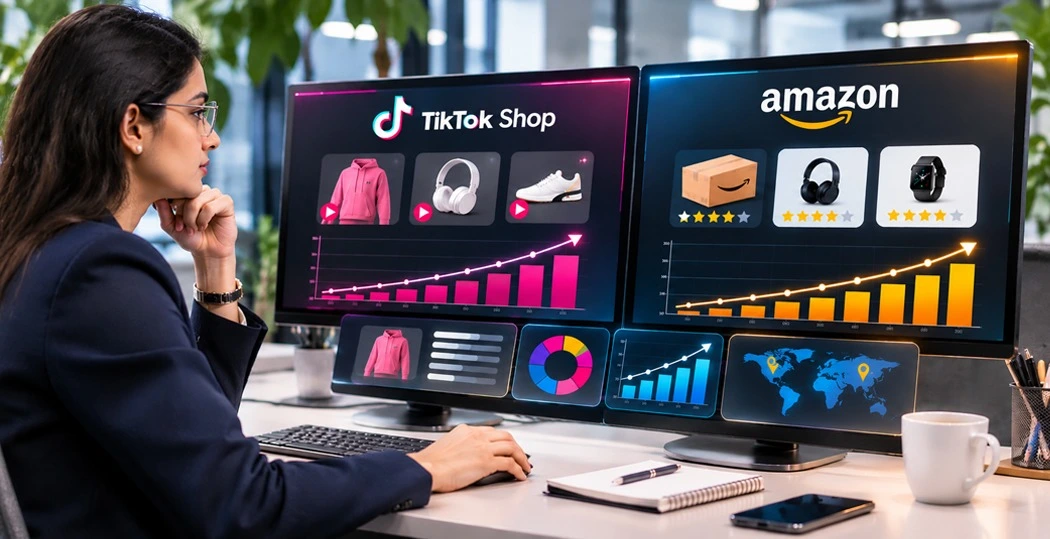
To fix this, the brand invested in proper ecommerce marketplace data analysis. The team began collecting TikTok Shop data and Amazon product data, cleaning it, and combining it into one clear view. This gave them real marketplace intelligence instead of hunches.
With cross-platform data analysis, they could see which products were trending on TikTok, check whether that demand held up on Amazon, and move fast on the winners. Over nine months, revenue from the two marketplaces grew 38%, product return rates dropped, and new-product launches became far more accurate.
Challenges
The brand’s biggest problem was not a lack of data. It was too much data, sitting in too many places, with no one making sense of it.
The data was scattered and messy: TikTok Shop data lived in one dashboard, Amazon product data in another, and website data in a third. Each used different formats, different names for the same things, and different time windows. Comparing them by hand took days.
TikTok Shop moved too fast to track: Products could go viral overnight and sell out in hours, then fade a week later. The team had no reliable way to spot which items were climbing and which were about to crash.
Amazon signals were being ignored: Thousands of reviews, star ratings, pricing changes, and competitor listings held clear clues about what customers wanted. Nobody was reading them at scale, so that insight went to waste.
There was no single view across platforms: A product might be a hit on TikTok but weak on Amazon, or the other way around. Without cross-platform data analysis, the team couldn’t tell the difference, and often bet on the wrong products.
New launches were expensive guesses: Every new product meant buying inventory, shooting content, and hoping it worked. Roughly one in three launches flopped, tying up cash in stock that didn’t sell.
Solutions RetailGator Provided
The fix was to turn scattered platform exports into one reliable system for ecommerce marketplace data analysis. The team built it in four simple steps.
- Collect TikTok Shop data: They started tracking the signals that actually predict sales: trending products in their category, sell-through speed, price points that converted, and which creator videos drove the most orders. This showed them what was heating up in real time.
- Collect Amazon product data: They pulled star ratings, review themes, pricing history, best-seller ranks, and competitor listings. Reading reviews at scale told them exactly what customers loved and what they complained about, which became raw material for ecommerce product intelligence.
- Combine both into one view: Instead of two separate dashboards, the two data sets were cleaned, matched up, and merged into a single marketplace intelligence dashboard. For the first time, the team could see a product’s full story across both channels on one screen.
- Act on cross-platform data analysis: The real power came from reading the two platforms together. A product trending on TikTok Shop was checked against Amazon demand and reviews before the brand committed inventory. A proven Amazon seller was tested with TikTok creators to open a new audience.
How they used the insight day to day:
- Spotting winners early: When an ingredient or format started trending on TikTok, they cross-checked Amazon search volume and reviews to confirm real demand, then moved fast.
- Cutting dead weight: Products that looked weak on both platforms were quietly discontinued, freeing cash and warehouse space.
- Fixing products, not just selling them: Recurring complaints in Amazon reviews (a pump that clogged, a scent people disliked) were sent straight to the product team for the next batch.
- Smarter pricing: Watching competitor pricing and TikTok conversion together helped them find the price that sold best without racing to the bottom.
- Better launches: New products were only greenlit once the data across both marketplaces pointed the same way.
Impact
Within nine months of putting marketplace intelligence at the center of its decisions, the brand saw clear, measurable gains.
Metric | Before | After 9 months |
Combined TikTok Shop + Amazon revenue | Baseline | +38% |
New-product success rate | ~2 in 3 worked | ~5 in 6 worked |
Time to spot a trending product | 2–3 weeks | 2–3 days |
Product return rate | 9.4% | 6.1% |
Dead/slow-moving SKUs in catalog | 14 | 5 |
Hours spent on manual reporting each week | ~20 | ~4 |
The numbers tell a simple story. By reading TikTok Shop data and Amazon product data together, the brand stopped guessing and started acting on evidence.
The biggest wins went beyond the dashboard:
- Faster, safer launches: Because every launch was backed by cross-platform data analysis, fewer products flopped and less cash was trapped in dead stock.
- Better products: Feedback buried in Amazon reviews drove real improvements in the next production runs.
- A repeatable playbook: Spotting a trend, validating it, and scaling it became a routine the team could run again and again, not a lucky break.
Conclusion
This brand did not win by spending more or working harder. It won by paying attention to data it already had access to and finally putting it to use.
TikTok Shop and Amazon each tell you something different. TikTok shows you what’s catching fire right now. Amazon shows you what people buy, keep, and recommend over time. On their own, each is useful. Read together through steady ecommerce marketplace data analysis, they become a powerful early-warning and decision-making system.
The lesson for any ecommerce brand is straightforward. Your marketplaces are already handing you the answers. The brands that pull that data together, turn it into real ecommerce product intelligence, and act on it quickly are the ones that spot the next winner before their competitors do.