Introduction
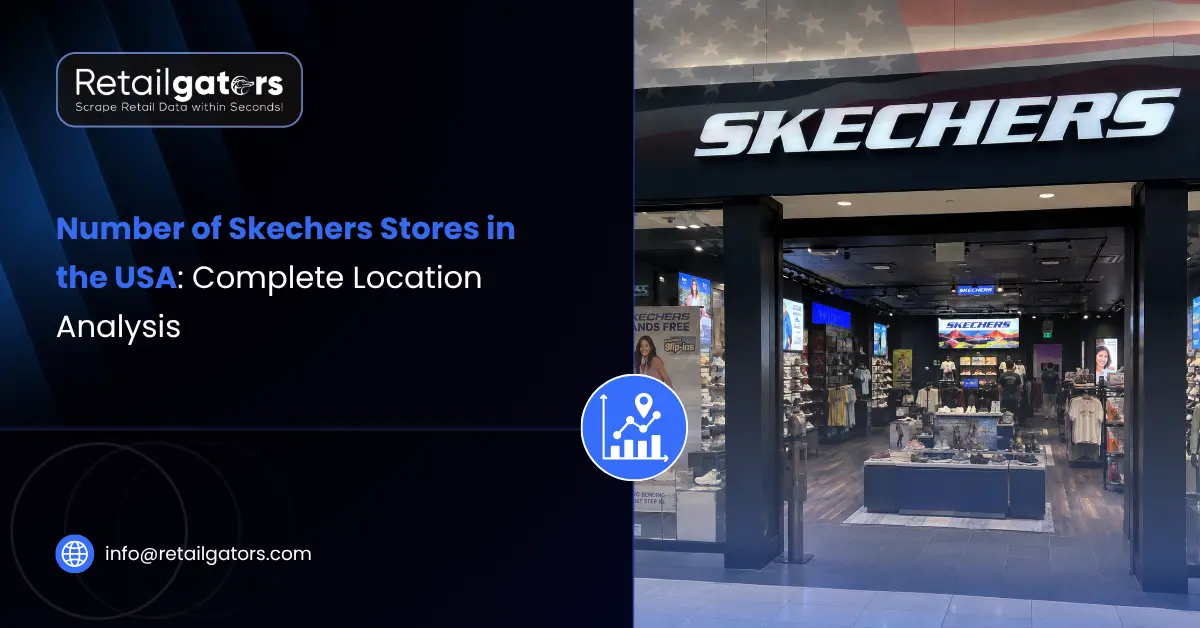
Skechers runs far more stores in the United States than most people would guess. In 2026, the brand counted 678 shops spread across nearly every state, and where those shops sit says a lot about how footwear retail works today. Some states hold dozens of locations. Others have none. That gap is the real subject of this blog, and the picture of Skechers store locations in the USA may explain plenty about how big shoe brands weigh where to plant a flag.
This post lays out the current Skechers store count state by state, ranks the busiest cities, and shows what all of it means for anyone who studies retail. You will get the hard numbers first, then the reasons behind them. If you track the footwear retail market, plan store sites, or research consumer demand, the patterns inside these Skechers locations will save you a lot of guesswork. Read on for the full breakdown, a clear data table, and the practical uses that make this store data worth your time.
The National Skechers Footprint in 2026
As of April 1, 2026, the United States has 678 Skechers stores. Those shops reach 48 states, though Oregon and Wyoming have none, and several U.S. territories and the District of Columbia sit without a store as well. Even so, the brand qualifies as a genuine national chain. You will find them in big-city shopping districts, in fast-growing suburbs, and in the outlet malls that draw weekend crowds.
The spread is the interesting part. A few states hold a big chunk of the total, while plenty of others get by with just a handful. That kind of imbalance shows up across most US retail chains, and it may reflect population density, local shopping habits, and regional demand. So the Skechers store count is likely far from random. Each location could mark a spot where the company expects steady foot traffic.
That 678 figure gives anyone watching the footwear retail market a solid reference point. It also suggests real commitment to brick-and-mortar retail at a time when online sales keep climbing. Shoes are a product people like to try on, and Skechers appears to be betting that fit and comfort still pull buyers into the store.
For more retail location insights, explore our retail data scraping services at RetailGators.
Top States Leading the Skechers Map
Store distribution across the country is far from even. A small group of states holds a large portion of all Skechers locations, which may point to where the brand sees the strongest demand. California leads by a wide margin, followed by Texas and Florida.
Here are a few key facts about the leading states:
- California sits far ahead with 110 stores, roughly 16% of every Skechers shop in the country.
- Texas lands in second place with 78 stores, a count its large population and wide-set cities could help explain.
- Florida takes the third slot at 62 stores, a total that may reflect heavy tourist traffic and steady demand from year-round residents.
- Oregon and Wyoming, along with several U.S. territories and the District of Columbia, have no Skechers stores whatsoever.
The table below shows the top ten states and territories ranked by store count, along with population figures that help explain the spread.
| State / Territory | Number of Stores | Share of Total | Population | Population per Store |
| California | 110 | 16% | 39.51M | 359.20K |
| Texas | 78 | 12% | 29.00M | 371.79K |
| Florida | 62 | 9% | 21.48M | 346.45K |
| New York | 42 | 6% | 19.45M | 463.10K |
| New Jersey | 27 | 4% | 8.88M | 328.89K |
| Illinois | 26 | 4% | 12.67M | 487.38K |
| Arizona | 21 | 3% | 7.28M | 346.62K |
| Ohio | 20 | 3% | 11.69M | 584.45K |
| Pennsylvania | 19 | 3% | 12.80M | 673.79K |
| Georgia | 16 | 2% | 10.62M | 663.75K |
This ranking makes one thing obvious. The most populated states tend to carry the most stores, but the ratio of people per store also matters. New Jersey, for example, has a very tight ratio, meaning shoppers there have relatively easy access compared to states like Pennsylvania.
City Hubs With the Densest Store Clusters
Zoom in from states to cities and a few clear hotspots show up among Skechers store locations in the USA. These are the places where crowds, tourists, and dense neighborhoods overlap, and that mix may be what draws a retailer in to open more shops.
The cities with the most Skechers stores include:
- Las Vegas, Nevada, sits at the top with 11 locations, thanks in large part to its heavy tourist traffic.
- Houston, Texas, comes next, with a cluster of stores spread across its wide metro area.
- Phoenix and Orlando both hold strong counts, backed by rising populations and a steady flow of visitors.
- San Antonio, Miami, and Chicago round out the list of the brand’s busiest urban markets.
Las Vegas sitting on top deserves a second look. It has fewer full-time residents than Houston, yet it carries more stores, which suggests how much tourism and outlet shopping can tip a retail map. That is where retail location intelligence earns its keep. Head counts alone miss half the picture.
For similar competitor mapping, check our store location datasets at RetailGators.
The Business Value Hidden Inside Store Data
Few things help a business more than knowing where the competition operates. For anyone studying the footwear retail market, a major brand’s store map serves as a valuable reference point. It can indicate where demand concentrates, where rivals cluster, and which customer segments a company appears to target.
A few reasons this data pulls its weight:
- Competitive benchmarking gets a lot simpler once you can pinpoint where a rival or partner actually operates.
- Market gaps often hide in plain sight, and the states with no stores may point to open ground or a purposeful pass.
- Site selection leans on proof, so studying the spots a trusted brand picked helps explain what made them work.
- Demand forecasting sharpens the moment store density is lined up against population and income figures.
Businesses across many sectors rely on retail location intelligence when they make these decisions. Skechers, with 678 stores in operation, offers them a deep pool of data shaped by years of market presence. Drawing lessons from that footprint can spare a company considerable time and expense.
Turning Location Intelligence Into Market Strategy
Raw store data only pays off when someone puts it to work. The sharpest brands never dump a list of Skechers locations into a folder and forget it. They stack it against other datasets until a fuller market view comes into focus.
Common ways businesses apply this data include:
- Territory planning, so teams can map current coverage and flag the regions that still need attention.
- Consumer behavior research draws on store placement to show where target shoppers live and how they spend.
- Supply chain work benefits too, because a clear view of store clusters trims distribution routes and tightens delivery timing.
- Investment analysis often rides on the same numbers, with analysts reading a brand’s growth through its store openings and closures.
Stack these methods together and the payoff grows fast. What started as a plain store list ends up guiding real decisions. That is the whole reason retail location intelligence now sits near the center of business planning, especially for US retail chains chasing the same shoppers.
Explore how our location intelligence solutions support these workflows at RetailGators.
Conclusion
By 2026, Skechers stores in the USA add up to a wide national spread with clear regional priorities. The 678 stores stretch coast to coast, and the lead held by California, Texas, and Florida suggests how the company may weigh population, tourism, and local demand before it opens a door. Read that way, the Skechers store count does more than tally shops. It could hint at where the brand sees customers and how it plans to reach them.
For businesses, researchers, and analysts, this data holds lasting value. Whether the goal is competitive benchmarking, site selection, or broad market study, the lessons hidden inside these Skechers store locations in the USA apply across the entire footwear retail market. At RetailGators, we help companies unlock exactly this kind of insight through reliable retail location intelligence built for real decisions. If you want to understand US retail chains at a deeper level, the story always starts with knowing where the stores are.