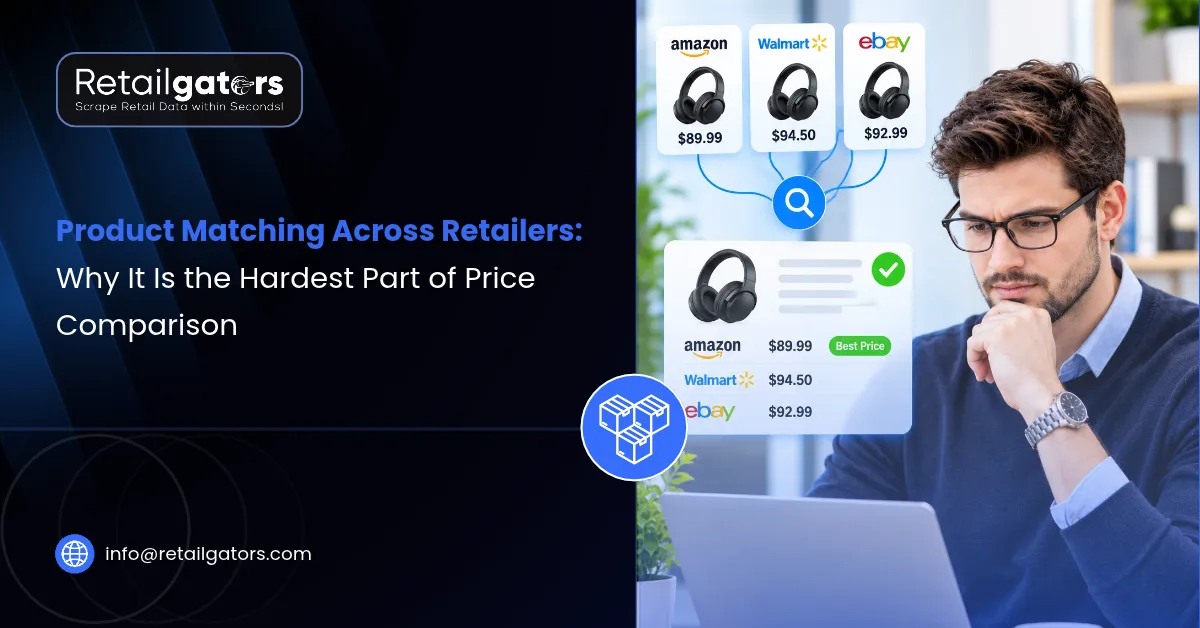
Comparing product prices across retailers sounds straightforward until you realize that the same item can appear under different names, SKUs, descriptions, and product images. A 128 GB smartphone listed on one website, for example, might be incorrectly matched with its 256 GB variant on another. Even a small mismatch like this can distort competitor price comparisons and lead to poor pricing decisions.
This is why product matching across retailers is one of the most important steps in ecommerce price intelligence. It involves identifying identical products across different websites using identifiers such as UPCs and GTINs, product attributes, descriptions, and image-based matching.
In this guide, we’ll explore how product matching works, why SKU matching across retailers is challenging, which automated matching methods improve accuracy, and how retailers can build a more reliable product matching process for competitor price monitoring.
What Is Product Matching in Ecommerce and How Does It Work?
Product matching in ecommerce is the process of identifying identical or comparable products listed across different retailers, online stores, and marketplaces. It helps businesses connect product listings that may have different names, descriptions, SKUs, or images but refer to the same item.
For example, a Samsung Galaxy smartphone might appear on three retail websites with different product titles and descriptions. Product matching helps determine whether all three listings represent the same model, storage capacity, color, and configuration.
There are two common approaches:
- Exact product matching: Identifies identical products using attributes such as brand, model number, UPC, GTIN, size, and color. It is essential for competitor price monitoring, MAP monitoring, and automated repricing.
- Similar product matching: Groups comparable products based on features, specifications, or intended use. Retailers use it for assortment analysis, alternative product discovery, and market positioning.
Choosing the right matching approach depends on the business objective. Price comparison requires a high level of exact-match accuracy, while assortment analysis can benefit from identifying similar products.
Why Is Accurate Product Matching Difficult Across Retailers?
Collecting prices is only half the job. The harder half is knowing which listing on one site is really the same product as a listing on another, because the open web offers no shared, reliable way to say so. Each retailer describes products in its own words, with its own page structure and its own gaps, so the matching layer has to reconstruct a truth that the data never states directly.
- The same blender can show up under three different product names, and inconsistent titles remain one of the biggest blockers for any matching engine.
- Smaller sellers often leave out identifiers altogether, which gives the system very little solid ground for a confident match.
- Color, size, and pack-count variants often share one title even though they are different items sold at different prices.
- Catalogs never sit still. New listings, renamed products, and discontinued stock mean the matching logic has to keep running instead of running once.
5 Product Matching Methods Used for Ecommerce Price Comparison
No single technique solves every case, so mature pricing teams blend several methods and let each one cover the blind spots of the others. The table below sums up the common approaches to automated product matching for price comparison and shows where each earns its place.
| Matching Method | How It Works | Typical Reliability | Best Suited For | Main Limitation |
| UPC / GTIN matching | Compares standardized GS1 codes shared across sellers | Very high when codes are present | Branded, barcoded goods | Many listings lack a valid code |
| SKU matching across retailers | Maps internal seller codes to one common reference | Moderate | Known catalogs with a mapping table | SKUs differ at every store |
| Attribute / rule-based | Compares brand, title, size, and specifications | Medium to high | Categories with structured data | Needs steady rule maintenance |
| Image + AI fuzzy matching | Compares photos and text with trained models | High after proper training | Messy, unbranded listings | Compute heavy, needs validation |
In practice, automated product matching works best when multiple techniques are combined.
A retailer might first use UPC or GTIN identifiers to identify exact matches. Listings without valid identifiers can then move through attribute-based and fuzzy text matching. Image recognition can provide another layer of evidence, while human reviewers handle uncertain matches.
This layered approach helps businesses improve product matching accuracy without depending on a single technique.
How Does SKU Matching Across Retailers Work?
A SKU, or stock keeping unit, is an internal code that a seller creates purely for its own operations and inventory. Two stores selling the identical product will almost always assign it two completely different SKUs, and neither code carries any meaning for the other. This is precisely why SKU matching across retailers cannot run as a simple lookup, and instead has to work as a careful multi-step reconciliation.
- Collect each retailer’s SKU, title, identifiers, and attributes into one working dataset that everything else builds on.
- Normalize units, brand spellings, and measurement formats so records from very different pages can be compared fairly.
- Pair candidates through identifiers first, then use titles and attributes for the many listings that arrive with no code at all.
- Validate the strongest pairs, often with a human reviewer confirming the borderline cases that confidence scores cannot settle alone.
What Challenges Affect Competitor Product Matching Accuracy?
Competitor product matching requires more than identifying products with similar names or descriptions. Retailers must ensure that the products being compared have equivalent specifications, quantities, and configurations.
Several challenges can affect matching accuracy:
1. Product Bundles and Multipacks
A retailer might sell a single bottle of shampoo for $10, while a competitor offers a three-pack for $25. Comparing the listed prices directly would create a misleading result. Once you calculate the unit price, the three-pack works out to roughly $8.33 per bottle, which is actually cheaper. Matching systems must account for pack sizes and calculate comparable unit prices.
2. Private-Label and Look-Alike Products
Some private-label products closely resemble branded alternatives in appearance, packaging, and descriptions. However, visual similarity does not establish product equivalence. These listings require additional attribute checks before being treated as exact matches.
3. Inconsistent Units of Measurement
Retailers may display quantities using different measurement formats, such as ounces, milliliters, grams, or kilograms. Standardizing these values helps businesses compare equivalent quantities and calculate accurate unit prices.
4. Regional and Seasonal Product Variations
Some products are available only in specific locations or during certain seasons. A matching system must account for availability, regional product variations, and temporary catalog changes to avoid comparing listings that are not commercially equivalent.
5. Incomplete or Conflicting Product Attributes
One retailer may provide a complete specification sheet, while another includes only a product title and a few basic details. Missing model numbers, dimensions, or technical specifications make it harder to establish an exact match.
These challenges highlight why competitor product matching requires continuous validation. Retailers should monitor not only whether two listings match but also whether their product attributes remain consistent as catalogs and prices change.
How Do You Measure Product Matching Accuracy?
A match is only useful if you can trust it, so accuracy needs to be checked rather than assumed. A simple routine works for most teams. Pull a random sample of matched pairs, open the product pages side by side, and count how many are truly the same item. Then look the other way too: check a sample of unmatched listings to see how many real matches the system missed. Wrong matches distort prices, while missed matches leave gaps in your coverage, so both numbers matter.
Many teams also set confidence tiers. High-confidence pairs, such as those confirmed by a valid UPC or GTIN, can be accepted automatically, while mid-confidence pairs go to a reviewer. Repeat the audit after major catalog changes, because accuracy tends to drift as listings are renamed, replaced, or discontinued.
How Can Retailers Improve Product Matching with RetailGators?
Accurate product matching requires consistent product data collection, attribute standardization, and ongoing validation. Retailers managing large catalogs across multiple websites need a process that can handle different product formats, missing identifiers, and frequently changing listings.
RetailGators provides product data scraping services that collect product names, brand details, prices, SKUs, identifiers, specifications, and other attributes needed for product comparison from retail and marketplace sources.
That data feeds into product matching services that link equivalent listings across retailers, so competitor price monitoring is built on products that are genuinely comparable rather than merely similar.
If you would like to see how matched data would look for your own catalog, you can start with a free pilot run.
Conclusion
Accurate product matching is the foundation of reliable ecommerce price comparison. When retailers compare the wrong products, even correctly collected pricing data can lead to misleading insights and poor pricing decisions.
Combining UPC and GTIN identifiers, SKU mapping, attribute-based matching, and image recognition helps businesses identify equivalent products across different retail websites. Regular validation is equally important to account for catalog changes, missing information, and product variations.
For businesses managing large product catalogs, a reliable product matching process can improve competitor price monitoring and support more informed pricing strategies, including pricing intelligence work.
To talk through your catalog and the sources you need to cover, contact the RetailGators team.