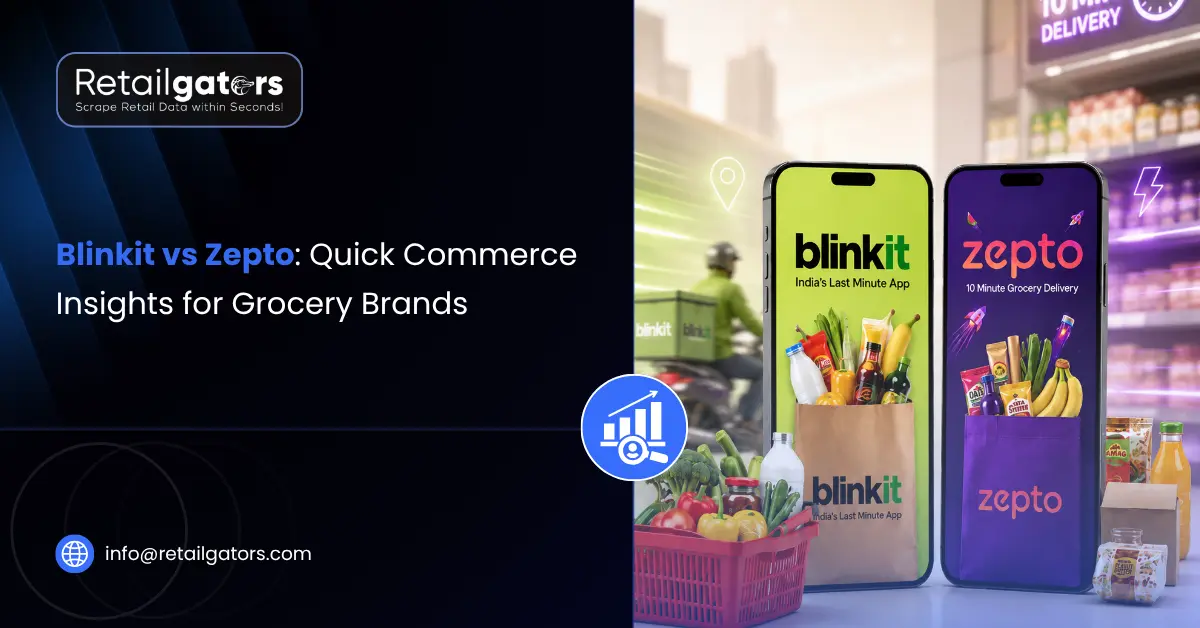
It’s Friday, and you are cooking something special for your loved ones, but you forgot the key ingredient needed to finish the dish. That’s when you remember: you can get those products delivered within minutes, thanks to quick commerce platforms like Blinkit and Zepto.
The ability to deliver everything within minutes is one of the core elements that has made quick commerce the fastest-growing segment of digital retail. In India, quick commerce platforms have grown so popular that the market is projected to reach a whopping ₹2 trillion by FY2028.
As quick commerce adoption continues to rise, platforms like Blinkit and Zepto are reshaping the grocery landscape. For grocery brands, these platforms are more than sales channels; they provide valuable data on product listings, pricing, discounts, availability, ratings, and reviews. Quick commerce data scraping helps brands extract and analyze this data at scale, giving them deeper visibility into market and competitor activity.
Analyzing this data can help brands understand market trends, benchmark competitors, identify demand patterns, and make smarter pricing, product, and marketing decisions.
In this blog, we’ll compare the two quick commerce platforms, Blinkit and Zepto, and explore how their data can help retail businesses grow.
Blinkit vs Zepto: A Quick Commerce Overview
Before jumping to the main topic, let’s pause for a moment and understand what quick commerce is.
What is Quick Commerce?
The quick commerce business is expected to reach an astonishing US$352.8 billion by 2030. Quick commerce, or Q-commerce, is the next big evolution in retail where customers can expect product deliveries within minutes, instead of days.
While conventional e-commerce operates on delivery timelines ranging from 1 to several days, quick commerce is designed to offer blazing fast fulfillment. And that’s possible with the help of fulfillment infrastructure such as dark stores, micro-warehouses, and strategically located inventories to streamline business processes and expedite deliveries.
Quick commerce is popular among customers because it focuses on speed, convenience, and instant access to everyday staples. Rather than planning purchases in advance, shoppers can simply order what they need, whenever they need it.
This convenience is powered by real-time inventory tracking, AI-powered demand forecasting, route optimization, and integrated delivery networks. In simple terms, quick commerce represents the next evolution of traditional e-commerce, shifting the focus from product availability to instant fulfillment and on-demand shopping.
Blinkit vs Zepto: Quick Overview
Here’s a quick comparison between the two biggest q-commerce brands.
| Platform | Key Strength | Market Position |
| Blinkit | Strong dark store network | ~52% market share |
| Zepto | Speed-focused logistics | ~27% market share |
As you can see, Blinkit dominates metro markets with dense warehouse networks and strong Blinkit seller performance data. Zepto focuses heavily on speed and product discovery.
What Quick Commerce Insights Can Grocery Brands Track?
Have a look at these insights that grocery brands can track for quick commerce.
- Product & Assortment Insights
Track product availability, SKUs, pack sizes, categories, and assortment changes across quick commerce platforms.
- Pricing & Discount Trends
Keep an eye on product prices, discounts, offers, coupons, and price changes to benchmark competitors and optimize quick commerce pricing strategies.
- Competitor performance
Compare your brand with competitors based on pricing, product range, promotions, visibility, and availability.
- Product Availability & Stock
Track in-stock and out-of-stock products to identify availability gaps, potential lost sales, and inventory issues.
- Search & Product Visibility
Monitor keyword rankings, search placement, sponsored listings, and product visibility to understand how easily customers can discover your products.
- Customer Review & Sentiment
Analyze ratings, reviews, recurring complaints, and customer sentiment to identify product strengths and areas for improvement.
- Promotions & Campaigns
Track competitor promotions, discounts, bundles, and seasonal campaigns to understand promotional strategies and market trends.
- Geographic & Location-Based Insights
Compare pricing, availability, assortment, and promotions across different cities, regions, and delivery zones.
- Delivery & Service Insights
Monitor estimated delivery times, delivery availability, and service coverage to benchmark the customer experience.
- Market & Category Trends
Analyze changes in demand, emerging products, pricing patterns, and category growth to identify new market opportunities.
By tracking these quick commerce insights, grocery brands can benchmark competitors, optimize pricing and inventory, improve product visibility, and respond faster to changing customer demand.
How Blinkit & Zepto Insights Help Grocery Brands?
Zepto and Blinkit data scraping helps grocery brands by providing real-time, hyperlocal insights into what consumers buy and when. Brands use this information to track inventory, monitor competitors, and run localized marketing campaigns. This ensures products are always available when and where buyers need them.
1. Sharpen Pricing and Promotions
- Targeted Offers: Deliver tailored flash sales and app-exclusive discounts to shoppers in specific zip codes or delivery zones with quick-commerce intelligence.
- Ad Campaign Tracking: Track how promotions and ads increase sales on quick-commerce apps.
- Dynamic Pricing: Adjust product prices instantly in response to competitor markdowns or local demand spikes.
2. Optimize Inventory and Stocking
- Demand Forecasting: Predict which items will sell out based on weather, time of the day, and seasonal trends.
- Shelf Visibility: Track product availability in real-time across different neighborhoods to prevent out-of-stock messages.
- Reduce Stockouts: Automatically replenish fast-moving goods at the right local micro-fulfillment centres.
3. Improve Competitor Analysis
- Market Share Monitoring: Observe which competitor brands are dominating specific product categories in local areas.
- Coverage Mapping: Determine geographic zones where your brand is missing out on quick commerce delivery but competitors are active.
- Assortment Tracking: Track competitor product launches, package sizes, and ingredient shift to adjust your own catalog.
4. Boost Customer Insights
- Customer Retention: Identify repeat buyers with the help of quick commerce intelligence and target them with loyalty programs to maximize their lifetime value.
- Hyperlocal Trends: Understand regional eating patterns and product preferences down to the neighborhood or pin-code level.
The Limitations of Manual Quick Commerce Monitoring
Manual monitoring makes it difficult for grocery brands to track fast-changing prices, product availability, promotions, and competitor activity across multiple quick commerce platforms. It also consumes time and increases the risk of errors.
For effective grocery intelligence, brands need timely and accurate data to identify market trends, monitor competitors, and respond quickly to changing customer demand.
How Automated Blinkit & Zepto Product Data Collection Works
Blinkit and Zepto product data and other valuable information are extracted through the following process.
Step 1: Define Data Requirements
Select products, categories, locations, prices, promotions, reviews, and availability.
Step 2: Collect Data
Automate collection from relevant quick-commerce sources.
Step 3: Clean & Standardise
Match product names, brands, SKUs, pack sizes, and categories.
Step 4: Analyse & Compare
Compare Blinkit and Zepto datasets to identify pricing, assortment, and availability differences.
Step 5: Deliver & Integrate
Provide structured data through:
- API
- CSV
- JSON
- Excel
- Custom formats
Best Practices for Using Quick Commerce Insights
To fully capitalize on the data Blinkit and Zepto generate, grocery brands need more than just access to numbers; they need a clear strategy for turning that data into action.
Here are some best practices to help brands make the most of their quick commerce insights.
Understanding Consumer Behavior Through Data Analytics
As the q-commerce landscape evolves, knowing your customers is not just about demographics anymore; it’s about understanding the considerations of their buying behavior. Grocery delivery analytics tools help businesses to track and analyze customer interactions across various touchpoints, like stores, apps, social media, etc. This valuable information helps businesses understand consumer preferences, enabling them to anticipate needs and personalize marketing campaigns accordingly.
Personalization at Scale
Personalization today is considered a necessity rather than a luxury. With valuable data, companies can cater to their audience with precision, crafting personalized experiences that resonate on an individual level. For example, by evaluating past order histories and browsing patterns, businesses can offer personalized product recommendations, targeted deals, and relevant content, thus boosting customer engagement and driving conversions.
Real-Time Inventory Management
The concept of q-commerce is all about delivering products within minutes. This requires real-time inventory management, which is where data analytics plays an essential role. By integrating data from different sources, businesses can maintain optimal stock levels, reduce wastage, and ensure that popular items are always available, thus increasing the ROI.
Elevating Customer Loyalty Through Data
Businesses must retain customers just as much as they acquire new ones, especially in the competitive landscape of quick commerce. Data-driven insights help businesses understand what drives customer loyalty.
When companies analyze customer feedback, purchase history, and engagement data, they can develop loyalty programs and strategies that resonate with customers, encourage repeat purchases, and foster long-term relationships.
Conclusion
You see, Blinkit and Zepto have redefined how grocery brands compete in the retail space, and their data offers a goldmine of opportunities for those who know how to use it. From pricing and promotions to inventory and customer sentiment, the insights hidden in this data can help brands make sharper, faster decisions in an increasingly competitive market.
However, manually tracking these fast-changing data points across platforms isn’t sustainable at scale. And that’s where quick commerce data scraping comes to the rescue, because it allows grocery brands to automate the collection of pricing and availability data, turning scattered information into structured and actionable insights. So, if you are looking to gain deeper grocery and FMCG market intelligence, partner with RetailGators to track Blinkit and Zepto pricing, product assortment, availability, and competitor activity with reliable data-driven insights.