Introduction
eCommerce competition is changing faster than traditional market research can track. Competitor prices, product assortments, stock availability, promotions, reviews, and advertising campaigns can change throughout the day. For retailers, the challenge is no longer simply collecting competitor data; it is turning constantly changing web data into decisions quickly.
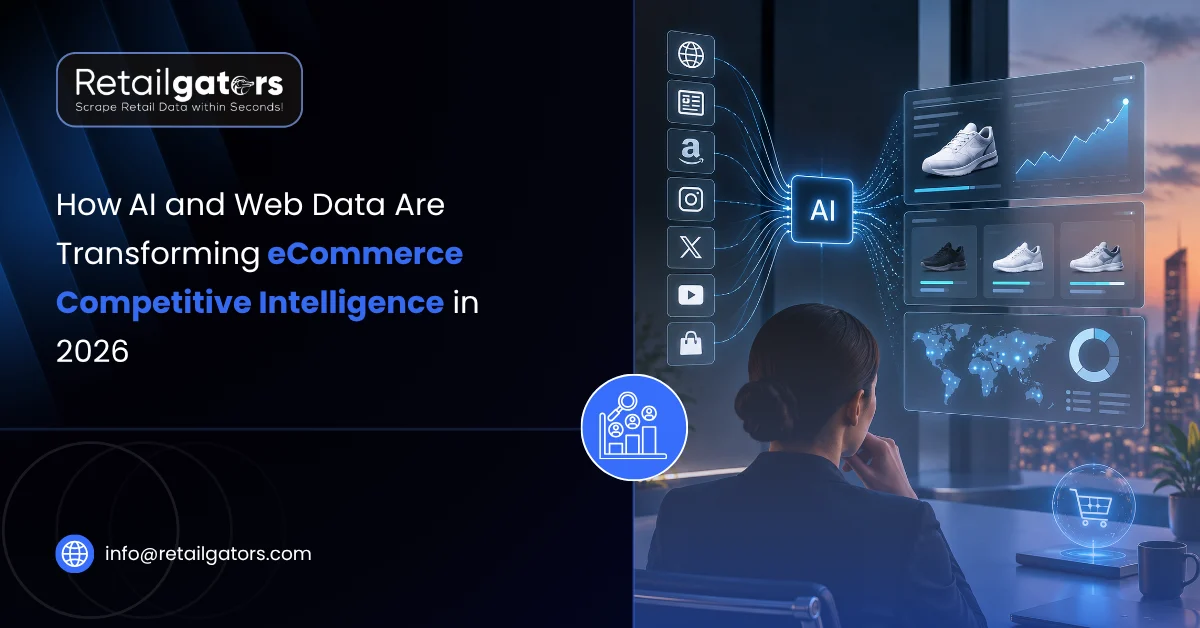
That is where AI-powered eCommerce competitive intelligence comes in. By combining automated web data collection with machine learning and natural language processing, retailers can monitor competitors at scale, identify pricing and assortment changes, analyze customer sentiment, and uncover emerging market trends.
This article explores how AI and web data are reshaping eCommerce competitive intelligence in 2026, which competitor data matters most, how AI converts that data into actionable insights, and how retailers can build a reliable intelligence workflow.
What Is Driving the Shift in 2026?
Two developments are accelerating the shift in eCommerce competitive intelligence: advances in AI and the growing availability of structured web data. Together, they allow retailers to collect competitor signals at scale and analyze them faster than traditional manual research. On their own, each was useful. Together, they created a completely new way to understand markets.
Traditional competitor monitoring often relied on manual page checks, spreadsheets, and periodic market reports. These methods can work for a small number of products, but they become difficult to maintain as retailers expand across categories, marketplaces, and regions. That approach was slow, limited, and often outdated by the time the report was finished. Automated data pipelines can now collect large volumes of competitor information on a recurring schedule and feed structured datasets into AI models for pattern detection, classification, forecasting, and anomaly detection. This is the foundation of ecommerce competitor intelligence in 2026, and it is why the discipline looks nothing like it did even three years ago.
How AI Changes eCommerce Competitive Analysis
Artificial intelligence has moved competitive analysis from description to prediction. Older systems could tell you what happened last week. AI can use historical performance, competitor activity, seasonality, and current market signals to identify patterns, estimate likely outcomes, and prioritize actions for analysts and retail teams.
Here is where the change is most visible, presented as a quick scan:
- Pattern and anomaly detection. AI can compare large volumes of competitor prices and flag unusual changes, sudden discounts, or recurring pricing patterns for further review.
- Demand forecasting. Historical sales, seasonality, market conditions, and competitor activity can be combined to estimate potential demand changes.
- Review and sentiment analysis. NLP models can classify customer feedback by sentiment, product feature, complaint type, and recurring theme.
- Assortment gaps: When a competitor keeps adding items to a category, and you have not, the system makes that gap obvious.
- Automated alerts: Your team learns about a competitor’s flash sale while it is running, not once it has already ended.
Notice that intelligence is no longer a monthly report sitting in a drawer. It is a living stream that guides pricing, marketing, and stocking decisions in near real time.
Why Clean Data Is the Real Engine
AI analysis is only as reliable as the data pipeline behind it. This is the reason web data for ecommerce has become the true engine behind every intelligence system. Public product pages, marketplaces, review platforms, and advertising libraries hold an enormous amount of signal, and collecting it cleanly is half the battle.
When retailers ask how quality inputs improve AI-powered analysis, the honest answer is that trustworthy data produces trustworthy outputs. A pricing model trained on stale or incomplete data will give confident but wrong advice. A model fed with fresh, structured, and accurate extraction will guide sound strategy. That difference in data hygiene often separates market leaders from the rest.
For retailers building this workflow at scale, a structured eCommerce data scraping solution can provide the recurring product, pricing, availability, and competitor data required for downstream analysis.
What eCommerce Competitor Data Should Retailers Track?
Not every data point carries equal weight, so it helps to focus your collection on categories that directly shape revenue. The table below breaks down the essentials, why each one matters, and how AI turns it into an advantage.
| Data Category | Example Data | Business Use | AI Application | Update Frequency |
| Pricing | List price, sale price, discount | Price positioning | Price anomaly detection | Daily/hourly |
| Product assortment | SKUs, variants, launches | Assortment planning | Gap detection | Daily |
| Availability | In stock, out of stock | Demand/supply monitoring | Stockout prediction | Hourly/daily |
| Reviews | Rating, text, themes | Product positioning | Sentiment analysis | Daily/weekly |
| Promotions | Coupons, offers, bundles | Promotional strategy | Promotion classification | Daily |
| Advertising | Creatives, messaging | Competitor marketing analysis | Creative/theme clustering | Daily/weekly |
The pattern here is clear enough on its own: pricing and assortment usually deliver the fastest returns, while reviews and ad signals sharpen your longer-term positioning.
Turning Prices and Catalogs Into Decisions
Pricing and assortment are the two areas where AI ecommerce competitive intelligence proves its worth most quickly. Once competitor prices are collected continuously, a model can compare them against your own catalog, factor in demand elasticity, and suggest a price that protects both sales volume and profit.
Consider a simple sequence that many retailers now follow:
- Automated extraction gathers competitor prices across several marketplaces every morning.
- The model matches each competitor product to the equivalent item in your catalog.
- Demand signals and seasonality are layered on top of the raw comparison.
- A recommended price appears, along with the reasoning behind it.
- Your team approves the change, or the system applies it automatically within set rules.
Assortment analysis operates on the same principle. If a competitor has been expanding a category with new products while your range in that category remains limited, the system identifies the shortfall and estimates the sales it may represent. That gives you a decision grounded in figures rather than assumptions.
The Quiet Workhorse Behind Every Insight
Automated data extraction is the quiet workhorse behind everything described above. Without a steady, reliable feed, even the best model runs dry. This is where the relationship between scraping and analysis becomes a genuine partnership rather than two separate tasks.
The value of automation shows up in several practical ways, listed here without the usual bullet clutter:
- Scale without staffing, because a single pipeline can monitor thousands of products across many competitors at once.
- Consistency over time, since scheduled collection removes the gaps that manual checks always leave behind.
- Speed that matches the market, as fresh data arrives daily or hourly rather than weekly.
- AI-ready structure: Data can be normalized into consistent fields, formats, categories, and records before being passed to analytics or AI systems.
A retailer who combines dependable extraction with capable analysis gains something rare in commerce: the ability to act while the opportunity is still open. That combination is the whole point of AI retail intelligence.
Building a Loop That Sharpens Itself
Bringing the two disciplines together is simpler than many teams expect, provided the steps happen in the right order. The goal is a loop that feeds itself, where fresh data improves the model, and the model tells you what data to prioritize next.
- Define business questions
What decisions need competitor data? - Identify the required data sources
Retailer websites, marketplaces, review platforms, ad libraries, etc. - Build the data collection layer
Determine scraping frequency, fields, geography, and historical retention. - Clean and normalize the data
Standardize products, prices, categories, currencies, and attributes. - Apply AI and analytics
Use anomaly detection, sentiment analysis, product matching, forecasting, and classification. - Deliver actionable alerts
Send findings to pricing, merchandising, marketing, or strategy teams. - Measure outcomes
Track whether the insights actually improve pricing, assortment, conversion, margins, or other business KPIs.
This loop is what separates a one-time report from a durable competitive edge. When it runs well, ecommerce competitor intelligence stops being a project and becomes a habit that quietly compounds in your favor.
Conclusion
In 2026, eCommerce competitive intelligence is increasingly becoming a continuous data-and-analysis process rather than a periodic reporting exercise. It is about the marriage of two strengths: the reach of web data and the reasoning of artificial intelligence. Retailers who treat AI ecommerce competitive intelligence as a connected system, rather than a collection of disconnected reports, are the ones setting prices with confidence, spotting product gaps early, and reading customer sentiment as it forms. The advantage no longer belongs to whoever has the most data, but to whoever turns clean data into timely action.
Ready to turn competitor web data into actionable eCommerce intelligence?
RetailGators can help you collect structured product, pricing, availability, and market data at scale for competitive analysis, monitoring, and AI-powered insights. Explore our eCommerce data scraping services to build a data pipeline aligned with your business goals.