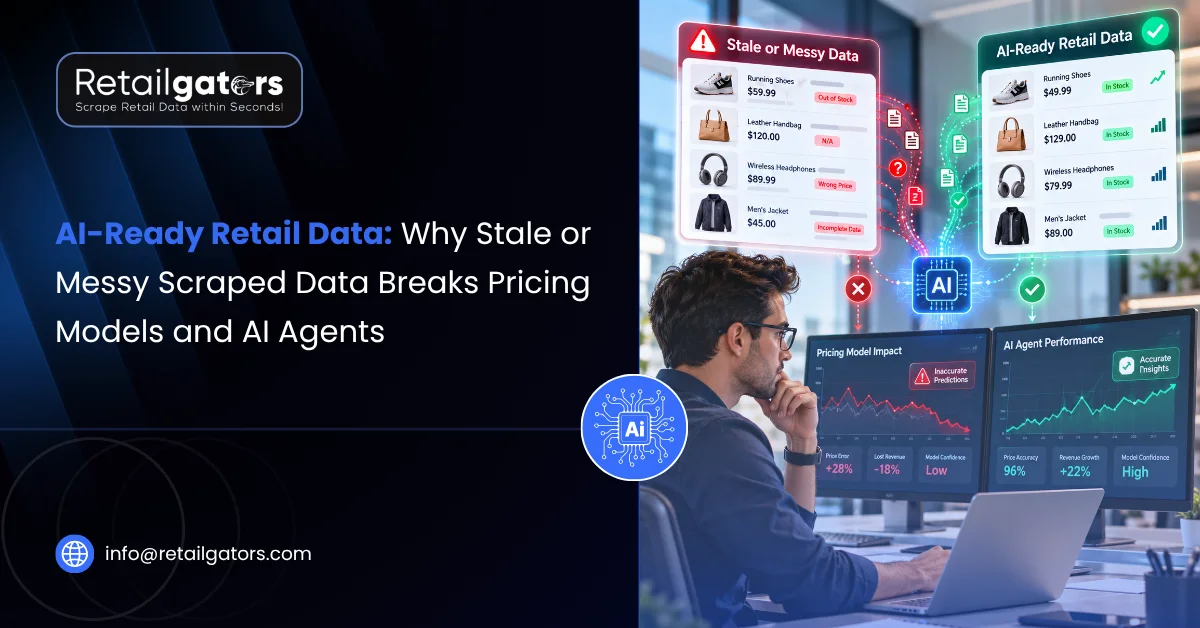
A pricing team plugs a new AI model into its competitor feed, and for the first week everything looks promising. Then the recommendations start to drift. The model suggests matching a competitor price that expired two days ago. It treats a bundle as a single unit and recommends a cut that wipes out the margin. It reads an out-of-stock listing as a live price. Nobody changed the model. The data underneath it was simply old, mismatched, or missing context, which is the usual story when teams move from manual price monitoring to automated decisions without first asking what the data looks like on arrival.
This is becoming a common problem as AI moves into pricing, merchandising, and competitive analysis. The models themselves are rarely the weak point. Agents and forecasting tools do what they are built to do with whatever they are given, and retail web data is one of the messier inputs a team can feed them. Prices change by the hour, the same product has different names on different sites, and a number without a timestamp or a seller attached is closer to a rumor than a measurement. This article looks at what actually goes wrong, what “AI-ready” retail data looks like in practice, and how to decide how often that data needs to refresh.
Why Retail Data Quality Matters More Once AI Is Involved
When a human analyst looks at a competitor price, they bring context without thinking about it. They notice that a listing looks odd, that a price seems too good to be true, or that a product page has been sitting unchanged for suspiciously long. An automated model has none of that instinct. It takes the row as given and acts on it, and it does so at a speed and scale that turns small data errors into repeated decisions.
AI agents raise the stakes further. A reporting dashboard that shows a wrong number gets questioned by whoever reads it. An agent that adjusts prices, flags assortment gaps, or drafts competitive summaries may act before anyone has looked at the underlying records. Errors that used to be caught in a review meeting now flow straight into outputs. That shift is why data preparation, which used to be a background task, has become the part of AI projects that decides whether they work.
Five Ways Stale or Messy Scraped Data Breaks Your Models
Stale prices produce confident, wrong recommendations. Retail prices are not stable facts. Flash sales, coupon windows, and marketplace repricing can change a competitor’s effective price several times in a day. A model trained or prompted on a snapshot that is even a day old will compare your price against a number the market has already moved past, and the output will look perfectly reasonable while being wrong.
Unmatched products create false comparisons. If a competitor’s 500 ml bottle is treated as equivalent to your 750 ml bottle, or a multipack is compared with a single unit, the model will find a “price gap” that does not exist. Product matching is the step where most pricing models quietly fail, because the error does not look like an error. It looks like an opportunity.
Inconsistent fields make aggregation unreliable. One source records price with currency symbols, another without. One lists weight in grams, another in ounces, another buried in the title. Category names differ across retailers. When those differences are not normalized before the data reaches a model, the model either breaks or, more dangerously, treats the variations as meaningful signals.
Missing context hides what the number actually means. A price is only half a fact. Was it a regular price or a promotional one? Was the item in stock? Which seller was offering it, and was shipping included? Strip that context away and a model cannot distinguish a real competitive move from a clearance listing nobody can buy.
Duplicates and ghost listings inflate everything. The same product appearing multiple times, or listings that remain visible long after they stopped being purchasable, skew averages, distort share-of-shelf calculations, and make a competitor look more aggressive or more present than they are.
None of these problems announces itself. They show up later as results that are slightly off, which is exactly why they survive for months.
What AI-Ready Retail Data Actually Looks Like
“AI-ready” has become a vague label, so it is worth being concrete about it. For retail pricing and product work, a dataset earns the label when it has a handful of properties that a model can rely on without guessing.
Every record is timestamped. The collection time matters as much as the price. It lets a model weight recent observations more heavily, lets analysts reconstruct what the market looked like at a given moment, and makes it possible to detect that a source has stopped updating. A feed without timestamps cannot be audited, only trusted or distrusted.
Products are matched, not just collected. Clean matching means each competitor listing is linked to the right internal product, with the same size, pack count, variant, and condition. This is the difference between a pile of scraped rows and a comparison a pricing model can use. It is also the part that takes the most care, which is why product matching deserves to be treated as its own stage rather than an afterthought.
Fields follow a consistent schema. Prices share a format and currency handling, units are standardized, categories map to one taxonomy, and missing values are marked as missing rather than silently filled. A model should never have to infer whether a blank means “free,” “unknown,” or “not applicable.”
Context travels with the price. Availability, seller, promotion status, and shipping details sit alongside the number they qualify. Which of these fields a project needs depends on the use case, but the principle holds: a price without its conditions is an incomplete record.
The source is traceable. Knowing which page a value came from, and when, lets teams debug strange model behavior in minutes instead of days. When an agent produces a questionable recommendation, traceability is what lets someone check the evidence behind it.
Refresh Frequency: How Fresh Does Retail Data Need to Be?
There is no single correct refresh rate, and teams often overspend by defaulting to “as fast as possible” or underspend by defaulting to weekly. A better approach is to match frequency to how quickly each data type actually changes and how expensive a stale reading would be.
Pricing and promotions on fast-moving marketplaces sit at the high-frequency end. If your pricing model reacts to competitor moves, a daily pull may already be too slow in categories where discounts rotate within hours, and sources that need near-immediate reads call for live price crawling rather than scheduled batches. Availability and stock signals also decay quickly, since a competitor going out of stock is exactly the kind of event a pricing agent should react to.
Product catalog attributes, such as titles, specifications, and category placement, change much more slowly and can usually refresh weekly or even monthly without hurting decisions. Reviews and ratings sit in between: they accumulate steadily, so a daily or weekly cadence usually captures the trend without paying for constant collection.
The practical move is to split the dataset by volatility. Refresh the fast-changing fields often, the slow-changing ones rarely, and record the collection time for each so the model always knows how old each value is. That keeps cost sensible while making sure the pieces of data that drive decisions are the ones kept current.
Messy Data vs. AI-Ready Data at a Glance
| Data Aspect | Messy Scraped Data | AI-Ready Retail Data |
| Timestamps | Missing or only a file date | Collection time recorded on every record |
| Product comparison | Titles compared by similarity | Matched to internal products by size, pack, and variant |
| Field formats | Mixed currencies, units, and category names | One schema with standardized values |
| Price context | Number only | Price with availability, seller, and promotion status |
| Duplicates | Repeated or inactive listings included | Deduplicated and validated |
| Refresh rhythm | One schedule for everything | Frequency set by how fast each field changes |
| Traceability | Unknown source or collection moment | Source and time recorded for each value |
| Missing values | Blanks or silent defaults | Clearly marked as missing |
From Raw Scraping to a Reliable Pipeline
Collecting the data is the visible part of the job. The less visible part is everything between the web page and the model: normalizing fields, removing duplicates, applying validation rules, and delivering the result in a form downstream systems can consume without custom cleanup. Teams that skip this layer tend to rebuild it later inside their own data science workflows, where it is slower and more expensive to fix.
Delivery matters as much as collection. Models and agents work best when data arrives in a predictable structure on a predictable schedule, whether that is an API call, a scheduled feed, or files dropped into cloud storage. Reliable delivery through a web scraping API or scheduled feeds means the pipeline behaves the same way every day, which makes monitoring and debugging far simpler.
One more point belongs here. Data collection should respect the terms of the websites involved, technical restrictions, and applicable legal requirements, and feasibility should be confirmed source by source rather than assumed. A pipeline that collects clean data in a way that creates legal or contractual exposure is not really AI-ready.
Training Datasets and Live Feeds Do Different Jobs
Teams sometimes treat these as the same need, and the confusion causes real waste. A training dataset is a large, historical, carefully curated collection used to teach or evaluate a model. Its priorities are breadth, consistent labeling, and documented structure, and freshness matters less than coverage. A live feed does the opposite job: it keeps a deployed model or agent informed about what the market looks like right now, so freshness and timestamping come first.
Most serious retail AI projects need both. Historical data lets a team build and test a pricing or demand model, while a refreshed feed keeps it grounded once it is running. If your team is still working out which one it needs first, RetailGators offers AI training datasets built from retail web sources, which is a useful starting point for model development before a live feed is connected.
How RetailGators Supports AI-Ready Retail Data
RetailGators collects publicly accessible product, pricing, inventory, seller, promotion, rating, and review data from eCommerce and retail platforms, and structures it to a schema the client defines. Records pass through normalization, deduplication, and validation checks before delivery, and the data can reach your systems through APIs, scheduled feeds, CSV, JSON, Excel, or cloud storage. Collection frequency is set per project, from hourly to monthly or on a custom schedule, with near-real-time monitoring possible for suitable pricing and inventory use cases.
For teams building AI into their workflows, the artificial intelligence web scraping service covers collection designed around model and agent inputs, and the data analytics side helps with enrichment, classification, and matching so records arrive ready to use. Which fields, sources, and refresh schedule make sense depends on the decision the model supports, so those are worked out per project rather than assumed.
If you are comparing providers, our pilot scorecard for evaluating a retail data vendor lays out what to check in a sample before committing, including freshness, matching accuracy, and field consistency.
Conclusion
Most pricing models and AI agents that disappoint in retail are not failing because of the model. They are failing because the data feeding them was old, mismatched, or stripped of the context that gives a price its meaning. Clean, matched, timestamped data with a refresh rate that fits how fast each field really changes is what lets an AI system make decisions a pricing or merchandising team can trust.
The easiest way to find out what that looks like for your catalog is to look at real records instead of a description. Tell us which competitors, products, and fields matter, and we will put together a sample dataset you can run through your own model or workflow. You can request a free pilot run or contact the RetailGators team with your requirements, and judge the data on its own terms.