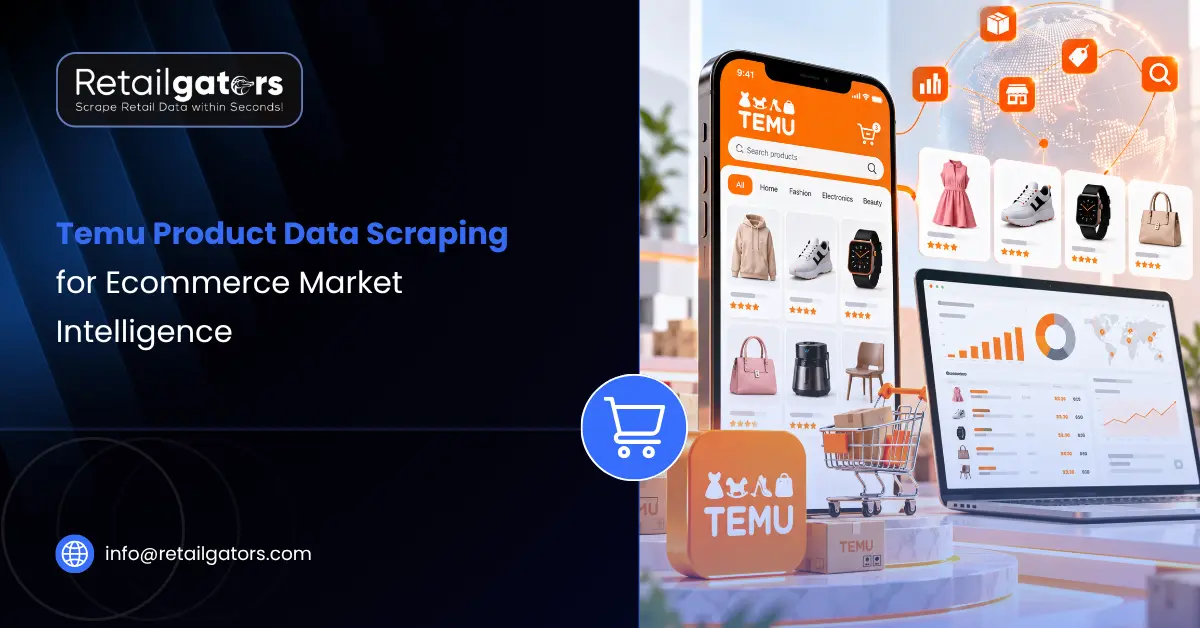
Temu product data scraping helps ecommerce businesses analyze product prices, discounts, ratings, reviews, and assortment changes across a large online marketplace. Instead of checking individual listings manually, retailers can organize available product information into structured datasets and use it to support pricing, sourcing, and competitor research.
For example, comparing similar products on Temu can help a retailer identify price gaps, spot emerging product categories, and understand how competing offers change over time. When combined with historical records and data from other marketplaces, these insights can support more informed ecommerce market intelligence decisions.
This guide explains which Temu product data fields matter, how a reliable data pipeline works, which pricing signals to monitor, and how to turn collected data into actionable competitor insights. It also covers data quality, collection limitations, and compliance considerations businesses should evaluate before starting a project.
Why Is Temu Product Data Valuable for Ecommerce Market Intelligence?
Temu has expanded rapidly since its launch in the United States in September 2022. Its broad product assortment and competitive pricing make the marketplace relevant to retailers researching product positioning, assortment gaps, and changing online offers. PDD Holdings’ company filings provide background on the platform’s launch and international expansion.
For ecommerce teams, the value of Temu product data lies in the ability to compare listings over time. Product prices, displayed discounts, ratings, review patterns, and assortment changes can help businesses understand how offers differ across categories and regions.
When collected through an authorized method and organized consistently, this information can support pricing reviews, product research, and sourcing decisions. It should be treated as one source of market evidence rather than a complete picture of consumer demand.
How Can Temu Product Data Improve Ecommerce Market Intelligence?
Temu product data becomes more useful when businesses compare listings across categories, sellers, and time periods. The resulting analysis can support several ecommerce decisions:
- Competitor price analysis: Compare similar products to understand where competing offers are priced lower or higher.
- Product demand research: Review available sales indicators, ratings, and review activity to identify products worth investigating. Treat these as signals, not definitive demand measurements.
- Assortment planning: Identify product types, variants, or categories that are underrepresented in your current catalog.
- Trend monitoring: Track changes in listing counts, prices, and review activity to spot emerging patterns.
- Customer feedback analysis: Group recurring review themes to understand common product complaints and potential opportunities for improvement.
These insights are most useful when combined with historical snapshots, internal sales data, and information from other relevant marketplaces.
Which Temu Pricing Metrics Should Retailers Track?
You don’t need every field. Pricing teams get the most mileage from a short list of Temu price data signals:
- Price gaps — how far your price sits from the cheapest comparable Temu listing, tracked per SKU.
- Discount depth — how deep the markdown runs below list price, which hints at how hard a seller is pushing.
- Price change frequency — how often prices move, a tell for dynamic pricing running in the background.
- Coupon and bundle offers — the quiet discounts that reshape what a buyer actually pays.
- Shipping and lead time — delivery terms that can tip a sale as easily as the sticker price.
Watch these on a steady cadence, lean on proper price monitoring, and your pricing stops trailing the market.
What Does a Reliable Temu Data Pipeline Look Like?
Listing the fields is the easy part. Keeping the data accurate while Temu redesigns pages under you is the real test. Most production setups for collecting Temu product data at scale run through six stages:
- Extraction, where headless browsers load the JavaScript-heavy pages while rotating residential proxies and throttled requests keep things stable and polite.
- Normalization, where prices snap to one base currency, units line up, titles get cleaned, and scattered categories map onto a single taxonomy.
- SKU matching, where fuzzy matching on title, brand, specs, and even image similarity ties Temu items to your catalog and your competitors.
- Validation, where outliers like a sudden 90% price drop get flagged, duplicates get cut, and half-empty records never move downstream.
- Storage, where clean, time-stamped snapshots land in a warehouse so you can look back at trends later.
- Reporting, where feeds, dashboards, or an API drop the finished data into your pricing and BI tools such as CSV, JSON, or Excel.
Get this right, and you’ve got a data product, not a script waiting to break.
Turning Scraped Data Into Smart Competitor Analysis
Gathering the numbers is only step one. The value shows up in the loop from the infographic above, where listings turn into decisions. Here’s a made-up example for a small electronics seller, comparing three of its SKUs against the cheapest matching Temu listings.
| Your SKU | Your price | Lowest Temu price | Price gap | Temu rating | Suggested action |
| Wireless earbuds A1 | $29.99 | $18.40 | +63% | 4.3 (2.1k) | Hold price, lead with warranty and support |
| LED desk lamp D7 | $24.00 | $21.50 | +12% | 4.5 (900) | Trim slightly or run a short promo |
| Phone case C3 | $12.99 | $6.80 | +91% | 4.1 (5k) | Reposition as premium, skip the price war |
Looked at this way, Temu competitor analysis becomes a habit rather than a one-off report, and every gap points to a move you can defend in a meeting.
What Are the Main Challenges of Collecting Temu Product Data at Scale?
Collecting and maintaining product data at scale involves several challenges that can affect coverage, accuracy, and consistency.
- Changing page structures: Listing layouts and field locations may change, requiring updates to approved collection methods.
- Regional differences: Prices, discounts, shipping estimates, and product availability may vary by market or delivery location.
- Incomplete information: Some listings may not expose every desired field, and certain indicators may be estimates rather than verified measurements.
- Product matching errors: Similar titles can describe different specifications, sizes, or bundles, which can distort competitor comparisons.
- Data freshness: A record can become outdated between collection cycles, especially in categories with frequent price changes.
- Quality control: Duplicate records, missing values, and unexpected changes need to be detected before the data is used for business decisions.
Businesses should assess these issues when comparing an internal solution with an authorized data provider. The right approach depends on access permissions, required coverage, update frequency, maintenance resources, and total cost.
One important limitation remains: displayed sales indicators, stock information, and delivery estimates should not be treated as exact measures of demand or availability unless independently validated.
Is Temu Data Scraping Legal and Compliant?
Compliance isn’t a footnote you bolt on later. Responsible collection sticks to information that’s already public, honors a site’s terms of service and robots rules, and leaves personal data about individuals alone. Privacy laws like GDPR in Europe and the CCPA in California stay in the picture too. A credible provider writes down how it collects, works inside legal and ethical lines, and says so plainly when a request crosses them. Handled that way, good data practice guards your insights and your reputation at the same time.
How Often Should You Update Temu Product Data?
The right refresh frequency depends on how quickly the information changes and how often your team uses it to make decisions.
- Prices and promotions: Use more frequent checks when permitted and when rapid changes materially affect pricing decisions.
- Product assortment: Review listing additions, removals, and variant changes on a schedule suited to your category.
- Ratings and reviews: Refresh periodically to monitor changes in customer feedback.
- Historical market analysis: Preserve consistent snapshots over time so trends can be compared across equivalent periods.
More frequent collection is not automatically better. Define a freshness target for each field, measure how often records become outdated, and balance the business value of newer data against collection and processing costs.
Who Gets the Most Value, and What Do You Receive?
Some teams feel this data more than others. The usual front-runners:
- Brands and retailers under pressure to protect margins against cut-price rivals.
- Dropshippers and sellers chasing winning products before everyone else piles in.
- Pricing and category managers who want today’s benchmarks, not last quarter’s.
- Market researchers reading demand as it shifts by region and season.
Final Thoughts
Temu product data can help ecommerce businesses compare competing offers, investigate assortment gaps, and monitor changes in product listings. Its value depends on more than the amount of data collected. Accurate product matching, consistent historical records, clear validation rules, and appropriate data access are essential for producing useful insights.
Before building a collection workflow, define the decisions you want the data to support and identify the fields, update frequency, and quality standards those decisions require. Retailers should also assess the applicable platform terms and legal requirements before using Temu data commercially.
RetailGators can introduce its relevant product data and marketplace intelligence services here, explaining the available scope, delivery options, and validation process. A clear project discussion is a practical starting point for determining whether the proposed data solution fits your business needs.