Most pricing and product teams don’t lack information about Amazon and eBay — they’re drowning in it. Prices shift several times a day, sellers rotate in and out of the buy box, listings appear and disappear, and promotions run on schedules nobody outside the marketplace can predict. The real problem isn’t visibility. It’s consistent. Checking a handful of competitor listings by hand once a week tells you almost nothing about what happened in between.
That’s where the “Amazon vs eBay” question usually goes wrong. Teams frame it as a popularity contest — which marketplace has more traffic, more sellers, more category depth — when the more useful question is structural: what kind of data does each platform actually expose, and which of your business problems does that data solve? Amazon and eBay are built around different catalog philosophies, different seller models, and different pricing mechanics. Once you understand those differences, you can decide which signals to track, and why, instead of defaulting to whichever marketplace feels bigger.
Amazon vs eBay Data Comparison: What Actually Changes?
The starting point is catalog structure. Amazon consolidates listings around a single product page per ASIN, with multiple sellers competing for the buy box on that one page. eBay, by contrast, lets multiple sellers list what is technically the same item as separate, independent listings — sometimes with different conditions, shipping terms, or formats attached. That single distinction cascades into almost everything else.
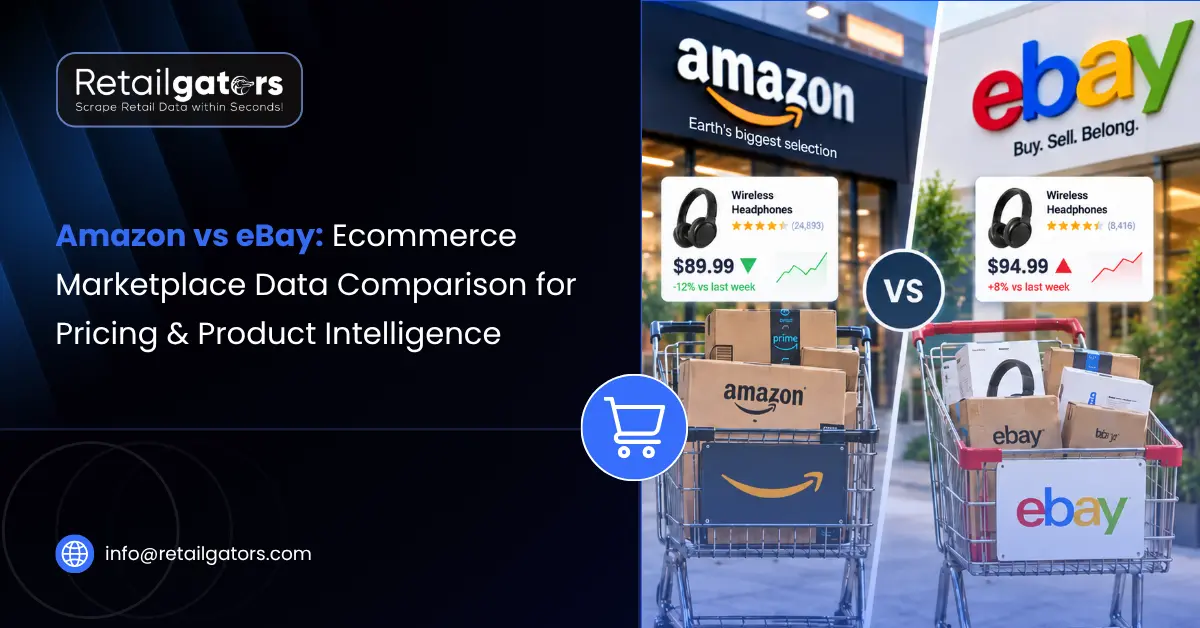
Pricing data behaves differently as a result. On Amazon, price tracking usually centers on the buy box price plus whatever competing offers are visible on that ASIN. On eBay, price tracking has to account for auction-style listings alongside fixed “buy it now” listings, which means the same search term can return a wider spread of price points for what looks, on the surface, like an identical product.
Product variations also diverge. Amazon groups variations (size, color, style) under one parent listing, so a business can see the full variation set in one place. eBay listings are more often standalone, so equivalent variations may need to be pieced together across several listing IDs rather than pulled from a single structured record.
Seller information carries different weights too. Amazon exposes seller-level data mainly through the buy box and offer listings, with fulfillment method (seller-fulfilled vs. Prime-eligible) as an added signal. eBay puts seller reputation front and center — feedback scores, ratings, and store information are core parts of how buyers evaluate a listing, which makes seller data more central to eBay analysis than it typically is on Amazon.
Reviews and ratings follow a similar split. Amazon aggregates reviews at the product level, so a single ASIN accumulates one rating history over time. eBay’s feedback system is oriented around the seller rather than the individual item, which means review-based intelligence on eBay tends to say more about seller trustworthiness than product quality.
Availability, categories, and promotions round out the picture, but the pattern holds throughout: Amazon’s data model rewards product-centric analysis, while eBay’s rewards listing-and-seller-centric analysis. Neither is deficient — they’re just answering different questions by default.
Amazon Product Data: What Businesses Can Analyze
Amazon’s catalog structure makes it a strong source for anything centered on a specific, well-defined product. A handful of data points do most of the work.
Product titles and descriptions matter beyond simple identification — they reveal how sellers position a product, which keywords they’re targeting, and how listing content shifts over time in response to competition.
ASINs function as a stable product identifier, which is what makes historical tracking possible in the first place. Without a consistent ID, price history and listing changes are much harder to stitch together over time.
Categories and brand fields support assortment analysis — understanding which brands dominate a category, how deep the competition runs, and where gaps might exist.
Prices and discounts are usually the first thing pricing teams look at, and for good reason: buy box price movement is one of the more direct signals of competitive intensity on Amazon.
Ratings and reviews give a read on product sentiment and can flag emerging quality issues before they show up in sales data.
Specifications and variations help with product matching — confirming that the item you’re comparing against a competitor’s catalog is actually the same item, not a similar one with a different spec sheet.
Availability and seller information, where publicly visible, indicate stock pressure and whether a listing is fulfilled by the seller or through Amazon’s own fulfillment network, which can affect delivery speed and buyer perception.
Individually, none of these fields is remarkable. Together, tracked consistently, they turn a single product page into a running record of how that product is performing in the market.
eBay Product Scraping and Marketplace Data
eBay data rewards a different kind of thinking, mostly because of the auction-and-listing model underneath it.
Product listings and titles work much like Amazon’s, but with more listing-to-listing variation, since there’s no single canonical page a seller is competing on.
Pricing is where eBay gets genuinely more complex. A business tracking “the price” of a product on eBay has to decide whether it means the current auction bid, the buy-it-now price, or an average across several listings — these aren’t interchangeable numbers, and treating them as one signal will produce misleading conclusions.
Seller information — feedback score, ratings, store presence — carries more analytical weight here than it does on Amazon, since buyer trust on eBay is built listing by listing and seller by seller rather than product by product.
Product condition is a field that matters more on eBay than on most other marketplaces, given how much of the catalog includes used, refurbished, or “for parts” inventory alongside new items. Ignoring condition when comparing prices across listings is a common source of bad analysis.
Categories, shipping information, and listing availability round out the practical fields, with shipping cost in particular playing a bigger role in total-price comparisons than it typically does on Amazon, where shipping is often bundled or standardized.
Product variations and promotions exist on eBay too, but because they’re tied to individual listings rather than a consolidated parent product, matching them across sellers takes more deliberate structuring.
The upshot: eBay data tends to be richer for understanding seller behavior, pricing spread, and condition-based market segments — areas where Amazon’s more standardized catalog doesn’t offer as much texture.
Amazon vs eBay for Competitor Pricing Intelligence
Manual price checks don’t scale, and most pricing teams learn that the hard way — usually after missing a competitor’s price drop for several days because nobody happened to look. Tracking prices consistently across dozens or hundreds of SKUs, on a schedule tight enough to matter, isn’t something a person can do reliably by hand.
Automated monitoring solves the frequency problem, but frequency alone isn’t the whole story. Historical pricing data is what turns a snapshot into a pattern — you start to see which competitors discount on weekends, which ones match price drops within hours, and which categories see the most volatility around promotional periods. A single price check tells you where things stand today. A pricing history tells you how they got there and what’s likely to happen next.
Discounts and promotions complicate the picture further, since a competitor’s “list price” often isn’t what customers actually pay. A product priced slightly higher but running a consistent coupon may be more competitive in practice than a lower-priced listing with no active promotion. Tracking discount patterns alongside base price is what makes pricing intelligence useful rather than just descriptive.
Comparing prices across Amazon and eBay for what looks like the same product requires proper product matching first — confirming that an ASIN and an eBay listing actually refer to the same item, in the same condition, before treating their prices as comparable. Skipping that step is one of the more common mistakes in cross-marketplace pricing work; it produces numbers that look precise but aren’t actually measuring the same thing.
None of this means one marketplace is a better pricing signal than the other. Amazon tends to offer cleaner, more directly comparable pricing because of its single-listing structure. eBay offers a wider spread of price points, which can be useful for understanding market range but requires more careful normalization before it’s usable for direct comparison.
Marketplace Analytics for Product Intelligence
Collecting data and generating intelligence are not the same activity, and it’s worth being explicit about the difference. Collection produces raw records — prices, titles, availability flags. Intelligence is what happens when those records are structured, compared over time, and connected to a business decision.
Assortment analysis is a good example. Knowing what products a competitor carries is data. Understanding which categories they’ve expanded into over the past two quarters, and what that implies about their strategy, is intelligence.
The same logic applies across the other common use cases: product discovery (what’s newly listed, and where), category trends (which segments are growing or shrinking based on listing volume and pricing behavior), product positioning (how a listing’s price, content, and reviews compare to category norms), competitor monitoring (tracking a defined set of competitors’ catalogs and pricing over time), promotion monitoring (when and how often competitors run discounts), product availability (stock-out patterns that might signal supply issues or unusually strong demand), seller analysis (which sellers are gaining or losing visibility), and broader market research (using aggregated listing data to understand a category’s overall shape).
What ties these together is repetition and structure. A one-off data pull can answer a single question. Ongoing, structured collection is what lets a business track how the answer changes.
Amazon vs eBay Data Comparison Table
| Data Area | Amazon | eBay | Business Use |
| Product information | Consolidated per ASIN, one listing per product | Distributed across individual seller listings | Catalog management, product research |
| Pricing | Buy box price plus competing offers | Auction bids, buy-it-now prices, seller-set prices | Competitor pricing, price benchmarking |
| Product variations | Grouped under a parent listing | Typically separate listings per variation | Assortment and catalog analysis |
| Seller information | Visible through offers and fulfillment method | Central to listings via feedback and store data | Seller monitoring, trust signals |
| Reviews/ratings | Aggregated at the product level | Aggregated at the seller level | Sentiment analysis, seller vetting |
| Availability | Stock status per offer | Listing status (active, ended, sold) | Inventory and demand signals |
| Promotions | Coupons, deals, discount pricing | Seller-run discounts, promoted listings | Promotion tracking, margin analysis |
| Competitor monitoring | Strong for single-product tracking | Strong for multi-seller price spread | Pricing strategy, market positioning |
| Product intelligence | Structured, easier to match at scale | Richer condition and seller detail | Catalog optimization, product research |
| Pricing intelligence | Cleaner direct comparisons | Wider price range, needs more normalization | Dynamic pricing, market benchmarking |
Which Marketplace Data Should Your Business Track?
There isn’t a universal answer here, and treating it like there is tends to produce tracking programs that collect a lot of data nobody actually uses. The right starting point is the business objective.
If the objective is competitor pricing, Amazon’s buy box data is usually the more direct signal for product-level price benchmarking, while eBay adds useful context on price range and discount behavior across multiple sellers of similar items.
If the objective is product assortment, Amazon’s category and brand structure makes it easier to map out competitive depth quickly, while eBay is worth layering in for categories — collectibles, used goods, parts — where it has meaningfully more listing volume.
If the objective is seller monitoring, eBay’s feedback and store data generally offers a clearer picture of seller-level performance, since that’s the axis the platform is built around.
If the objective is market research at a category level, combining both marketplaces gives a broader read than either alone, since Amazon and eBay attract different seller profiles and, in some categories, different buyer behavior.
If the objective is multi-marketplace intelligence — tracking a product’s overall market presence rather than its position on a single platform — combining sources is close to necessary. A product’s Amazon price alone doesn’t tell you whether a customer might find it meaningfully cheaper on eBay, and vice versa.
Why Automated Marketplace Data Collection Matters
Manual collection runs into the same limitations regardless of which marketplace you’re working with: it doesn’t scale past a small number of SKUs, it can’t realistically run on a tight schedule, and it produces inconsistent formatting when different people are doing the collecting at different times.
Scale is the most obvious constraint — checking ten products by hand is manageable; checking a few thousand, across two marketplaces, on a recurring basis, is not. Frequency compounds the problem, since competitor prices can change several times within a single day, and a weekly manual check will miss most of that movement. Data consistency suffers too, because manual collection is prone to copy-paste errors, missed fields, and formatting that varies by whoever did the work that week.
Historical tracking is arguably the biggest casualty of manual collection. Without a structured, repeated process, there’s no reliable price history to analyze — just scattered snapshots that are hard to compare. Automated collection, run on a defined schedule, is what makes trend analysis possible in the first place.
None of this should be read as a claim that data collection is unlimited or unconditional. Collection needs to respect the applicable terms of the source websites, technical access restrictions, and relevant legal requirements — that’s a baseline consideration regardless of which marketplace or which collection method is in use, and it’s worth confirming feasibility on a source-by-source basis rather than assuming one approach works everywhere.
How RetailGators Supports Marketplace Data Intelligence
Once a business has worked out which data actually matters for its objective, the remaining question is usually operational: how do you collect it consistently, in a usable format, without building and maintaining that infrastructure internally.
RetailGators works with businesses on exactly that layer. For Amazon product data, that means structured collection of titles, ASINs, pricing, discounts, ratings, reviews, specifications, variations, and availability across country-specific Amazon marketplaces. For eBay product data, it covers listings, pricing (including auction and buy-it-now formats), seller details, feedback and ratings, product condition, and shipping information across eBay’s global marketplaces.
Beyond raw collection, RetailGators supports the intelligence layer that sits on top of it — pricing intelligence for tracking competitor price movement over time, product matching for confirming that items being compared across sources are genuinely equivalent, and broader marketplace data intelligence for businesses trying to understand their competitive position across more than one platform at once.
Data is delivered in the format that fits the workflow it’s feeding — CSV, Excel, JSON, API-ready feeds, or scheduled deliveries at a frequency the business defines, whether that’s daily, weekly, or on a custom cadence. For teams still working out which fields and sources matter most, reviewing sample output before committing to full-scale collection is part of the process, rather than something bolted on afterward.
Businesses that need Amazon and eBay data at scale — or a combined view across both — can talk through their requirements with RetailGators and work out a collection and delivery approach that fits their existing systems.
Final Takeaway
Amazon and eBay aren’t competing answers to the same question — they’re different sources built around different catalog and pricing logic, and each surfaces signals the other doesn’t. Amazon’s consolidated product pages make it easier to track a specific item’s price and reputation cleanly over time. eBay’s listing-and-seller model makes it a stronger source for price range, condition-based segments, and seller-level trust signals.
The value doesn’t come from picking a winner. It comes from working through the chain deliberately: data → analysis → intelligence → business decision, with the fields you’re collecting chosen because they answer a specific question you actually have. A pricing team and a product-assortment team pulling from the same two marketplaces will often want almost entirely different fields, and that’s fine — it’s the objective that should drive the data strategy, not the marketplace.
If your team is still deciding what an Amazon vs eBay data comparison should look like for your own catalog, RetailGators can help structure the collection around what you’re actually trying to decide.