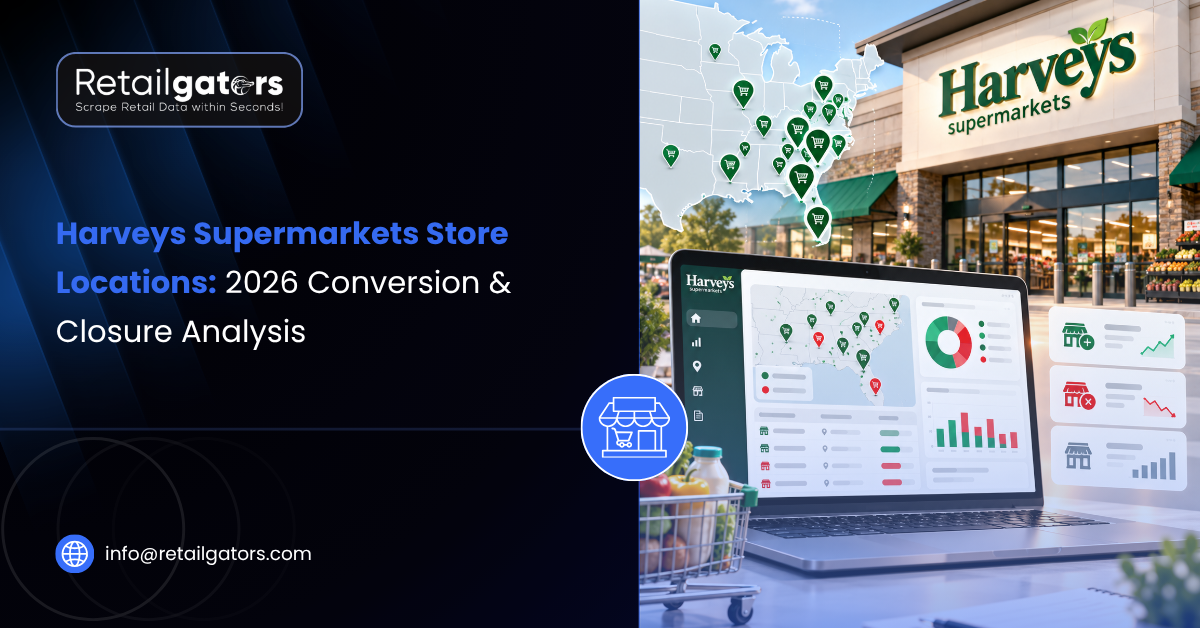
Looking for Harveys Supermarket locations in 2026? The grocery chain’s former stores have undergone a major branding change, with locations transitioning to the Winn-Dixie name. This means shoppers searching for a nearby Harveys may still find a familiar store operating under a different banner.
This guide explains what happened to Harveys Supermarkets, when the final conversion took place, and which former locations transitioned to Winn-Dixie. It also examines the brand’s historical footprint across the Southeast and explains how store openings, closures, and rebranding affect grocery retail market analysis.
Whether you’re a shopper checking a store’s status or a retail analyst tracking competitors, understanding these changes requires more than an old address list. Current store records, company announcements, and reliable local reporting can help establish which locations remain active and how their branding has changed.
What Happened to Harveys Supermarkets in 2026?
Harveys Supermarkets no longer operates as a separate retail banner following The Winn-Dixie Company’s conversion of its remaining Harveys locations. On June 22, 2026, the company announced that it had completed the final conversions, bringing eight additional stores under the Winn-Dixie name. The change ended Harveys’ presence as a separate brand, although the converted stores continued operating under new branding.
The brand had been part of Southeastern Grocers for years, and the parent company itself went through a major identity change. The Southeastern Grocers name was retired at the start of 2026, replaced by a refreshed identity as The Winn-Dixie Company.
Because of that consolidation strategy, there are no active Harveys store locations left in 2026, since each one now runs under a single, unified name. For anyone tracking Harveys Supermarket locations in the USA, the practical takeaway is simple: the store may still be there, but the sign and the branding have changed.
Harveys Supermarket Closure and Conversion Timeline
The road to the final Harveys store conversion stretched across several years and several ownership changes. The table below lays out the key milestones so you can follow the sequence at a glance.
| Date | Event |
| March 2024 | Aldi completed its purchase of Winn-Dixie and Harveys Supermarket from Southeastern Grocers, covering roughly 400 stores. |
| 2024–2025 | Anthony Hucker and C&S Wholesale Grocers acquired Southeastern Grocers and 170 remaining Winn-Dixie and Harveys stores to keep the banners running. |
| January 2026 | The Southeastern Grocers name was retired and rebranded as The Winn-Dixie Company. |
| March 16, 2026 | Seven Harveys Supermarket locations across Florida and southern Georgia were announced for transition to the Winn-Dixie banner. |
| June 10, 2026 | The last Harveys store in Jacksonville converted, ending 102 years of the brand. |
| June 22, 2026 | The Winn-Dixie Company completed the conversion of eight Harveys locations to the Winn-Dixie banner. |
8 Former Harveys Supermarket Locations Converted to Winn-Dixie
The Winn-Dixie Company announced on June 22, 2026, that it had completed the conversion of eight former Harveys Supermarket locations in Florida and southern Georgia. The list below identifies those stores by address. Seven of the converted stores sit in Florida and one is in Georgia. Here are the eight addresses that completed the switch:
- 201 W. 48th St., Jacksonville, Florida
- 5250 Moncrief Road W., Jacksonville, Florida
- 5909 University Blvd. W., Jacksonville, Florida
- 4506 SW Heritage Oaks Circle, Lake City, Florida
- 2630 U.S. Highway 92, Lakeland, Florida
- 1305 Ariana St. W., Lakeland, Florida
- 3435 N. Pine Ave., Ocala, Florida
- 3606 S. Second St., Folkston, Georgia
The company said the converted stores would feature the Winn-Dixie brand and its product lineup, including private-label products, fresh produce, quality meats, and prepared foods. Confirm any claims about automatic rewards transfers against the company’s published customer guidance before including them.
Which States Previously Had Harveys Supermarket Locations?
Harveys Supermarkets’ geographic footprint changed over time as stores were sold, closed, or transferred to other operators. To understand the chain’s historical reach, it is important to distinguish states where Harveys-branded stores operated from states included in broader Southeastern Grocers transactions. For a clear picture of where these Harveys store locations operated, here is a breakdown by region:
- Georgia served as the original home of the chain, which traces its roots to Nashville, Georgia, and kept a strong presence in the southern part of the state.
- Florida became the core market in the later years, and it held the final cluster of stores before the Winn-Dixie transition.
- South Carolina and North Carolina carried Harveys-branded stores at earlier points, several of which were later sold to other operators.
- Alabama, Louisiana, and Mississippi rounded out the wider Southeastern Grocers territory that Aldi reviewed during its 2024 acquisition.
The Aldi deal alone spanned Alabama, Florida, Georgia, Louisiana, and Mississippi, with Florida accounting for the heaviest concentration at nearly 300 stores. That regional spread is a big reason the closures drew so much attention across multiple markets.
What the Harveys Rebranding Means for Shoppers and Competitors?
Shoppers felt the change before they understood it. One week the Harveys sign was up, and the next it read Winn-Dixie, even though the aisles, the staff, and the parking lot stayed exactly the same. For loyal customers, the shift was mostly cosmetic, since prices, rewards, and familiar faces carried over without much fuss. The bigger story sits with the competition. Publix still rules Florida by a wide margin, and Aldi keeps pushing its low-price format into the same neighborhoods, so every former Harveys store now fights under a stronger, single banner instead of a fading one. That matters for anyone studying the remaining Harveys Supermarket Locations on a market map.
Fewer brands means sharper rivalries, tighter margins, and faster moves, and reliable grocery store location data is what helps analysts see those shifts coming rather than reacting late.
How Store Rebranding Affects Grocery Retail Market Analysis?
The Harveys story is more than a nostalgia piece, because it shows how quickly a retail map can change. A single brand went from hundreds of Harveys store locations to zero active stores within a few short years, and that pace is exactly why accurate grocery store location data has become essential for competitive planning. Businesses that rely on outdated address lists risk making decisions based on stores that no longer exist under the same name.
Reliable location intelligence supports several high-value use cases:
- Market expansion teams depend on fresh store counts to spot gaps and plan new sites with confidence.
- Real estate and site-selection analysts need conversion records to understand where competitors are gaining or losing ground.
- Consumer brands and suppliers use banner-level data to route products to the right stores after a rebrand.
If your team wants structured, up-to-date retail feeds, our grocery store location data scraping services can help you monitor banners, addresses, and store status at scale. Clean data turns a messy wave of Harvey’s store closures into a clear strategic signal.
How to Track Grocery Store Openings, Closures, and Rebranding
Keeping pace with a fast-moving retail map takes the right mix of tools and sources. No single method covers everything, so most teams stack a few together when they track openings, closures, and each Harveys store conversion style event:
- Automated web scraping does the heavy lifting. It pulls store locators, addresses, and operating status straight from retailer sites on a schedule you set.
- Press releases and company newsrooms are where the official conversion dates come from, so you can cite a source instead of guessing.
- Trade publications and local news fill in the gaps, especially the closure details that corporate statements tend to leave out.
- Geospatial mapping platforms turn the raw numbers into something visual, and regional patterns jump out far faster on a map than in a spreadsheet.
Combining these sources creates a more reliable record of store changes. Analysts should also track the source, verification date, and confidence level of each record so they can distinguish confirmed changes from unverified reports.
Final Thoughts
Harveys spent more than a hundred years as a familiar name across the Southeast, so watching it fold into Winn-Dixie inside a single year says a lot about how fast retail moves now. A chain does not have to fail to disappear from the map. It can simply get absorbed, rebranded, and quietly renamed while the same building keeps its doors open. That is the part worth remembering about the Harveys Supermarket Locations closure: the stores mostly survived, but the brand did not.
For anyone who depends on store maps to plan, sell, or invest, the lesson lands hard. A list of addresses is only useful when someone keeps it current, and that is exactly where reliable grocery store location data earns its keep. If your team needs retail datasets that reflect these changes as they happen, RetailGators is built to keep that information accurate and ready to use.