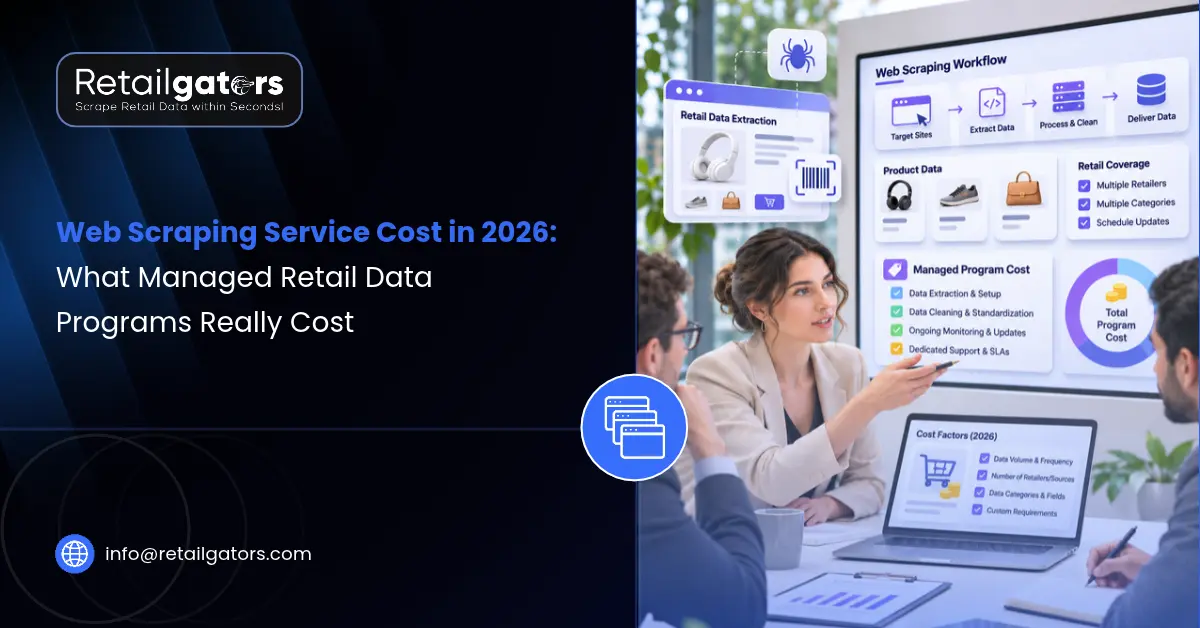
How much does web scraping cost in 2026? The answer depends on what you need to collect, how frequently you need updates, and how difficult it is to access your target websites. A basic scraping tool might cost 500 per month, while a fully managed web scraping service can run into thousands of dollars for large-scale data extraction.
For retailers and e-commerce businesses, pricing involves more than collecting product information. Proxy usage, anti-bot protection, data accuracy, refresh frequency, and ongoing maintenance can all influence the final cost. Understanding these expenses before choosing a provider helps prevent unexpected charges and budget overruns.
This blog breaks down web scraping pricing across different service models, explains six factors that influence costs, and compares sample retail data budgets. It also examines in-house versus managed scraping expenses to help businesses choose an approach that fits their operational requirements.
How Much Does Web Scraping Cost in 2026?
Web scraping costs in 2026 vary depending on the pricing model, website complexity, data volume, and frequency of extraction. A self-service scraping tool may start at a few dollars per month, while managed scraping programs can cost several thousand dollars for ongoing enterprise workloads.
Most providers follow one of three pricing approaches:
- Self-service scraping tools: Usually charge a monthly subscription based on usage limits, features, and credits. These are suitable for smaller projects where an internal team can manage extraction.
- Web scraping APIs: Typically charge based on successful requests, results, credits, or subscription tiers. Costs increase when JavaScript rendering, premium proxies, or specialized target support is required.
- Managed web scraping services: Use project-based or recurring pricing. The quote usually considers website complexity, extraction volume, refresh schedules, data validation, and delivery requirements.
For example, Apify offers subscription plans starting at $19 per month, while Oxylabs publishes Web Scraper API plans starting at $49 per month. Managed providers such as ScrapeHero publish service packages starting at $199 per month, with more extensive enterprise plans starting at $1,500 per month.
These prices represent different products and service scopes, so they should not be treated as direct equivalents. To estimate your actual web scraping cost, evaluate the number of websites, records required, update frequency, and level of ongoing support.
What Factors Affect Web Scraping Service Costs?
Two web scraping projects can involve the same number of pages but have completely different budgets. The difference usually comes down to the work required to collect, process, validate, and deliver the data consistently. Understanding the following cost factors makes it easier to compare vendor quotes and identify expenses that may not appear in the initial proposal.
- Data volume: Explain the difference between SKUs, product variants, pages, and successful extraction requests. These are not interchangeable billing units.
- Anti-bot complexity: Keep CAPTCHA, JavaScript rendering, and proxy requirements, but remove the claim that a page can cost roughly $0.20 unless you have a documented example.
- Refresh frequency: Include a simple example showing how weekly, daily, and hourly updates change monthly extraction volume.
- Data quality: Explain missing fields, duplicate records, incorrect product matches, and validation as separate quality concerns.
- Delivery and integration: Include CSV, JSON, APIs, cloud storage, and database integration.
- Compliance: Discuss access permissions, website terms, applicable privacy laws, data retention, and rate limiting. Avoid suggesting that compliance review always adds a fixed cost.
Managed Web Scraping Pricing Models Compared
The first table maps the four common ways retail data gets priced in 2026. Figures marked verified are taken directly from a vendor’s published pricing page; figures marked estimate are typical ranges compiled across several buyer guides, since many providers quote only on request.
| Approach | Typical 2026 price (USD) | Source type | Effort on your team | Best fit |
| No-code / self-service tools | 500 / mo | Verified | High | Small, simple, low-volume jobs |
| Scraping APIs (per request) | ~0.20 / page | Verified | Medium | Developer teams wanting bypass handled |
| Managed scraping service | 20,000 / mo | Estimate | None | Ongoing retail feeds, zero maintenance |
| In-house build | 300,000 / yr | Estimate | Very high | Rare, highly custom, deep-pocketed teams |
A detail worth flagging is that managed web scraping pricing commonly carries a one-time setup fee, often around $500 per scraper (a rate Bright Data lists publicly), before monthly billing starts. That charge usually covers the custom build and the first QA pass, so it reads as an investment rather than a hidden penalty.
Sample Monthly Budgets by SKU Volume
Abstract ranges only get a buyer so far, so the next table turns them into three illustrative retail scenarios. These are modeled estimates built from the per-page and managed ranges above, not fixed quotes, and your real number will shift with site mix and delivery needs.
| Scenario | SKUs tracked | Refresh | Site complexity | Est. monthly (USD) |
| Starter | 10,000 | Weekly | Low, mostly static | 800 |
| Growth | 100,000 | Daily | Mixed, some anti-bot | 4,000 |
| Enterprise | 1M+ | Hourly | Heavy anti-bot (Amazon, Walmart) | 20,000+ |
A retailer tracking 10,000 SKUs once a week is pulling roughly 40,000 pages a month from forgiving sites, which a lean managed plan or a mid-tier API covers for a few hundred dollars. Step up to 100,000 SKUs refreshed daily, and the monthly volume jumps to around three million pages, several of them behind anti-bot walls; that workload realistically costs between $1,500 and $4,000 through a managed partner once proxies and QA are folded in. The jump between those two tiers shows why refresh frequency, not SKU count alone, tends to be the budget’s true pivot.
In-House vs Managed Scraping Cost: Where the Money Really Goes
The spreadsheet math on building internally almost always looks cheaper than it proves to be, since a salary line hides most of the real spend. The points below explain why the in-house vs managed scraping cost comparison so often flips once the full picture is visible.
- Engineer salaries of $90,000 to $150,000 a year form only the visible tip, and most serious programs need more than one specialist (figures per ScrapeHero and X-Byte, 2026).
- Maintenance alone consumes 15% to 25% of developer time once a team tracks 20 or more sites, which a 2026 PromptCloud analysis converts into tens of thousands in buried salary cost.
- Infrastructure and proxies add another $2,000 to $10,000 a month that the original budget rarely anticipated, according to Browse AI’s 2026 buyer guide.
- Downtime from a single site change can stall pricing decisions for days, and that opportunity cost never appears as a line item.
- Three-year totals tell the real story: the same PromptCloud total-cost-of-ownership model found DIY scraping runs roughly $395,000 higher than a managed program over that window.
Taken together, the balance usually favors buying. Both Browse AI and X-Byte report that managed services trim total spend by 40% to 70% against a comparable internal team, which tracks closely with the three-year gap above.
How Much Does a Retail Price Monitoring Service Cost?
Retail price monitoring involves more than collecting product prices from competitor websites. Businesses often need to track product availability, discounts, promotions, seller information, and product variations to understand how competitors position their catalogs.
The cost of a retail price monitoring service depends on the number of competitors monitored, catalog size, refresh frequency, and data fields required. A small brand tracking a few hundred products daily will have different requirements from a retailer monitoring millions of SKUs across multiple marketplaces.
For example, an electronics retailer may need to monitor model numbers, storage configurations, product variants, stock availability, and promotional prices. Grocery retailers, on the other hand, may need more frequent updates to capture changing prices, offers, and local inventory conditions.
A managed price monitoring solution can handle these extraction and validation requirements through scheduled data feeds. Before selecting a provider, businesses should compare product matching accuracy, update frequency, historical data availability, delivery formats, and support arrangements.
The goal is not simply to collect competitor prices. It is to obtain reliable, structured information that pricing and merchandising teams can use to make better decisions.
Conclusion
Choosing a web scraping solution requires more than comparing monthly subscription prices. Businesses need to evaluate extraction volume, website complexity, refresh frequency, data accuracy, and ongoing maintenance to understand the actual cost of a data program.
For retailers and ecommerce businesses, a managed scraping solution can simplify continuous product data collection while reducing the operational effort required to maintain extraction infrastructure. The right approach ultimately depends on the organization’s scale, technical capabilities, and data requirements.
If your business needs reliable retail product data without managing the entire scraping process internally, explore RetailGators’ data extraction solutions. Compare your requirements, understand the expected costs, and choose a solution that supports your long-term data strategy.