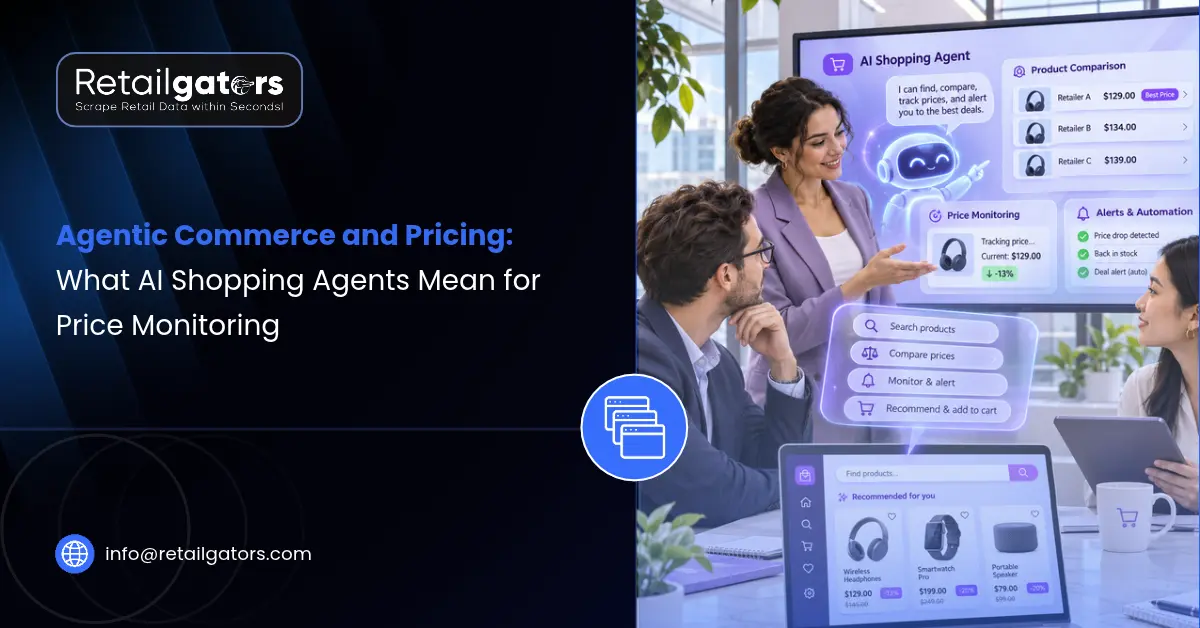
Online shopping is entering a new phase where AI agents can do more than recommend products. They can compare prices, check product availability, evaluate delivery options, and, in supported environments, complete purchases on behalf of consumers. This shift is changing how retailers compete for visibility and customer decisions.
Agentic commerce pricing refers to how product prices, discounts, shipping costs, and other purchase conditions are evaluated during these AI-driven shopping journeys. Unlike traditional shoppers, AI agents can compare multiple sellers using structured product information and predefined preferences. This makes accurate pricing data and frequent updates increasingly important.
For e-commerce businesses, the challenge goes beyond tracking competitor prices. Retailers also need to ensure their product information is consistent, accessible, and competitive across digital channels. This guide explores how AI shopping agents are changing price monitoring and what retailers can do to prepare.
What Is Agentic Commerce and How Does Pricing Fit Into It?
Agentic commerce is a form of digital commerce in which AI agents perform shopping-related tasks on behalf of consumers. Based on a shopper’s requirements, budget, and preferences, an agent can discover products, compare prices across retailers, evaluate reviews, check delivery options, and, where supported, initiate or complete a purchase.
Pricing plays an important role in this process. AI agents evaluate more than the displayed product price. They may also consider shipping charges, discounts, stock availability, seller reliability, and return policies when identifying suitable offers. For retailers, agentic commerce pricing means making these details accurate, competitive, and accessible so AI-powered shopping systems can evaluate their products correctly.
Traditional ecommerce relies heavily on how consumers interact with product pages, advertisements, and brand messaging. AI shopping agents introduce another layer to this journey by extracting and comparing product information across multiple sources. While brand reputation and customer reviews can still influence recommendations, incomplete product details, outdated prices, or unclear purchase conditions can affect how an offer is evaluated.
Retailers therefore need to focus on both pricing competitiveness and product data quality. Monitoring competitor prices helps businesses understand market movements, while accurate product feeds ensure their own offers remain consistent across digital shopping channels.
Why Are AI Shopping Agents Changing Ecommerce Price Monitoring?
AI shopping agents are changing how consumers discover and compare products. Instead of manually visiting several ecommerce websites, shoppers can delegate product research and comparison tasks to AI-powered tools. This creates a new challenge for retailers: their offers need to remain competitive and accurately represented across the digital sources these agents use.
Here are five ways this shift affects ecommerce price monitoring:
1. Faster competitor price comparisons
AI agents can evaluate product offers from multiple retailers during a single shopping session. Retailers need frequent competitor price updates to identify changes in market positioning, promotional activity, and pricing gaps.
2. Greater importance of total purchase cost
The lowest displayed price does not always represent the best deal. Shipping charges, taxes, discounts, delivery estimates, and additional fees can influence which offer an agent considers suitable. Retailers should monitor these components alongside product prices.
3. Better product data becomes essential
Incomplete specifications, inconsistent product identifiers, and outdated availability information can make it harder for shopping systems to evaluate an offer. Maintaining accurate product feeds and structured information helps reduce these inconsistencies.
4. Promotions need clearer conditions
AI agents may compare promotional prices with standard prices, coupon requirements, membership conditions, and minimum-order thresholds. Retailers need to make discount eligibility and validity periods clear.
5. Pricing decisions require continuous monitoring
Frequent competitor price changes can create opportunities for retailers to adjust their offers. Automated price monitoring helps pricing teams identify these changes and respond using predefined business rules rather than relying entirely on manual checks.
How Does Agentic Price Monitoring Differ From the Traditional Approach?
The gap between old and new price monitoring is wide, and the table below makes it concrete. Traditional monitoring was built for human buyers who shop slowly. Agentic monitoring has to serve machine buyers who decide in milliseconds.
| Factor | Traditional Price Monitoring | Agentic-Era Price Monitoring |
| Who reads the price | Human shoppers comparing a few tabs | AI shopping agents parsing data feeds |
| Refresh speed | Daily or weekly manual checks | Near real-time, updated within minutes |
| Data format | Web pages designed for people | Machine-readable pricing data and APIs |
| Deciding factors | Brand, design, promotions | Price, reviews, shipping, availability |
| Competitor coverage | A handful of key rivals | Dozens of retailers tracked at once |
| Risk of being skipped | Low; shoppers still see your store | High; agents drop listings they cannot read |
The lesson from the comparison is that speed and format now matter as much as the price itself. A competitive number that an agent cannot read cleanly may as well not exist.
How to Prepare Machine-Readable Product and Pricing Data for AI Shopping Agents?
AI shopping agents need reliable product information to compare offers and identify suitable purchases. Retailers should therefore ensure that their pricing and product data is structured, consistent, and accessible through supported digital channels.
Preparing this information involves more than publishing a price on a product page. Businesses need to maintain accurate product attributes, availability details, promotional conditions, and seller information across their ecommerce systems.
1. Maintain structured product information
Product names, brand details, GTINs, SKUs, variants, prices, currency, and availability should be organized consistently. Retailers can use Schema.org Product and Offer structured data to describe relevant information on their product pages.
2. Keep product feeds and website information consistent
The price displayed on a product page should match the information provided through product feeds and connected commerce systems. Inconsistent pricing can create confusion for both consumers and automated shopping systems.
3. Provide accurate stock and availability information
A product listed as available when it is actually out of stock creates a poor shopping experience. Regular inventory synchronization helps ensure that product availability reflects actual selling conditions.
4. Make shipping and discount conditions transparent
Shipping charges, delivery estimates, coupon requirements, membership discounts, and return conditions should be clearly documented. This allows shopping systems to evaluate the actual purchase offer rather than relying only on the displayed price.
5. Establish frequent data refresh cycles
Competitor prices, product availability, and promotional offers can change throughout the day. Retailers should establish refresh schedules based on product category, competitor activity, and pricing volatility.
6. Validate data quality regularly
Automated checks should identify missing product attributes, incorrect currency values, duplicate listings, outdated prices, and mismatched product variants. These checks help prevent unreliable information from reaching pricing dashboards and downstream systems.
What Do the Numbers Say About AI Shopping Adoption?
The trend is not a forecast anymore; it is already visible in consumer behavior. A few figures put the scale into perspective:
- 6% of U.S. consumers used AI to help with shopping in the past six months, and 43.21% use it at least weekly, per research reported by Search Engine Land and TechWyse.
- 55% of AI shoppers rely on these tools to find the best price or deal, while 5% use them for product research, which shows that price comparison sits at the core of the behavior.
- Agentic shopping adoption is projected to climb from 19% to 46% of consumers by the end of 2026, according to data tied to Visa’s Trusted Agent Protocol work.
- Analysts place agent-influenced spend at 10% to 20% of U.S. e-commerce by 2030, a share too large for most retailers to ignore.
One more signal is worth noting for retailers weighing where to invest. Price-drop alerts rank as the single most requested AI shopping feature, cited by 54% of consumers in Clutch’s research, which tells you exactly how closely buyers and their agents are watching your numbers.
How RetailGators Helps Retailers Strengthen Price Monitoring for AI-Driven Commerce?
Preparing for AI shopping agents as retailers is partly a data problem and partly a visibility problem, and both start with knowing where your prices stand against the market in real time. That is the gap a dedicated data partner fills. At RetailGators, we help brands and sellers collect accurate, structured competitor pricing at scale, so your team can react to market moves while they are still happening rather than a day later.
Our web scraping and price monitoring solutions pull product, price, stock, and promotion data across marketplaces and competitor sites, then deliver it in clean, machine-readable formats your pricing engine can act on. That same structured output supports better AI agents price comparison results, because the data you publish stays consistent with the data you track. If you want to see how continuous tracking fits your catalog, explore our competitor price monitoring services to get started. The goal is straightforward: keep your offers readable, current, and competitive for every buyer, whether that buyer is a person or a machine.
Conclusion
Agentic commerce is changing how consumers discover, compare, and evaluate products online. As AI shopping tools become more involved in product research and purchasing decisions, retailers need to pay closer attention to pricing accuracy, product information, and competitor activity.
However, preparing for this shift does not mean abandoning traditional price monitoring. It means strengthening existing processes with more frequent data updates, accurate product matching, and reliable pricing information. Retailers that understand competitor movements and maintain consistent product data will be better positioned to respond to changing shopping behavior.
With automated competitor price tracking and ecommerce data collection, businesses can make more informed pricing decisions. RetailGators helps retailers turn market data into actionable pricing insights as ecommerce continues to evolve.