A shopper used to start with a search bar. Increasingly, they start with a question typed into an AI assistant — “find me a waterproof jacket under $150 with good reviews” — and the assistant answers by pulling from product data it can actually parse. If your catalog isn’t structured in a way these systems can read, your products simply don’t show up in the answer, no matter how good the product actually is. That’s the quiet shift happening across ecommerce right now, and it’s forcing a conversation that used to be a nice-to-have — clean, structured product data — into something closer to a prerequisite for staying visible at all.
The problem isn’t that brands lack product information. Most catalogs have titles, descriptions, prices, and images in abundance. The problem is that a lot of that information was written for a human scanning a page, not for a language model trying to extract a precise answer from unstructured text. AI shopping tools need data they can confidently parse, compare, and cite — and that’s a different bar than “looks fine on the website.”
What Does “AI Ready” Actually Mean for Product Data?
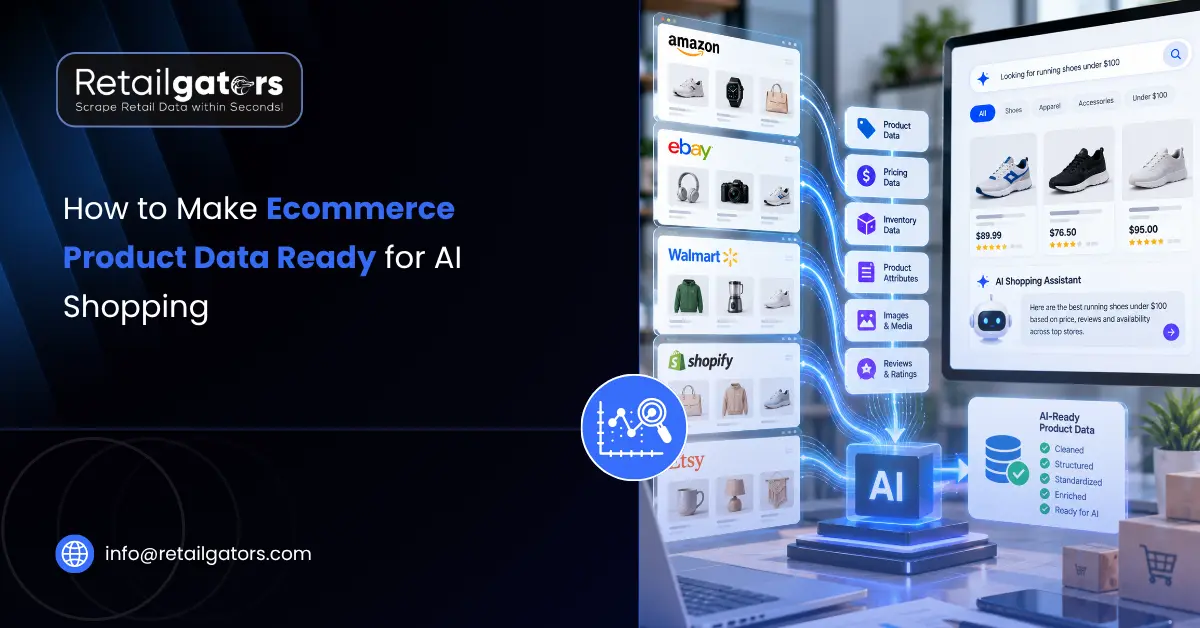
AI ready product data is information that’s structured, consistent, and complete enough for an AI system — whether that’s a shopping assistant, a search engine’s AI overview, or a recommendation model — to understand a product without needing to guess. It’s less about adding new information and more about making existing information machine-readable.
Think about the difference between a product title like “Nike Men’s Air Zoom Pegasus 41 Running Shoe — Black/White, Size 10” and one that reads “Great running shoe!! BUY NOW.” The first gives a model concrete attributes it can match against a query. The second gives it almost nothing to work with. Multiply that gap across a catalog of ten thousand SKUs, and the difference between an AI-ready catalog and a messy one becomes the difference between showing up in AI-driven shopping results and not.
This is also where the distinction between human-facing and machine-facing data starts to matter. A page can look polished to a shopper while still being effectively invisible to an AI system, if the underlying markup, attributes, and structured fields behind that page are missing or inconsistent.
Why Ecommerce Product Data Often Isn’t AI Ready
Most ecommerce product data accumulates over years, through multiple systems, multiple vendors, and multiple people entering information slightly differently each time. That history is exactly what makes AI readiness hard to achieve without a deliberate cleanup effort.
Inconsistent attribute naming is one of the most common culprits. One SKU lists “color: Navy,” another lists “colour: Dark Blue,” and a third skips the field entirely. A human scanning the page fills in the gap intuitively. A model trying to match a query like “navy blue jacket” against structured fields has no such intuition — it either finds a match or it doesn’t.
Thin or duplicated descriptions cause similar problems. Many catalogs, especially larger ones, rely on manufacturer-supplied copy that’s identical across competing retailers. When every seller’s description reads the same, an AI system has no distinguishing signal to work with beyond price — which flattens product differentiation into a price race that few brands actually want to be in.
Missing structured markup is another gap worth calling out specifically. Even when a product page has good descriptive content, if that content isn’t exposed through structured data formats (schema markup, product feeds, consistent field naming), AI crawlers and shopping agents may not extract it correctly, or at all. The information exists; it’s just not in a form the system can reliably use.
Core Elements of Structured Product Data AI Systems Need
A handful of data elements tend to matter most when it comes to AI product visibility, and it’s worth being specific about what they are rather than treating “better data” as a vague goal.
Consistent, descriptive titles that include the attributes a shopper would actually search for — brand, product type, key specification, size or variant — rather than marketing language that doesn’t map to a real query.
Structured attributes broken into discrete fields (color, size, material, dimensions, compatibility) rather than buried inside a paragraph of prose. A model can match a field far more reliably than it can infer one from unstructured text.
Accurate pricing and availability, kept current. AI shopping tools that surface outdated prices or out-of-stock items erode trust fast, both for the shopper and for the retailer whose data was wrong.
Specifications and compatibility details, especially for categories where fit or compatibility actually determines a purchase decision — electronics, auto parts, appliances. This is where thin data causes the most friction, since a vague spec sheet leaves an AI system unable to confidently confirm fit.
Reviews and ratings, structured in a way that’s attributable to the specific product rather than aggregated at a brand or category level. Sentiment signals are increasingly part of how AI shopping tools rank and recommend, which makes product intelligence around review data a meaningful part of readiness, not an afterthought.
Unique, accurate descriptions that go beyond manufacturer boilerplate — even a few sentences of genuinely differentiated copy can be the difference between a product a model treats as distinct and one it treats as interchangeable with a dozen competitors.
How AI Shopping Is Changing Product Visibility
The mechanics of product discovery are shifting in a way that’s worth naming directly. Traditional SEO optimized for ranking on a results page a human would scroll through. AI product visibility optimizes for being the answer a model actually surfaces, cites, or recommends — a narrower and, in some ways, more demanding target.
This changes what “ranking well” means in practice. A product can sit on page one of a traditional search result and still be skipped entirely by an AI shopping assistant if its underlying data doesn’t give the model enough structured confidence to recommend it. Visibility is no longer just about keywords and backlinks — it’s about whether the data behind the page is legible to a system that’s summarizing, comparing, and filtering on the shopper’s behalf.
It also changes the stakes of data accuracy. A ranking algorithm might tolerate a slightly outdated price for a day or two. An AI shopping assistant recommending a product at the wrong price, or suggesting an item that’s actually out of stock, creates an immediate, visible failure that reflects poorly on both the retailer and the platform surfacing the recommendation. That raises the bar on how current structured product data needs to stay, not just how complete it is.
Product Data Optimization: Step-by-Step Approach
Getting a catalog to AI-ready status is rarely a single project with a clean end date — it’s closer to an ongoing discipline. Still, most product data optimization efforts follow a similar sequence.
The first step is an audit: understanding what data actually exists across the catalog today, where it’s inconsistent, and where it’s missing entirely. This is harder than it sounds for catalogs built up over years across multiple systems, which is why structured ecommerce product data analysis at this stage tends to save significant rework later.
From there, standardization is the next priority — establishing consistent naming conventions for attributes, consolidating duplicate or near-duplicate fields, and making sure the same product characteristic is described the same way across the entire catalog rather than varying SKU by SKU.
Enrichment follows standardization. This is where thin descriptions get expanded, missing specifications get filled in, and structured markup gets added where it’s absent. It’s also where a lot of businesses realize how much of their “complete” catalog was actually relying on gaps a human shopper happened to tolerate.
Validation and ongoing monitoring close the loop. AI readiness isn’t a fixed state — prices change, stock levels shift, and new products get added continuously, so a catalog that was AI ready at launch can quietly drift out of readiness within weeks if nothing is tracking the data over time.
Common Mistakes That Keep Product Data From Being AI Ready
A few recurring issues show up across almost every catalog audit, regardless of category or business size.
Treating product data as a one-time project is probably the most common. A catalog gets cleaned up ahead of a big launch or a platform migration, then drifts for the next two years as new SKUs get added with inconsistent formatting, undoing much of the original effort.
Optimizing only for human readability is another frequent miss. A description that reads beautifully to a shopper but buries key attributes inside flowing prose, rather than exposing them as structured fields, looks fine on the page while remaining largely opaque to a model trying to extract specific facts from it.
Ignoring structured markup entirely is a gap that’s easy to overlook because it doesn’t show up anywhere a human would notice. The product page looks complete; the schema behind it is thin or missing, which is exactly the layer AI systems often rely on most.
And finally, letting pricing and availability data go stale is a mistake that compounds specifically in an AI shopping context, since these tools often act as a direct intermediary between the shopper and the purchase decision — a wrong answer here isn’t just a minor inconvenience, it’s a broken recommendation.
How RetailGators Supports AI-Ready Product Data
Getting from a messy, inconsistent catalog to one that’s genuinely AI ready is largely a data problem — one of collection, structuring, and ongoing maintenance at a scale that’s hard to manage manually once a catalog passes a few hundred SKUs.
RetailGators works with ecommerce businesses on exactly that layer. Product data scraping and structuring services help normalize titles, attributes, specifications, and descriptions across large catalogs, converting inconsistent or incomplete records into a consistent structured format. For businesses monitoring how their products appear relative to competitors across marketplaces and retail sites, digital shelf analytics provides ongoing visibility into pricing, content, and availability gaps that could be undermining AI visibility without anyone noticing.
RetailGators also supports the data layer behind AI and machine learning use cases more directly, through AI-focused web scraping services that collect and structure data at the scale AI pipelines require, and through AI training dataset services for businesses building their own models around product or market data rather than relying solely on third-party AI shopping platforms.
As with any data initiative, the right starting point is usually a sample review — seeing what a structured version of a specific category or product set actually looks like before committing to a full catalog overhaul. Businesses working through what AI-ready product data means for their own catalog can talk through the requirements directly with RetailGators and scope an approach that matches their current data maturity.
Conclusion
AI shopping tools don’t reward the catalog with the most marketing polish — they reward the catalog with the clearest, most structured, most current data. That’s a meaningful shift from traditional ecommerce visibility, where a well-written page could carry a product a long way even with some underlying data gaps. In an AI-driven discovery environment, those gaps are no longer invisible; they’re the reason a product gets left out of the answer entirely.
Getting there isn’t about rewriting a catalog overnight. It’s about treating structured, accurate, consistently formatted product data as infrastructure — something that gets audited, standardized, enriched, and maintained on an ongoing basis, rather than fixed once and left alone. Businesses that start treating product data this way now are simply going to be easier for AI shopping systems to find, trust, and recommend than those that don’t.
If your catalog still has the gaps that keep it out of AI-driven shopping results, RetailGators can help map out what getting it AI ready would actually involve.