Introduction
A retailer may notice that the same product sells at different prices on Amazon and Walmart, appears with different availability levels, has different sellers, and receives different customer responses. These marketplace differences create valuable signals for brands, sellers, and ecommerce teams.
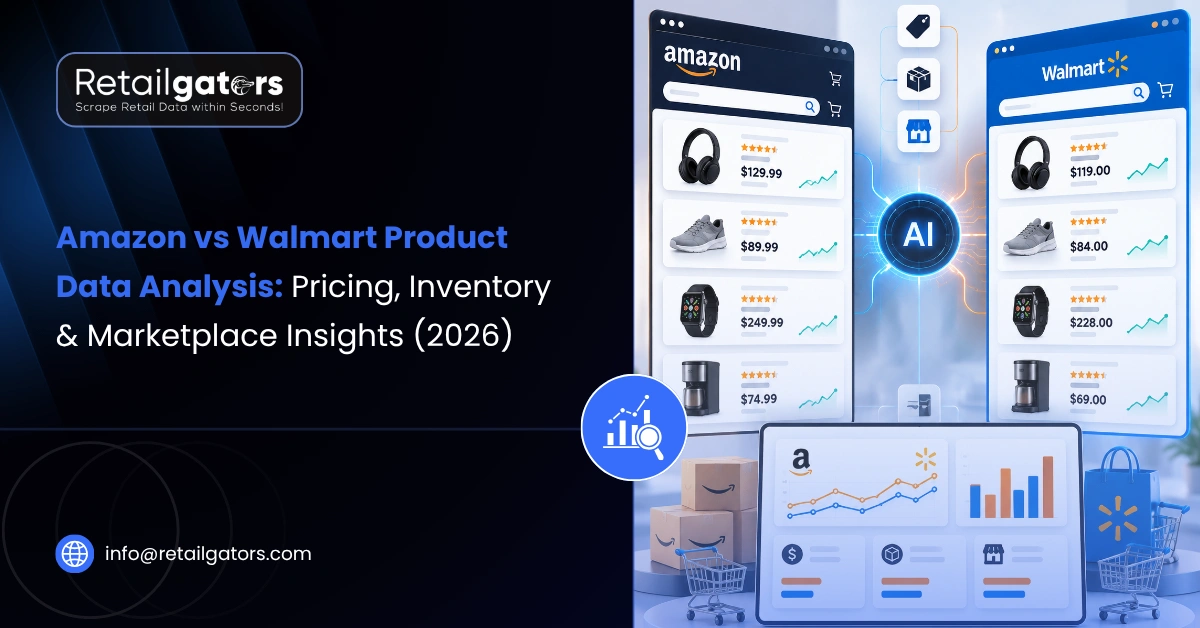
Amazon and Walmart product data helps businesses understand pricing movements, inventory conditions, product assortment, reviews, promotions, and competitive behavior. Comparing Amazon and Walmart marketplaces in 2026 requires more than checking prices. Businesses need to analyze multiple data points together to understand market opportunities and customer demand.
Why Compare Amazon and Walmart Product Data?
Brands, retailers, sellers, and market researchers compare both marketplaces because each platform provides different insights. Differences in pricing, assortment, sellers, availability, promotions, and reviews help businesses understand competitor strategies and customer behavior.
Amazon vs Walmart Product Data: What Should Businesses Track?
Businesses should collect and compare product information, pricing details, inventory status, seller activity, reviews, ratings, and promotional activity to build accurate marketplace intelligence.
Product and Catalog Data
Product names, SKUs, ASINs, item IDs, categories, brands, specifications, variants, and attributes help businesses match products accurately across marketplaces.
Pricing and Discounts
Product pricing analysis requires more than comparing displayed prices. Businesses review list price, current price, sale price, coupons, discounts, promotions, and historical changes.
Inventory and Availability
Tracking stock status helps businesses understand product availability, demand changes, and competitor opportunities.
Reviews and Ratings
Review volume, rating changes, and customer feedback help evaluate product perception and competitive positioning.
Amazon Price Monitoring vs Walmart Pricing
Amazon price monitoring helps businesses track frequent price changes, seller competition, discounts, promotions, and unusual price movements. Walmart pricing analysis provides additional marketplace visibility because retail and marketplace sellers follow different pricing patterns.
Understanding Walmart Product Data
Walmart product data reveals information about product listings, prices, availability, sellers, promotions, and assortment. It should not be treated as identical to Amazon data because marketplace structures differ.
Amazon vs Walmart Product Data Comparison
Data Point | Amazon | Walmart | Business Value |
| Product Assortment | Large marketplace with broad seller participation and extensive categories | Diverse retail and marketplace catalog | Helps identify assortment gaps and expansion opportunities |
| Pricing | Frequent seller-driven changes, dynamic pricing, coupons, and competitive adjustments | Retail and marketplace pricing variations with promotions | Supports pricing strategy and competitor analysis |
| Inventory | Availability depends on sellers, fulfillment models, and demand changes | Retail and marketplace stock visibility | Helps monitor supply conditions |
| Sellers | Multiple third-party sellers compete on many products | Walmart retail listings plus marketplace sellers | Shows seller competition and marketplace pressure |
| Reviews | High review volume across many categories | Growing customer feedback ecosystem | Measures customer perception and product quality |
| Ratings | Large customer interaction signals | Ratings reflect customer experience | Helps compare product acceptance |
| Promotions | Lightning deals, coupons, and seller promotions | Rollbacks and promotional offers | Reveals promotion patterns |
| Product Availability | Influenced by sellers and fulfillment | Influenced by Walmart inventory and sellers | Identifies availability opportunities |
| Competitive Positioning | High seller competition across categories | Retail strength combined with marketplace sellers | Shows marketplace-specific positioning |
Comparing both marketplaces provides more context than reviewing a single platform. A product may have stronger visibility on Amazon but better availability or pricing conditions on Walmart. These differences help businesses make better decisions around competitive positioning.
How This Data Supports Ecommerce Competitor Analysis
Ecommerce competitor analysis becomes more useful when businesses compare marketplace data instead of reviewing one platform alone. Companies can identify pricing gaps, assortment opportunities, availability issues, promotion patterns, and competitor strategies.
Using Marketplace Intelligence for Better Decisions
Marketplace intelligence turns collected product information into actionable insights. Businesses can use it for pricing strategy, assortment planning, promotion analysis, inventory planning, market research, and retail decisions.
Why Automated Product Data Collection Matters in 2026
Manual tracking becomes difficult with thousands of products, frequent price changes, multiple sellers, changing inventory, and regular promotions. Automated collection helps maintain updated marketplace records.
Key Insights Businesses Can Get from Amazon vs Walmart Data
Comparing marketplace data over time can reveal pricing differences, inventory gaps, competitor promotions, assortment strengths, and customer feedback patterns.
Challenges in Amazon and Walmart Product Data Analysis
Challenges include large datasets, product matching, different IDs, variants, changing prices, seller differences, and maintaining historical records.
What Businesses Should Focus on in 2026
Businesses should focus on continuous price tracking, inventory visibility, competitor monitoring, assortment analysis, promotions, historical data, and actionable analytics.
Conclusion
Amazon vs Walmart Product Data becomes valuable when businesses analyze pricing, inventory, assortment, sellers, promotions, reviews, and marketplace behavior together. Combining marketplace intelligence with product pricing analysis helps companies make informed ecommerce decisions.