Introduction
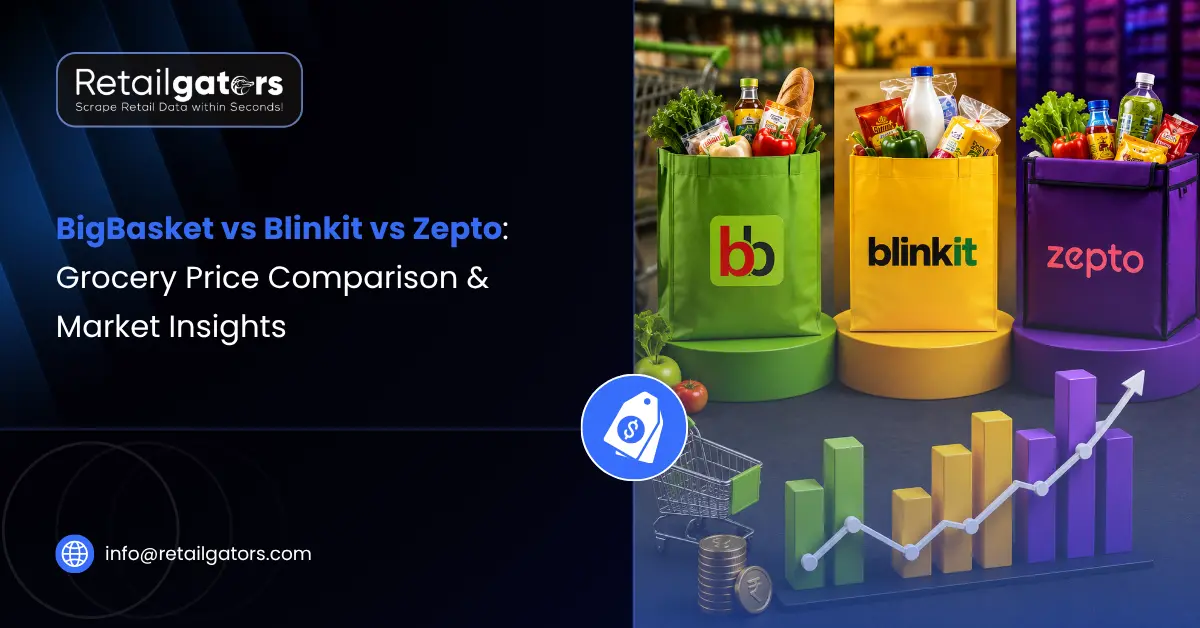
The same grocery basket can cost different amounts depending on where you shop. Across India’s quick commerce market, products such as milk, atta, vegetables, rice, and cooking oil may carry different prices on BigBasket, Blinkit, and Zepto. This makes grocery price comparison useful not only for shoppers but also for retailers, brands, and market analysts tracking competitive pricing.
This blog examines how BigBasket product pricing, Zepto pricing, and Blinkit pricing vary across grocery categories and what these differences reveal about quick commerce pricing. It also explores the factors behind price changes, including promotions, inventory, demand, and location. Along with product- and category-level comparisons, the analysis explains how businesses can use grocery market intelligence to monitor competitors, improve pricing decisions, and identify changing market opportunities.
Why Do Grocery Prices Differ Across BigBasket, Blinkit, and Zepto?
The same grocery product can have different prices across quick commerce platforms because pricing depends on factors such as location, inventory, promotions, and demand. Real datasets tell a different story. When identical products are lined up side by side, small differences appear, and those small differences add up fast across a full cart.
Several forces drive this variation:
- Fulfillment and inventory costs: Warehouse location, stock levels, and replenishment patterns can influence product availability and pricing.
- Inventory turnover on fresh produce, where tomatoes and leafy greens shift often with supply
- Promotional structures, because some platforms cut the sticker price while others lean on wallet credits and coupons
- Location-based sourcing, as the same SKU may be priced by city, warehouse, and delivery zone
Price variation differs by category. Branded packaged products may be affected by promotions, while fresh produce can change with supply, demand, seasonality, and local inventory. Fresh categories react to season and stock, while branded items respond to brand-led campaigns. Here is a sample basket that illustrates the pattern:
| Product | BigBasket Price (₹) | Zepto Price (₹) | Blinkit Price (₹) |
| Amul Milk 1L | 68 | 70 | 69 |
| Tomatoes 1kg | 32 | 28 | 35 |
| Basmati Rice 5kg | 420 | 445 | 435 |
| Eggs (12 pack) | 78 | 82 | 80 |
| Cooking Oil 1L | 145 | 152 | 148 |
No single platform wins every row. That is the core insight of any honest grocery price comparison: price leadership shifts by product, not by brand loyalty.
How Do Competitive Strategies Shape Quick Commerce Pricing?
The race for instant grocery delivery has pushed these platforms into constant price adjustment. Competition in India’s quick commerce market has increased the importance of pricing, promotions, assortment, and delivery speed. Prices are not fixed for the day; they move with demand, stock levels, and flash campaigns.
Because quick commerce prices can change with promotions, inventory, demand, and location, repeated price observations are more useful than a single daily snapshot . Demand spikes during evenings and weekends push prices in one direction, while surplus stock pulls them the other way. This is where quick commerce pricing becomes genuinely dynamic rather than static.
Category leadership tells the real story. One platform may undercut on vegetables while another dominates packaged snacks. The table below shows how that plays out at the category level:
| Category | BigBasket Avg (₹) | Zepto Avg (₹) | Blinkit Avg (₹) | Price Leader |
| Fruits | 120 | 110 | 118 | Zepto |
| Vegetables | 95 | 88 | 92 | Zepto |
| Packaged Foods | 210 | 225 | 215 | BigBasket |
| Dairy | 88 | 92 | 90 | BigBasket |
Industry fact: India’s quick commerce market has grown into a multi-billion-dollar segment, with instant grocery delivery expanding faster than traditional online grocery. That growth is exactly what fuels the aggressive discounting behind these numbers.
The cheapest platform can also change depending on basket composition. A platform that offers lower prices on vegetables may not have the lowest total basket cost once packaged foods, dairy, delivery charges, and promotions are included. A shopper optimizing for savings would need to split orders across apps, which is impractical for most people but perfectly practical for a business monitoring the data at scale.
How to Track Grocery Price Changes Across Quick Commerce Platforms?
Manually tracking prices across multiple quick commerce platforms becomes difficult as the number of products, locations, and observations increases. RetailGators supports this kind of high-frequency monitoring. Businesses gather thousands of SKUs at once, then study the patterns those numbers reveal.
A solid monitoring setup typically captures the following:
- Product listings with current and historical price points
- Discount structures, including coupons, bundles, and membership deals
- Stock availability and out-of-stock frequency by location
- Delivery fees and any surge charges applied during peak hours
With Blinkit price monitoring feeding into a wider dataset, analysts can pinpoint which platform leads in a given category and detect sudden market shifts within hours. Statistical modeling then separates a genuine price cut from a short-lived flash sale. The value of proper grocery market intelligence lies in that separation: knowing what is a real trend versus temporary noise.
Promotional campaigns deserve special attention, since they distort the picture more than most people expect:
| Campaign Type | Typical Discount |
| App Flash Sale | 10–18% |
| Membership Deals | 5–12% |
| Bundle Offers | 8–20% |
Continuous tracking of these signals gives brands a clear view of competitive movement, and that view is only reliable when the data collection runs constantly rather than in occasional snapshots. Retailers can also automate this type of monitoring through quick commerce data collection, which are built for exactly this scale of tracking.
What Business Value Comes From Grocery Price Comparison Data?
Insights only matter when they change a decision. For retailers, brands, and analysts, a well-run grocery price comparison program directly shapes pricing, stocking, and promotion strategy.
The practical benefits look like this:
- Sharper pricing decisions, because competitor tags are visible in near real time
- Better promotion timing, since flash-sale patterns become predictable over weeks
- Stronger assortment planning, as gaps in a competitor’s catalog reveal open opportunities
- Reduced margin leakage, because underpriced and overpriced SKUs surface quickly
Strong grocery market intelligence also supports dynamic pricing, where prices adjust automatically based on live competitor movement. That capability separates reactive sellers from proactive ones. A retailer with fresh data can respond within the same day, while one relying on gut feel responds a week late, if at all.
Businesses that need closer tracking across grocery platforms can use RetailGators’ Grocery & Supermarket Data Scraping. Paired with its Price Monitoring Services, the scattered price points across apps become a single, usable dataset rather than a pile of disconnected numbers.
Conclusion
Grocery prices across BigBasket, Blinkit, and Zepto can vary by product, category, location, inventory, and promotional activity. As a result, there is no single platform that consistently offers the lowest price across an entire grocery basket. A meaningful grocery price comparison therefore needs to look beyond individual product prices and consider discounts, availability, delivery costs, and changes over time.
For retailers, FMCG brands, and market analysts, this data provides a broader view of competitive positioning. Continuous monitoring can help identify pricing gaps, track promotions, understand category trends, and support better assortment and pricing decisions. As India’s quick commerce market continues to evolve, timely grocery market intelligence can help businesses respond to competitive changes with greater confidence and make decisions based on current market data rather than assumptions.