Introduction
The retail market moves quickly, and keeping up with changing product prices, inventory levels, and customer preferences has become a constant challenge for brands and retailers. That’s why businesses increasingly scrape Target product data to gain real-time insights that support smarter pricing, inventory planning, and competitive decision-making. Product prices can change multiple times a day, popular items often sell out within hours, and customer reviews can significantly influence buying behavior. Manually tracking these changes is both time-consuming and inefficient.
Target product data scraping automates the collection of valuable information such as pricing, stock availability, product descriptions, ratings, and reviews, helping businesses build stronger retail intelligence strategies. Whether your goal is Target price monitoring, competitor analysis, or demand forecasting, access to accurate and up-to-date product data provides a clear competitive advantage.
In this blog, you will learn what product data can be collected from Target.com, why businesses invest in Target product data scraping, the common challenges involved, and how automated data extraction supports better business decisions in 2026.
What Does It Mean to Scrape Target Product Data?
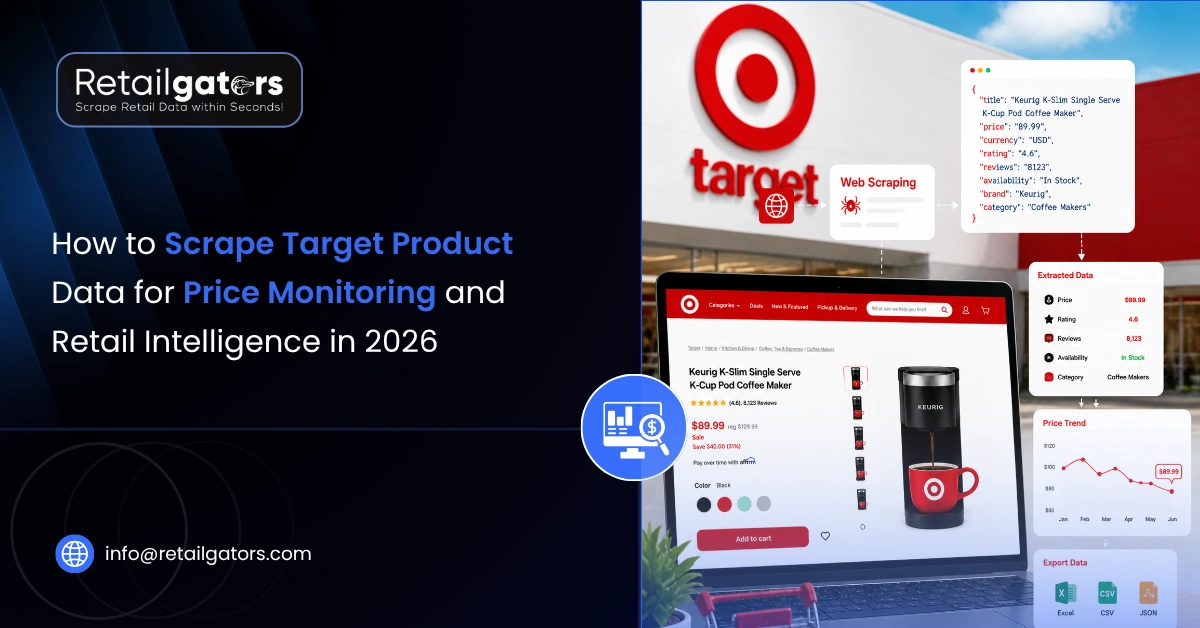
Target product data scraping is the automated process of collecting publicly available product information from Target.com and converting it into structured datasets that businesses can easily analyze. Instead of manually copying information from individual product pages, automated web scraping tools extract key details such as product titles, prices, stock availability, ratings, reviews, descriptions, SKUs, and promotional offers, then organize the data into formats like CSV, JSON, or databases for further analysis.
The biggest advantage of scraping Target product data is speed and scalability. While manual tracking can only cover a limited number of products, automated solutions monitor thousands of SKUs simultaneously and update data on scheduled intervals. This enables businesses to perform accurate Target price monitoring, monitor inventory trends, evaluate competitor strategies, and improve retail planning with real-time insights.
Today, Target product data scraping goes far beyond collecting prices alone. By combining pricing, inventory, customer reviews, product attributes, and promotional information, businesses gain comprehensive retail intelligence that supports smarter pricing decisions, demand forecasting, assortment planning, and overall competitive growth
What Product Data Can You Collect From Target.com?
Target pages hold a surprising amount of useful detail. Before you launch a project, it pays to know which fields actually earn their place. Every field brings its own angle. Price by itself answers one question. Price, alongside stock status and reviews, tells a fuller story about demand, value, and trust. That is exactly why serious teams cast a wide net instead of chasing a single figure.
| Product URL
| UPC | GTIN
| Seller Information
| Shipping Cost
|
| Stock status | Ratings and star scores | Review text and dates | Brand and category tags | Product images and SKUs |
| Customer Questions
| Availability by ZIP Code
| Product title and description | Target product price data | Promotional badges |
| Delivery Availability
| Pickup Availability
| Discount Percentage | Product Variants | Bundle Offers |
Why Do Retailers and Brands Monitor Target Product Prices?
Every scraping project rests on a real business reason. Nobody collects data just to have it. They collect it to make calls that guard margins and lift sales. Target price monitoring serves a handful of clear goals at the same time.
For one, it keeps your pricing sharp. Knowing what Target charges lets you set your own number with a steady hand. Price too high and the sale walks away. Price too low and the profit does. Hitting that middle ground is what smart retail is really about.
It also shields a brand’s reputation. Plenty of brands sell across several channels, and mismatched prices leave shoppers confused. By keeping an eye on Target product price data, a brand can flag broken pricing agreements and step in fast. That keeps the market honest and the brand image intact.
On top of that, it fuels demand forecasting. Pair price trends with Target inventory tracking, and you begin to see which products fly off the shelf and which ones linger. That read shapes your own stock planning and the timing of your promotions.
Here are the main reasons at a glance:
- Stay price competitive against a major national retailer.
- Protect brand pricing rules across sales channels.
- Sharpen demand forecasts with real market signals.
- Get the jump on new product launches and category changes.
- Time promotions with evidence instead of hunches.
Ready to put these price signals to work? RetailGators builds custom Target price monitoring feeds that land in your dashboard on the schedule you choose. Talk to our team and start tracking the data that moves your margins.
How Can Businesses Scrape Target Product Data for Price Monitoring in 2026?
The work moves along a clear path, from planning through to reporting. The tools have grown sharper over the years, yet the core steps have held steady and stayed easy to grasp. A tidy workflow keeps your data honest and frees your team to weigh decisions rather than push buttons.
A simple step-by-step approach:
- Define your product list. Pin down the SKUs, brands, or categories you care about.
- Set your data fields. Decide which details matter, from price through reviews.
- Build or hire a scraper. Run a custom system or lean on a data service partner.
- Schedule the runs. Choose how often to refresh, whether hourly or daily.
- Clean & Store Data. Remove duplicates & Format output for easy use.
- Analyze and report. Shape the dataset into dashboards, alerts, and insights.
A lot of companies hand this work to a managed service. A dedicated partner carries the technical load, keeps the scrapers running, and ships data that is ready to use. That route saves hours and trims risk, especially on days when Target reworks its site design. For teams that want dependable Target product data scraping without the upkeep, a professional agency usually makes the most sense.
Comparison Table: In-House Scraping vs. Managed Data Service
The table below lines up the two main approaches side by side. Use it to pick the path that suits your budget, your team, and your goals.
| Factor | In-House Scraping | Managed Data Service |
| Setup speed | Slow, needs engineers | Fast, ready to deliver |
| Maintenance | Your team handles it | Handled by the provider |
| Cost over time | High and variable | Predictable and clear |
| Scale ability | Limited by resources | Built for large volume |
| Data quality | Depends on your skill | Cleaned and validated |
| Best for | Tech-heavy firms | Most brands and retailers |
For the majority of businesses, a managed service is the quickest way to dependable Target product price data. It lifts the technical weight and lets your team stay on strategy.
How RetailGators Supports Your Target Data Goals
At RetailGators, we help brands and retailers turn Target data into a real edge. We build and maintain reliable scrapers, provide clean datasets and are quick to adapt when the site changes. Whether it is Target price monitoring, Target product reviews scraping, or Target inventory tracking, we adapt the solution to your requirements.
Accuracy, speed, and simple delivery sit at the heart of what we do. You get data in the format you want, on the schedule you set, ready to drop into your dashboards. That leaves your team free to spend its hours on strategy rather than technical upkeep.
Turn Target product data into actionable retail intelligence with automated price monitoring, inventory tracking, and competitor insights. Contact RetailGators to build a customized data solution that supports smarter pricing and faster business decisions.
Conclusion
Retail in 2026 rewards speed, accuracy, and a clear read on the market. When you scrape Target product data, you earn the visibility to price with confidence, forecast demand, and guard your brand. From Target price monitoring through Target product reviews scraping, every data point feeds real value into your strategy.
The wisest move is to team up with a partner who knows the ground. RetailGators brings the tools, the track record, and the steady care that dependable data calls for. If you are ready to turn Target data into a lasting edge, visit RetailGators and let our team build the solution that fits your goals.
Get started with RetailGators today. Whether you need Target product data scraping, Target inventory tracking, or full Target product reviews scraping, we deliver clean, ready-to-use data built around your goals. Request a free quote and see the difference accurate data makes.