Introduction
Today, it is essential to understand how your customers perceive your brand in the digital world. Consumers share their opinions on review sites, social media platforms, forums, and e-commerce websites. It creates a collection of views that, when properly gathered and analyzed, can provide valuable insights. These insights can inform marketing strategies, product development, and customer retention efforts, ultimately enhancing overall business performance.
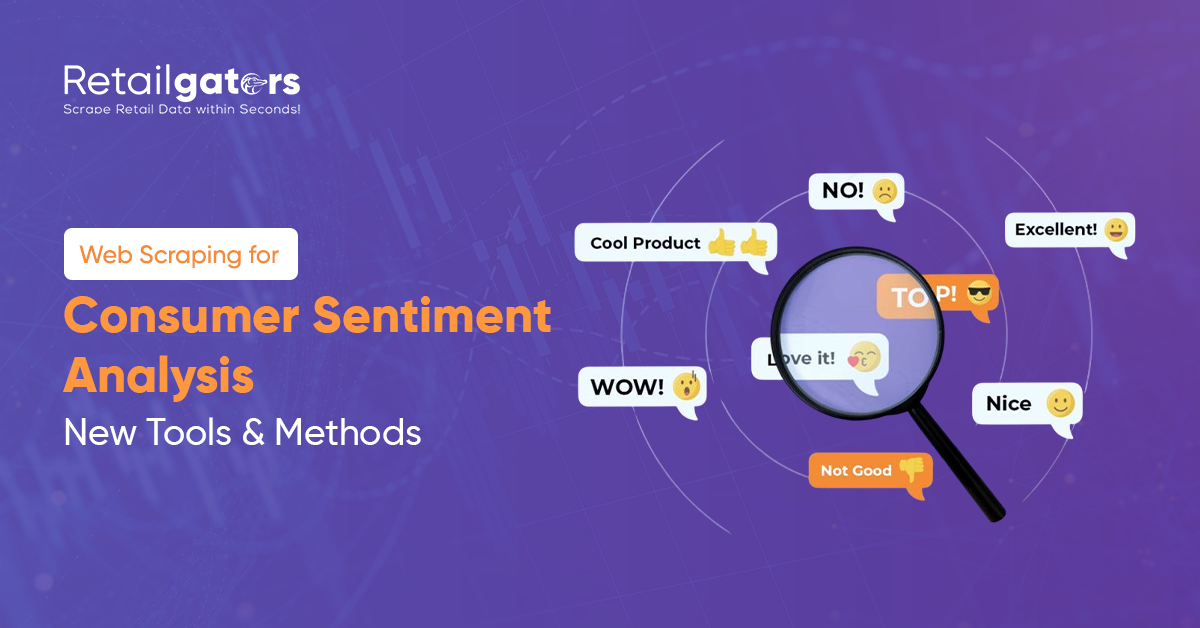
The combination of web scraping and sentiment analysis can be truly transformative. Web scraping sentiment analysis data allows businesses to extract large quantities of unstructured data from publicly available sources. Sentiment analysis detects customers’ opinions, typically in unstructured form, about brands, products, or services through the use of sentiment analysis models. From market research to brand management, sentiment analysis enables businesses to remain relevant and meet consumer expectations.
By 2025, web scraping will not only extract opinions in textual form but also extract opinion-based insights about the consumer. Due to advances in scraping frameworks and machine learning models, you can transform unstructured data from unstructured platforms into actionable insights.
This guide is a comprehensive roadmap that shows businesses how to utilize web scraping and sentiment analysis to establish meaningful and sentiment-rich data. It explores the tools transforming the sentiment and data scraping space, as well as modern analysis methods and ethical considerations to consider.
What is Consumer Sentiment Analysis?
Consumer sentiment analysis is the study of written content, such as reviews and comments, to understand the emotional tone of the content. What is the emotional tone – positive, negative, or neutral? Brands can gain a comprehensive understanding of overall public opinions by analyzing sentiment at scale.
Brands may use sentiment analysis for these purposes:
- Assess brand perception
- Identify customer needs
- Improve product features
- Assist with marketing efforts
- Spot complaints early: Warning Sign
For instance, a retail brand can analyze online reviews to discover an increasing number of complaints regarding delivery delays. It might lead to prompt operational adjustments before public ratings suffer.
What Is The Importance of Web Scraping for Sentiment Analysis?
Although using sentiment analysis tools can take care of analyzing text, you need to get large amounts of text from the real world—customer feedback, reviews, online discussions, and so on. That is where web scraping comes in.
Benefits of Web Scraping for Sentiment Analysis:
- Extensive Volume Data Collection: Automatically collect reviews, comments, and thread posts from thousands of sources that are continuously updating.
- Real-Time Monitoring: Begin scraping to gather new reviews or mentions as they are published.
- Cross-Platform Monitoring: Capture consumer sentiment data from various sites that host reviews, including Amazon, Reddit, TripAdvisor, and Twitter.
- Custom Data Collection: Scrape specific fields, such as review scores, review/post dates, usernames, product IDs, and more, to enhance the depth of sentiment analysis.
At RetailGators, we specialize in developing scalable, accurate, and highly customized web scraping pipelines to facilitate sentiment analysis for our clients across various industries.
What Data Sources Can Be Scraped?
The effectiveness of sentiment analysis depends heavily on the quality and diversity of data. Here are some of the most valuable sources our clients target:
| Platform Type | Examples | Value for Sentiment |
|---|---|---|
| E-commerce | Amazon, Walmart, eBay | Product opinions, shipping reviews |
| Social Media | Twitter, Reddit, Facebook | Real-time opinions, brand mentions |
| App Stores | Google Play, Apple App Store | Feature requests, bugs, app satisfaction |
| Forums & Communities | Quora, StackOverflow, Reddit Threads | Niche feedback and deeper discussions |
| Blogs & News Sites | Medium, personal blogs, news comments | Contextual sentiment on broader topics |
RetailGators builds scraping bots tailored for each platform’s structure and language, ensuring clean, structured, and sentiment-ready outputs.
What Are The Innovative Tools that Make a Difference?
Several web scraping and sentiment intelligence platforms are expanding the limits of what’s possible. Here are some key players that help brands tap into the emotions of consumers:
X-Byte Technologies
X-Byte develops powerful, enterprise-quality scraping tools. Their sentiment modules can scrape and analyze user reviews, feedback loops, and branded mentions in real-time, making them great for high-volume conversions and rapid assessment.
Scraping Intelligence
Scraping Intelligence has developed domain-specific scraping solutions. They provide curated datasets for sentiment analysis tasks and sentiment identification datasets, particularly in the hospitality, travel, and e-commerce sectors. Their output is organized in a manner that enables direct integration into machine learning applications.
iWeb Scraping
A very economical scraping solution for startups and mid-sized businesses. iWeb Scraping will deliver custom scraping for review sites like Yelp, Amazon, and Trustpilot. Their services also include tagging sentiment and filtering results for delivery in formats ideal for reuse, such as JSON and CSV.
RetailGators’ Custom Solutions
RetailGators is unique in that the scraping endpoints we provide are fully managed and specifically tailored to the industry. Each RetailGators client receives:
- Multi-source scraping with syncing of requested pages to monitor changes in real-time.
- Integration into our sentiment analysis dashboards with API functionality.
- Dynamic and complex websites use scraping that is not readily available.
- OCR and CAPTCHA bypass for sites that seem impossible.
- Recurring jobs that assess consumer monitoring on an ongoing basis.
We do not just collect data—we make it analysis-ready.
What Are The Advanced Techniques in Sentiment Analysis?
Sentiment analysis occurs once you scrape the data. Here are the latest techniques that are making consumer opinion analysis more potent than ever:
Lexicon-based Analysis
It is a rule-based methodology that utilizes dictionaries of positive and negative words to measure sentiment. Lexicon-based analysis is fast and interpretable but has lower accuracy on nuanced text.
Machine Learning Models
Using labeled review datasets, machine learning models learn to differentiate between sentiments based on data features. Here are the more popular models:
- Naïve Bayes
- Support Vector Machines (SVM)
- Random Forests
Deep Learning Approaches
Deep learning approaches use LSTM (Long Short-Term Memory) models and CNNs (Convolutional Neural Networks) to develop a more precise understanding of the context, tone, and sequence of words, which can be confusing in complex or compound sentences.
Transformer-based Models
Generally speaking, pre-trained natural language processing (NLP) models, such as BERT, RoBERTa, and DistilBERT, outperform most older methods and have significantly improved accuracy when dealing with sarcasm, slang, and domain-specific languages.
Aspect-based Sentiment Analysis (ABSA)
ABSA is more specific than traditional sentiment analysis, as its purpose is not to analyze the sentiment of the entire review, but rather to focus on the pieces of content relevant to the aspects being discussed in the review. For example: “The battery life is terrible, but the screen resolution is stunning.” ABSA provides businesses with more clarity on what works and what needs fixing.
What Are The Methods of Data Extraction for Sentiment Analysis?
Sentiment analysis begins with data extraction, which provides the input for your analysis, and the higher the quality of the data, the more accurate your analysis. There are many methods for collecting consumer opinion data, each suited to the complexity and nature of the target website.
As a rule of thumb, the most apparent method is to parse the HTML itself, using tools and libraries like Scrapy, BeautifulSoup, or Parsel, and scrape the HTML by searching for CSS selectors or XPath. It works exceptionally well with static web pages, especially if the reviewer section or comment section is marked in the HTML.
More modern websites offer content asynchronously via JavaScript rendering, so you’ll need to use Selenium or Playwright to create a browser to capture the rendering of the page. This ensures that you won’t miss any content that is served after the page has been rendered.
A more advanced approach is to leverage hidden APIs that websites use to load content asynchronously. In many cases, your target website is servicing the front-end requirements by making a simple call to a back-end API. If you can identify where the API is served from and make the same call yourself, you will retrieve well-structured data without the need for parsing HTML.
Very few websites offer an open API or an RSS feed. Still, these are the best options, as they enable the display of structured data without any legal or technical implications. These are the best for successfully monitoring sentiment over the long term.
Some methods yield robust, relatively stable options, while others are stable; however, each approach has its pros and cons. You can combine multiple techniques to develop and deploy stable and scalable data extraction strategies.
What Are The Real-World Applications of Sentiment Data?
Now let’s look at how sentiment scraping and sentiment analysis are shifting business strategy across multiple sectors:
Retail & eCommerce
A growing number of brands study customer sentiment by examining online reviews, while also learning about other factors, such as which products are starting trends and which are falling out of favor. Web scraping replaces market trends, removes uncertainty, and keeps brands ahead of the competition.
Hospitality & Travel
Scraping reviews from travel sites can help establish customer trends and understand what customers prefer in terms of cleanliness and how they perceive the behavior of hospitality staff. You can manage emerging issues more effectively for guest services and make localized adjustments, such as cleaning policies and staff training, quickly.
Mobile Apps & SaaS
Sentiment data available from app stores and a small number of forums provides timely customer insights into bugs, annoyances, and missing features, which in many cases allows teams to iterate and improve their UX product and outcome at a much faster pace.
Brand Monitoring & PR
Scraped sentiment is more than just protecting brand reputation. It is also essential to understand how the world perceives new product launches, campaigns, and crises.
What Are The Challenges in Sentiment Scraping and How to Overcome Them?
Dynamic Websites Frame
With JavaScript-based websites using asynchronous loading methods, it can make it challenging for simple scrapers to pull the desired sentiment content. There are updated and more sophisticated options, such as Puppeteer and Selenium, which can utilize full-automated web scrapers that parse this content by mimicking the behavior of an actual browser user.
Data Noise and Irrelevance
Often, the scraper data will contain some form of noise, including overlapped ads, duplicate content, and irrelevant information. It will be crucial to clean up your data to strip out noise; implementing keyword filters, deduplication, and clean parsing structures will be necessary to achieve accurate and legitimate sentiment results.
Language and Contextual Variability
Language is full of sarcasm, slang, or expressions that you might take as regional or contextually knowledgeable. Ideally, you would want to be able to pick that up; however, it has become a major issue within research. Those transformer models that are becoming the dominant force for NLP, like BERT or mBERT, rely on a deeper understanding of language’s nuances than previous ML and sentiment analysis methods.
Rate Limit or Blocked
If you are scraping too often, you may trigger rate limits and/or security alerts, and remain blocked. Rotating proxies and user agents, along with randomizing the delay times of your requests, may help alleviate triggered notices and maintain a consistent scrape timeline without interruption.
Ethical and Lawful Scraping
Ethics are an essential aspect for a scraper; complying with the site’s terms of service, especially when scraping personal data, is crucial. Always use robots.txt before scraping and extract only public content.
Final Thoughts
Consumer sentiment can be a significant lever for business strategy, but valuable insights depend on timely, comprehensive, and quality data. Brands can utilize web scraping to gather real-time data from e-commerce platforms, social media, and forums, which helps identify trends, flag issues, and make more informed decisions.
RetailGators provides web scraping solutions tailored for sentiment analysis, allowing you to leverage raw opinions into strategic action at the exact time it matters.