What makes one Shopify store stand out while another one struggles to gain traction? It’s not always about who offers the lowest prices. Product variety, promotional strategies, inventory availability, and how quickly retailers respond to the market all shape customer choices and drive sales.
But keeping up with competing Shopify stores is easier said than done. Prices change, new products launch, promotions come and go, and popular items frequently go out of stock. Tracking these shifts manually across multiple stores can instantly become overwhelming, leaving retailers with an incomplete picture of the market.
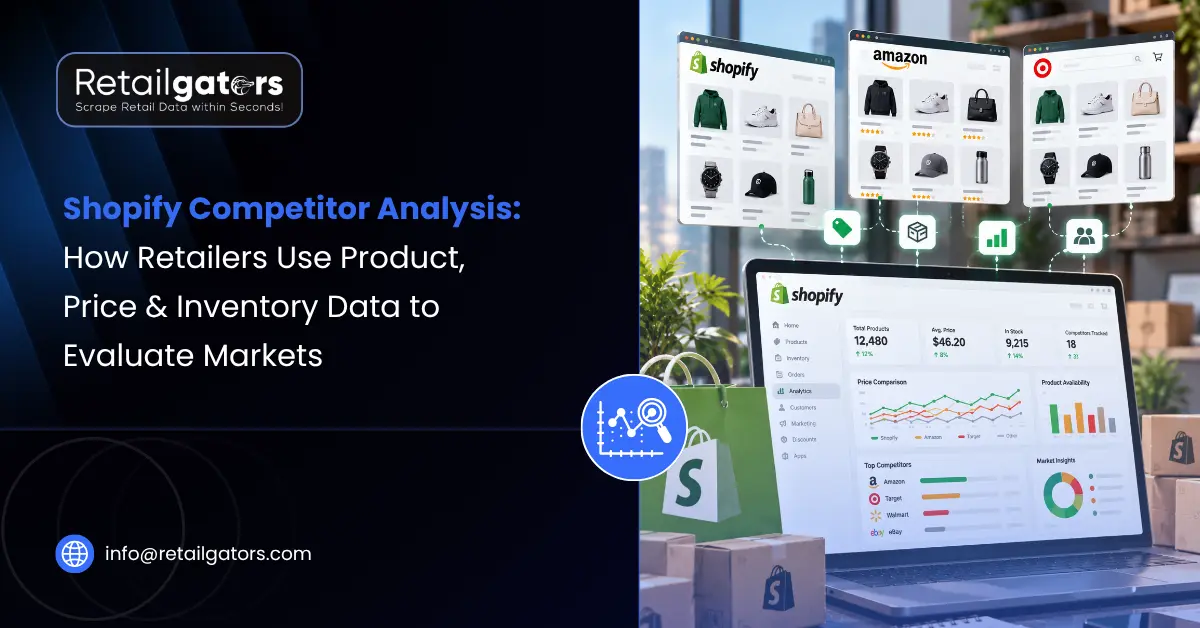
Shopify competitor analysis offers a smarter, data-driven way to stay ahead. By tracking competitor product, pricing, and inventory data, retailers can uncover emerging trends, evaluate market demand, benchmark their offerings, and identify untapped growth opportunities.
The real advantage lies not just in knowing what competitors are doing, but in using those insights to make more informed decisions about what to sell, how to price it, and where to grow next.
What Is Shopify Competitor Analysis
Shopify competitor analysis is the process of identifying your competitors and evaluating their strategies to understand their strengths and weaknesses compared to your product or service.
It differs from a generic “competitive analysis” you might run for an agency business. With Shopify stores, almost everything you need is publicly visible: product listings, checkout flow, the theme they are using, and even estimated revenue if you use the right store spy tool. You don’t need to guess; you need a system, like a scraper, for pulling the data together.
- Direct competitors offer the same or similar products to the same target audience, such as two Shopify stores selling pet grooming kits.
- Indirect competitors address the same customer needs through different products or solutions, such as a pet care subscription box versus a one-time purchase.
Why Product, Price & Inventory Data Matter in Competitor Analysis
Understanding your competitors requires more than a quick look at their storefronts. Shopify product data provides a wider view of how other retailers position their products, respond to market demand, adjust prices, and manage inventory. Together, these insights help businesses identify market gaps, refine pricing strategies, and make smarter decisions about product assortment and inventory planning.
Product Data Reveals Competitor Assortment
Product data gives retailers a clear picture of what competitors are selling and how they present their offerings. Through Shopify product data scraping, businesses can track product catalogs, spot new launches, identify popular categories, and uncover gaps in their own assortments. Comparing product variations, descriptions, and positioning also helps retailers understand how competitors differentiate their offerings and appeal to specific customer segments.
Price Data Highlights Competitive Positioning
Pricing plays a significant role in how customers compare products and make purchasing decisions. Shopify price monitoring helps retailers track competitor prices, discounts, promotions, and price adjustments over time. These insights reveal pricing gaps, highlight promotional trends, and create opportunities to refine pricing strategies while protecting profit margins.
Inventory Data Provides Market Availability Signals
Inventory data offers valuable clues about product demand and how competitors manage stock across their catalogs. Tracking stock availability and out-of-stock products in Shopify competitor data helps retailers identify recurring stockouts, spot changes in availability, and understand which items may be experiencing higher demand. These signals can support better inventory planning, reduce missed sales opportunities, and help businesses respond more effectively to changing market conditions.
How Retailers Use Shopify Product Data to Evaluate Markets
Product-level insights can tell retailers much more than what competitors are selling. By scraping Shopify product data, businesses can study competitor catalogs at scale, understand shifting customer interests, and make more informed decisions about which products or categories to prioritize.
- Product Assortment Analysis: Compare the breadth and depth of competitor catalogs to understand which categories, brands, product types, and variations are widely available across the market.
- New Product Discovery: Track recently added products and emerging categories to spot changes in competitor assortments and identify areas gaining market attention.
- Market Gap Identification: Find product sizes, colors, features, or variations that competitors offer in limited ranges or do not adequately serve, helping retailers identify potential assortment gaps.
- Product Positioning: Compare product titles, descriptions, images, attributes, and other listing details to understand how competitors present their products and differentiate their offerings.
- Trend Identification: Monitor changes in competitor product assortment over time to spot growing categories, emerging product themes, and shifts in market interest.
How Inventory Data Helps Retailers Evaluate Competitor Performance
Inventory data can offer useful clues about how competitors manage product availability and how the market is changing. With Shopify competitor data, retailers can track availability patterns across competing stores and identify areas that may warrant deeper research. However, being in stock or out of stock does not confirm sales volume or customer demand. These signals are most useful when combined with product, pricing, and other market data.
- Stock Availability Monitoring: Track which competitor products are in stock, unavailable, or frequently out of stock to maintain a clear view of market availability.
- Inventory Movement Signals: Use observed availability changes as signals for further market investigation, particularly when multiple competitors show similar patterns.
- Stockout Pattern Analysis: Monitor recurring availability changes across competitor stores to identify products or categories that frequently fluctuate.
- Opportunity Identification: When competing products become unavailable, examine the gap alongside pricing, product, and market data to identify opportunities to improve your own assortment or availability.
- Assortment Consistency: Compare availability across competitor catalogs to understand how consistently retailers maintain their product ranges and variations.
How Retailers Combine Product, Price & Inventory Data for Market Evaluation
Analyzing product, price, or inventory data individually can reveal useful patterns, but combining all three gives retailers a much broader view of the competitive landscape. By bringing together Shopify competitor data from multiple sources, businesses can understand how competitors position their products, adjust prices, and manage availability across different market segments. This combined perspective helps retailers move beyond isolated observations and make decisions based on a more complete picture of market activity.
| Data Combination | What Retailers Can Understand |
| Product + Price | How competitors price different product categories, brands, and variants, and where pricing gaps exist. |
| Product + Inventory | Which products remain consistently available, which experience recurring stockouts, and where assortment gaps may exist. |
| Price + Inventory | How pricing changes coincide with shifts in product availability, offering signals for further investigation into competitor strategies. |
| Product + Price + Inventory | Competitor positioning, assortment changes, pricing patterns, and potential market opportunities across product categories. |
When these insights are evaluated together, retailers can make more informed decisions about their market strategies; for instance, they can:
- Evaluate Competitor Positioning: Compare product ranges, pricing, and availability to understand how competing retailers target different customer segments.
- Identify Underserved Product Categories: Spot categories or product variations with limited competitor offerings and investigate potential opportunities to expand their assortment.
- Refine Assortment and Pricing Decisions: Use competitor benchmarks to determine which products to prioritize and where pricing adjustments may be worth exploring.
- Build Informed Market Entry or Expansion Strategies: Evaluate product availability, pricing conditions, and assortment coverage across target markets before committing resources to new categories or locations.
- Investigate Availability Changes: Examine recurring stockouts alongside price and assortment data to better understand competitor activity without assuming that stock changes directly reflect demand.
Finally, combining product, price, and inventory data helps retailers connect individual market signals and turn them into actionable insights. Rather than reacting to isolated competitor changes, businesses can develop a clearer understanding of market conditions and make more confident decisions about where and how to grow.
Key Metrics to Track in Shopify Competitor Analysis
Collecting competitor data is only the first step. To make it useful, retailers need to track the following metrics:
- Product assortment size
- New product introduction rate
- Average competitor price
- Price difference percentage
- Discount frequency
- Promotional depth
- Product availability rate
- Out-of-stock frequency
- Price change frequency
- Competitor assortment overlap
- Product category coverage
How Shopify Competitor Data Scraping Supports Market Intelligence
Raw competitor data becomes much more valuable when you collect it consistently, structure it accurately, and make it easy to analyze. Shopify competitor data helps retailers gather product, pricing, and inventory information from multiple stores at scale, creating a reliable foundation for Shopify competitor analysis and Shopify market research.
Identify Relevant Competitor Stores
The process begins by identifying Shopify stores that are relevant to the analysis. Retailers can select competitors based on product categories, target audiences, pricing levels, geographic markets, and market overlap. This ensures Shopify store data extraction focuses on competitors that matter to specific business goals.
Extract Product, Price, & Inventory Information
Once relevant stores are identified, Shopify product data scraping can collect key product-level information, including:
- Product name and URL
- Brand and category
- SKU and product variants
- Current and original prices
- Discounts and promotional offers
- Product availability
- Product descriptions and attributes
This data gives retailers a clearer view of competitor assortments, pricing strategies, and product availability, supporting more effective Shopify competitor analysis.
Clean and Structure the Data
Collected data may contain inconsistent information for similar products. Cleaning and standardizing the data helps normalize prices, map comparable products, and remove duplicates, making Shopify competitor data easier to compare and analyze accurately.
Monitor Changes Over Time
A single data snapshot shows what competitors are doing at a specific point in time. Recurring Shopify price monitoring and Shopify store data extraction reveal how their strategies evolve. Regular data collection can capture price changes, new product launches, promotional updates, and inventory shifts, helping retailers identify emerging market patterns.
Integrate Data into Business Workflows
After collecting and structuring the data, retailers can access competitor insights through APIs, dashboards, CSV files, or databases. This lets pricing, merchandising, and strategy teams incorporate Shopify market research insights into existing workflows and make more informed decisions.
Conclusion
Shopify competitor analysis gives retailers a clearer view of how competitors shape their product assortments, pricing, and inventory strategies. By combining Shopify competitor data across these areas, businesses can spot market gaps, track emerging trends, refine pricing and assortment decisions, and uncover potential growth opportunities.
The goal isn’t simply to track what competitors are doing; it’s to turn those market signals into smarter decisions about what to sell, how to price it, and where to grow next.