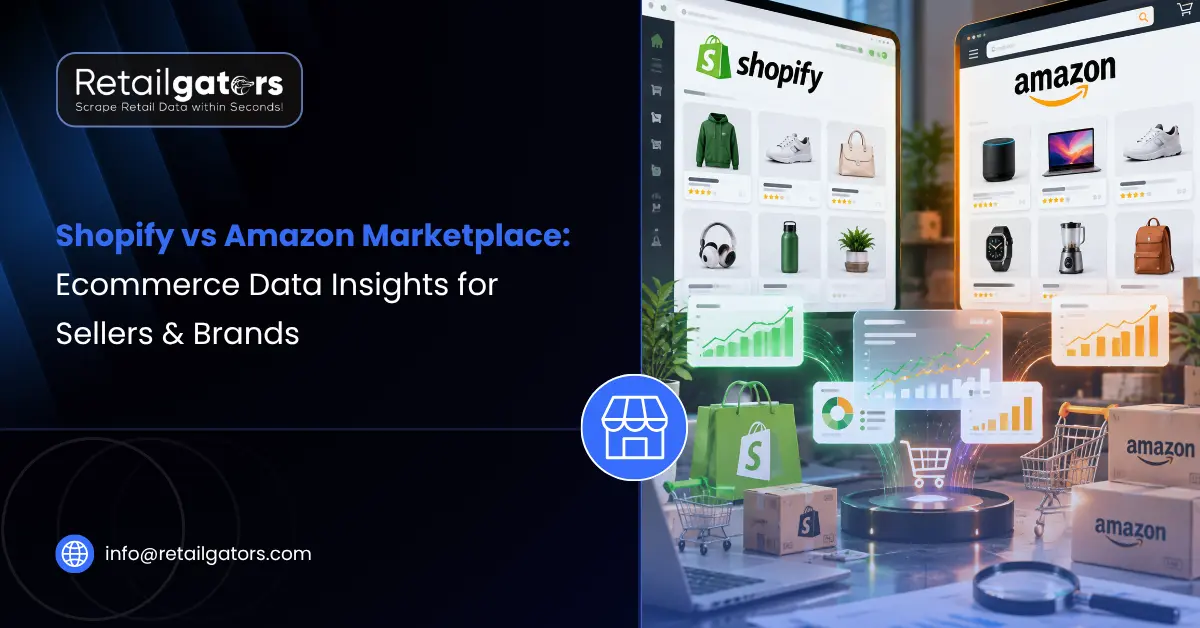
Sellers choosing between Shopify and Amazon rarely lack opinions — everyone has heard that Amazon delivers traffic and Shopify delivers control. What most sellers and brands actually need before making that call, or before deciding to run both at once, is data: how pricing behaves differently across the two, what product information each platform exposes, and how sellers can track performance signals like pricing intelligence without guessing. The Shopify vs Amazon marketplace question isn’t really about which platform is “better.” It’s about which one gives you the kind of data your business needs to compete.
That distinction matters more than it sounds. Amazon is a marketplace where thousands of sellers compete on the same product pages, and Amazon itself controls much of the customer relationship. Shopify is a storefront platform where a brand owns its own site, its own customer data, and its own pricing — but gets none of Amazon’s built-in audience. The data each platform produces, and the way a business can collect and use it, reflects that structural difference from the ground up.
Shopify vs Amazon Marketplace: What Actually Changes?
The core difference starts with ownership. On Amazon, a brand’s product exists inside a shared catalog structure — one listing per ASIN, with Amazon controlling search ranking, the buy box, and much of the customer experience. On Shopify, a brand runs its own independent storefront, meaning there’s no shared catalog and no buy box competition; the store owner controls the product page, the pricing, and the checkout flow entirely.
That ownership difference reshapes what kind of data is even available. Amazon exposes rich competitive signals by design — you can see competitor prices, ratings, reviews, and rankings because they’re all sitting on public pages within one marketplace. Shopify stores, by contrast, are independent websites, so gathering competitive data means collecting it store by store rather than pulling it from a single unified catalog.
Pricing behaves differently as a result. Amazon pricing tends to be reactive and highly visible, since multiple sellers can be competing for the same buy box in real time. Shopify pricing is set independently by each brand, so price comparisons across Shopify stores require pulling data from each site rather than reading it off one shared listing.
Product data structure diverges too. Amazon standardizes fields around the ASIN — title, brand, category, specifications — which makes cross-seller comparison relatively straightforward. Shopify stores each build their own product schema, so titles, descriptions, and variant structures can differ meaningfully from one store to the next, which is where product data intelligence work has to account for more variation than it would on a standardized marketplace.
Seller and brand visibility follow the same logic. On Amazon, seller performance is partly visible through ratings, reviews, and buy box wins. On Shopify, “seller insights” mean something closer to brand-level intelligence — traffic signals, product assortment, pricing patterns, and how a brand’s catalog evolves over time, since there’s no shared seller reputation system the way there is on a marketplace.
Amazon Marketplace Data: What Sellers and Brands Can Track
Amazon’s structure makes it a strong source for direct, product-level competitive tracking, since so much of the relevant data sits on a single, standardized page per ASIN.
Product listings and specifications show how competitors are positioning a product — the keywords in the title, the structure of the bullet points, and how listing content shifts in response to competitive pressure.
Pricing and buy box data are usually the first thing sellers watch, since buy box price movement is one of the clearest real-time signals of how aggressively competitors are pricing a given product.
Ratings and reviews give a read on product sentiment at scale, and tracking review volume and rating trends over time can flag quality issues or shifting customer expectations before they show up in sales numbers.
Category rank and bestseller data help sellers understand where a product sits relative to its competitive set, which is useful for both pricing decisions and assortment planning.
Seller and fulfillment information, where publicly visible, indicates whether a listing is seller-fulfilled or fulfilled through Amazon’s own network, which affects delivery speed and, often, buy box eligibility.
For sellers already operating on Amazon, or brands weighing whether to launch there, this kind of structured tracking is what turns a single product page into an ongoing read on competitive pressure rather than a one-time snapshot.
Shopify Store Data: What It Reveals About Brands and Products
Shopify data tells a different kind of story, mostly because there’s no shared catalog holding everything together — each store is its own independent source.
Product catalogs and descriptions reveal how a brand structures its own assortment, how it names and categorizes products, and how frequently it updates or expands its catalog — useful signals for brands studying competitor positioning outside the marketplace environment.
Pricing data across Shopify stores shows how independent brands set prices without the buy box dynamic that shapes Amazon pricing. That makes Shopify pricing data useful for understanding a brand’s standalone pricing strategy, separate from whatever competitive pressure it might also be facing on Amazon or other marketplaces.
Product variations, images, and inventory signals help with catalog benchmarking — comparing how a brand structures sizes, colors, or bundles compared to competitors in the same category.
Collections and merchandising patterns offer a look at how brands group and promote products, which can hint at seasonal strategy, new launches, or shifting priorities within a catalog.
Because Shopify stores are independently owned, this data doesn’t come pre-aggregated the way Amazon’s does. Building a useful competitive picture usually means collecting structured data from multiple stores and normalizing it into a comparable format, which is a meaningfully different exercise than reading a single Amazon category page.
Shopify vs Amazon for Pricing Strategy and Competitive Insights
Pricing strategy looks different depending on which platform a business is watching, and treating the two the same way tends to produce weak analysis.
On Amazon, pricing strategy is often reactive by necessity. Buy box competition means prices can shift multiple times a day, and sellers who aren’t tracking that movement closely can lose the buy box without realizing why. Structured, automated price tracking is less of a convenience here and more of a baseline requirement for staying competitive.
On Shopify, pricing strategy tends to be more deliberate, since there’s no real-time buy box forcing reactive changes. Brands set prices based on their own margin targets, positioning, and promotional calendar — but that doesn’t mean pricing is static. Tracking how competitor Shopify stores adjust prices around sales events, new launches, or seasonal shifts still matters, it just moves on a slower, more planned rhythm than Amazon’s.
Cross-platform pricing analysis is where things get genuinely useful for a lot of brands. A product sold both on Amazon and through a brand’s own Shopify store can carry two different price points, and understanding that gap — along with how each channel’s pricing responds to competitive pressure — helps brands set a coherent pricing strategy rather than letting each channel drift independently. That kind of analysis depends on proper product matching across platforms, since comparing a Shopify listing to an Amazon ASIN only works if you’re confident they’re actually the same product.
Neither platform’s pricing data is inherently better for strategy work. Amazon gives cleaner, more frequent competitive signals. Shopify gives a clearer view of a brand’s independent pricing logic, without the noise of buy box competition distorting the picture.
Ecommerce Analytics for Sellers Running Both Channels
A growing number of sellers and brands run Amazon and Shopify simultaneously, using Amazon for reach and Shopify for margin and customer ownership. That dual-channel approach makes ecommerce analytics more complicated, but also more valuable when it’s done well.
Assortment comparison across channels shows whether a brand is selling the same products everywhere or reserving certain items — bundles, exclusives, limited releases — for its own Shopify store. Pricing comparison across channels reveals whether Amazon pricing pressure is bleeding into Shopify pricing, or whether the two are being managed independently, intentionally or not.
Promotion and discount tracking matters on both platforms but shows up differently — Amazon promotions often run through deals and coupons tied to the listing itself, while Shopify promotions are usually driven by the brand’s own marketing calendar. Understanding both, together, gives a fuller read on how aggressively a brand or competitor is discounting across its full sales footprint rather than just one channel.
Inventory and availability signals matter too, particularly for brands trying to gauge how a competitor is managing stock across channels — whether they’re prioritizing Amazon fulfillment during high-demand periods, or holding inventory back for their own site.
None of this is about picking a winner between the two platforms. It’s about recognizing that a seller or brand’s real competitive position often spans both, and analyzing only one channel gives an incomplete picture of what’s actually happening in the market.
Which Platform’s Data Should Your Business Track?
The right answer depends entirely on what decision the data needs to support, not on which platform feels more relevant at a glance.
If the objective is competitor pricing on Amazon, buy box tracking and offer-level pricing data are the most direct signal, since that’s where the real-time competitive pressure shows up first.
If the objective is brand and catalog benchmarking, Shopify data tends to be more revealing, since it shows how a brand structures and prices its own assortment without marketplace interference.
If the objective is cross-channel pricing strategy, tracking both platforms together — with proper product matching between them — is close to essential, since managing Amazon and Shopify pricing in isolation tends to create inconsistencies that competitors or customers eventually notice.
If the objective is market research on a category or niche, combining Amazon’s marketplace-level visibility with Shopify’s brand-level detail gives a broader view than either source alone, especially in categories where DTC brands compete directly against marketplace sellers.
If the objective is seller or brand performance monitoring, the right data set depends on where that seller or brand actually operates — Amazon signals for marketplace-only sellers, Shopify signals for DTC-first brands, and both for anyone running a hybrid model.
Why Structured Data Collection Matters Across Both Platforms
Manual tracking runs into familiar limits on either platform, but the specific pain points differ. On Amazon, the challenge is speed — buy box prices can change too fast for manual checks to keep up, and missing a shift by even a few hours can mean losing competitive position without knowing it happened. On Shopify, the challenge is fragmentation — there’s no single catalog to check, so tracking multiple independent stores means visiting each one separately and normalizing the data afterward.
Automated, structured collection solves both problems from different angles. It gives Amazon sellers the frequency they need to react to buy box and pricing changes in time to matter, and it gives brands tracking Shopify competitors a way to pull consistent, comparable data from stores that were never designed to be compared to each other in the first place.
As with any data collection work, this needs to respect the applicable terms of the source websites, technical access limitations, and relevant legal requirements — a consideration that applies whether the source is a single Amazon listing or a dozen independent Shopify storefronts, and one worth confirming on a source-by-source basis before any collection work begins.
How RetailGators Supports Shopify and Amazon Data Needs
Once a business knows which signals matter — Amazon pricing, Shopify catalog structure, or both together — the remaining challenge is usually operational: collecting that data consistently without building an internal scraping team to do it.
RetailGators works with sellers and brands on exactly that layer. For Amazon, that means structured Amazon product data covering pricing, ratings, reviews, specifications, and seller information across country-specific marketplaces.
For Shopify, RetailGators can collect product data directly from Shopify stores — titles, descriptions, variant pricing, images, and availability — structured into a format that’s actually comparable across multiple independent stores.
Beyond raw collection, RetailGators supports the analysis layer that makes the data useful in the first place, including pricing intelligence for tracking price movement over time and ecommerce data analytics for turning catalog and pricing data from both platforms into something a pricing or merchandising team can actually act on.
Data is delivered in whatever format fits an existing workflow — CSV, Excel, JSON, or API-ready feeds — on a schedule the business defines, whether that’s daily buy box monitoring on Amazon or a weekly sweep of competitor Shopify catalogs. Sellers and brands with more specific requirements can review a sample data set before committing to full-scale collection, so there are no surprises once a project scales up.
Conclusion
Shopify and Amazon aren’t answering the same question for sellers and brands — they’re two different environments with fundamentally different data structures, and the value of tracking either one comes from matching the data to what a business is actually trying to decide. Amazon offers dense, standardized competitive signals inside a shared marketplace. Shopify offers a clearer window into how individual brands manage their own catalog and pricing, without the noise of buy box competition.
For sellers and brands running both channels — which is increasingly the norm rather than the exception — the real advantage comes from tracking them together rather than treating each as a separate silo. That’s where a structured commerce marketplace analysis, built on consistent data from both platforms, turns two disconnected data sources into one coherent view of competitive position.
Businesses working out how to track Shopify and Amazon data together can talk to RetailGators about a collection approach built around their specific catalog, competitors, and reporting needs.