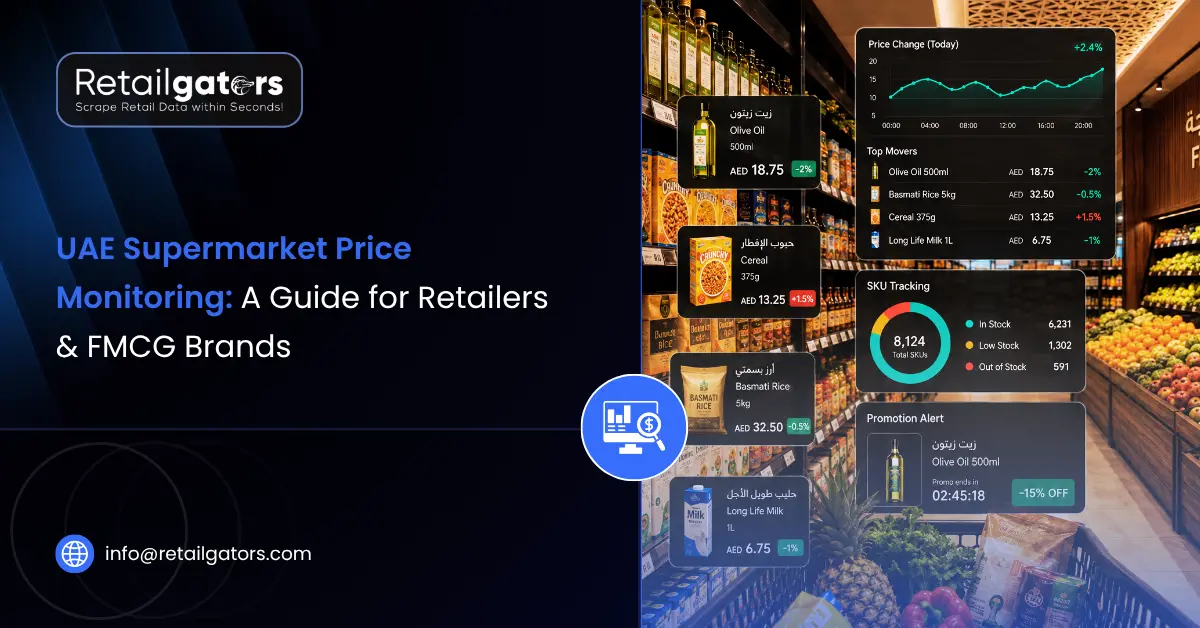
UAE grocery retail is one of the most competitive and varied markets in the Middle East. A shopper can compare products across hypermarkets, neighborhood supermarkets, cooperatives, discount stores, ecommerce platforms, and quick-commerce apps within minutes. Prices do not stay consistent across these channels. Promotions change quickly, stock varies by location, and the same item may appear under several pack sizes, loyalty conditions, or bundle offers.
That complexity makes occasional competitor checks unreliable. A screenshot from one supermarket website cannot explain whether a price is temporary, location-specific, available only to members, or attached to a product that is already out of stock. Retailers and FMCG companies need a structured way to observe the market over time.
UAE Supermarket Price Monitoring provides that structure. It allows pricing, category, sales, and revenue teams to track regular prices, promotional activity, inventory, assortment changes, and competitor behavior across the UAE grocery market. When the data is accurate and properly matched, it supports better pricing decisions without forcing businesses into unnecessary discounting.
This guide explains how supermarket price intelligence works, why UAE grocery pricing requires a local approach, which data points matter, and how retailers and FMCG brands can turn monitored information into practical commercial decisions.
What Is UAE Supermarket Price Monitoring?
UAE Supermarket Price Monitoring is the recurring collection, standardization, comparison, and analysis of grocery prices across selected retailers, digital channels, stores, and locations.
A useful program captures more than a product name and selling price. It records the exact SKU, pack size, brand, variant, promotion type, stock status, location, and collection time. This context prevents false comparisons between different packs, loyalty-only offers, or products that cannot be purchased.
It supports Retail Price Monitoring by helping teams answer practical questions:
- Which competitors changed prices?
- Is the difference temporary or persistent?
- Which retailers use the deepest promotions?
- Where are priority SKUs unavailable?
- How does pricing vary by emirate or channel?
- Which private-label products are putting pressure on branded goods?
The objective is not to follow every competitor move. It is to understand which changes require action and which should be ignored.
Why UAE Grocery Pricing Is Unique
Diverse Shopper Needs
The UAE serves customers with varied cuisines, incomes, household sizes, and brand preferences. A family buying large monthly packs behaves differently from a customer ordering premium imported items or urgent groceries through an app. This makes category-level price elasticity more useful than one market-wide assumption.
Imported Product Costs
Many grocery and FMCG categories depend on international supply chains. Freight, exchange rates, supplier terms, origin, and shelf life can affect UAE grocery pricing. A sudden increase may therefore reflect procurement pressure rather than an aggressive competitor move.
Frequent Promotional Activity
Weekend offers, loyalty rewards, bundles, bank-card deals, Ramadan campaigns, Eid promotions, and app-exclusive flash discounts can change the market quickly. Weekly collection may miss short promotions that still influence demand and customer price perception.
Regional Differences
Store costs, nearby competition, customer profiles, delivery coverage, and stock levels vary across emirates and neighborhoods. Online prices and availability may also change with the selected delivery location.
Expert Tip: Build benchmarks by location, format, and customer mission. A premium Dubai supermarket is not always the right comparison for a value-led hypermarket in Sharjah.
Retail Competition in the UAE
The UAE grocery market includes international groups, regional hypermarkets, cooperatives, premium supermarkets, discounters, convenience stores, ecommerce marketplaces, and quick-commerce apps.
Competition occurs across several dimensions:
- Price on visible household staples
- Seasonal and weekend promotions
- Imported, local, and private-label assortment
- Delivery speed and store convenience
- Loyalty rewards and member pricing
- Availability when a customer needs an item
A shopper may use a hypermarket for monthly stock-up purchases, a neighborhood supermarket for weekly essentials, and an app for urgent items. Grocery competitor pricing should reflect those shopping missions.
Price wars often begin when teams react to one isolated discount. Historical supermarket price intelligence shows whether the move is temporary, location-specific, out of stock, or part of a longer strategy.
Hypermarkets vs Supermarkets: Different Monitoring Priorities
Hypermarkets and supermarkets compete in overlapping categories, but their commercial models are not identical.
| Retail Format | Typical Pricing Approach | Common Customer Mission | Monitoring Priority |
| Hypermarket | Broad promotions, bulk savings, strong key-value pricing | Monthly or large household basket | Wide SKU coverage, pack matching, promotion depth |
| Supermarket | Curated assortment, local convenience, selective offers | Weekly top-up and neighborhood shopping | Local price gaps, availability, premium mix |
| Cooperative | Competitive essential goods and community relevance | Regular household shopping | Regional pricing, essential items, member offers |
| Discount Store | Low base prices and private-label focus | Value-seeking purchases | Price floors, private-label gaps, basket cost |
| Convenience Store | Higher unit prices for access and speed | Urgent or immediate purchases | Small packs, availability, acceptable premium |
| Online Grocery Platform | Location-based pricing and frequent promotions | Planned or convenient delivery | Real-time stock, delivery terms, app-only offers |
| Quick-Commerce App | Fast delivery and dynamic availability | Immediate need | High-frequency tracking, flash discounts, fees |
A useful monitoring strategy should compare each format against the right competitors. Incorrect benchmarking can lead to unnecessary price reductions or misleading performance reports.
What Data Should Businesses Monitor?
A strong monitoring program combines product identity, price context, promotion conditions, and stock information.
Core Product and Price Data
- Product title, brand, GTIN, category, and variant
- Pack size and unit of measure
- Regular, selling, previous, and unit price
- Discount value and percentage
- Loyalty, coupon, app-only, or bank-card price
- Retailer, seller, location, and timestamp
Promotion Data
Promotion tracking should identify the mechanic, not only the lower price. Common examples include percentage discounts, fixed AED reductions, multi-buy offers, free gifts, loyalty rewards, coupons, and flash deals.
Inventory and Assortment Data
Businesses should also track stock status, delivery availability, restocks, delistings, new launches, and assortment changes. A low price has limited competitive value when the item is unavailable.
| Data Group | Why It Matters |
| SKU identity | Prevents false matches |
| Regular and promotional price | Separates base pricing from campaigns |
| Unit price | Compares different pack sizes fairly |
| Promotion mechanic | Shows the real customer benefit |
| Stock status | Confirms whether the offer is purchasable |
| Location and timestamp | Reveals regional and historical patterns |
FMCG price monitoring may also include recommended retail price, distributor details, promotion compliance, authorized sellers, and MAP monitoring where appropriate. Legal teams should review resale-price policies before enforcement decisions.
How UAE Supermarket Pricing Data Is Collected
Web Scraping
Web scraping collects publicly displayed product, price, promotion, and stock data from supermarket websites. Reliable Ecommerce Data Scraping must handle location selectors, dynamic pages, product variants, temporary banners, and changing site structures.
API Collection
Authorized APIs can provide structured, frequent records. Teams should still confirm whether the response includes promotions, location, stock, seller details, and historical changes.
Direct Feeds
Retailer or distributor feeds often provide accurate identifiers and commercial fields. Their limitation is usually coverage because each feed represents only participating partners.
Store Audits
Physical checks capture shelf labels, displays, and local offers that may not appear online. They work best as a validation method for priority stores and SKUs.
| Method | Main Strength | Main Limitation |
| Web scraping | Broad, scalable coverage | Site changes and page complexity |
| API | Structured, frequent delivery | Access and field limits |
| Direct feed | Strong source accuracy | Partner-only coverage |
| Store audit | Physical shelf visibility | Higher cost and slower updates |
Expert Tip: Validate priority SKUs through a second source, such as a store check, supplier record, or authorized feed.
How to Build a Reliable Monitoring Program
1. Define the Decision
Begin with a commercial objective, such as protecting 200 key value items, measuring beverage promotions, tracking private-label pressure, or finding dairy distribution gaps. A clear decision determines coverage and frequency.
2. Select a Representative Retailer Panel
Include the formats that influence the actual shopper choice. A focused mix of hypermarkets, supermarkets, cooperatives, discount stores, and online channels often produces better insight than an oversized list.
3. Build a Clean SKU Master
Maintain brand, variant, pack size, unit, GTIN, image, and retailer-specific naming. Classify products as exact matches, comparable items, substitutes, or private-label alternatives.
4. Set Category-Based Frequency
- Multiple daily checks for flash deals and quick commerce
- Daily updates for essential goods and priority SKUs
- Several weekly checks for stable branded products
- Weekly monitoring for long-tail assortment
Real-time monitoring adds value only when the team can act quickly.
5. Normalize Prices and Promotions
Standardize AED values, units, VAT treatment, bundle quantities, and eligibility conditions. Keep regular price, promotional price, loyalty benefit, and coupon value in separate fields.
6. Create Decision-Ready Analytics
A Retail Intelligence dashboard may include price index, promotion depth, basket cost, stock availability, assortment changes, private-label gap, regional variance, and price-change frequency.
7. Add Governance
Set margin floors, alert thresholds, approval owners, legal review points, and audit history. These controls prevent false matches or temporary discounts from triggering unnecessary price cuts.
Using Supermarket Price Intelligence for Better Decisions
Competitor Price Tracking
Competitor Price Tracking shows where a retailer or brand sits against exact SKUs, comparable products, and private-label alternatives. It helps teams identify the limited number of products where a price response could improve customer perception.
Promotions and Flash Discounts
Promotion analysis should measure depth, frequency, duration, and mechanic. This reveals whether a competitor relies on regular shallow discounts, occasional deep campaigns, or short app-only offers.
Dynamic Pricing
Dynamic pricing can combine demand, inventory, supplier costs, and competitor movement. Grocery teams still need category-specific rules, margin limits, and human approval, particularly for essential or highly visible products.
Price Elasticity
Combining competitor prices with internal sales and margin data helps estimate how demand responds to price changes. Staples, premium imports, snacks, and personal care products rarely behave in the same way.
Assortment and Stock Analysis
Monitoring new launches, delistings, pack changes, private-label growth, and repeated stock gaps helps brands find distribution problems and helps retailers identify assortment weaknesses.
AI-Powered Pricing
AI-powered pricing can process large datasets, but its recommendations are only as reliable as the SKU matching, promotion conditions, and availability data behind them. Teams should require clear explanations for recommended changes.
Practical Example: Comparing a Weekly Household Basket
A supermarket tracks a 40-SKU household basket across Dubai, Abu Dhabi, and Sharjah. The first report shows that Competitor A is 4 percent cheaper.
The pricing team reviews the details and finds three issues:
- Four competitor products use smaller pack sizes.
- Two discounted items are out of stock in Dubai.
- One detergent price is available only to app members.
After the team compares exact, purchasable matches, the price gap falls to 1.2 percent.
Instead of cutting prices across the entire basket, the supermarket adjusts two highly visible items and creates a weekend diaper promotion. The retailer improves price perception while protecting margin on the remaining products.
This example shows why unit price, eligibility, location, and stock status must sit beside the displayed selling price.
Mini Case Study: Improving Promotion Planning for a Dairy Brand
The following illustrative case reflects a common FMCG pricing situation.
A regional dairy brand sells milk, yogurt, laban, and flavored beverages through several UAE supermarket groups. Its commercial team receives monthly retailer reports, but those reports arrive too late to explain weekly changes in sales.
The company starts daily FMCG price monitoring for 180 matched SKUs across Dubai, Abu Dhabi, and Sharjah. The data reveals three patterns:
- A competing yogurt range receives deep weekend discounts at two retailers.
- Another supermarket uses recurring multi-buy offers on family packs.
- The brand’s large laban pack frequently goes out of stock in selected delivery zones.
The team adjusts its promotion calendar to avoid heavily discounted competitor weeks. It also proposes a family bundle where inventory is stable and works with the distributor to correct availability gaps.
During the next retailer review, the company brings historical evidence instead of isolated screenshots. It shows promotion frequency, price gaps, and stock losses by retailer. This improves the discussion around funding, shelf space, and replenishment.
The brand does not win by discounting more often. It wins by choosing better promotional timing and fixing the availability problem that was limiting sales.
Challenges in UAE Supermarket Price Monitoring
Common technical and analytical challenges include:
- Different titles and pack descriptions for the same SKU
- Location-based prices and delivery availability
- Loyalty, coupon, or personalized conditions
- Website and app structure changes
- Complex multi-buy and bundle calculations
- High data volume without clear commercial priorities
Strong systems use product identifiers, match-confidence scores, validation rules, error alerts, and recurring quality reviews. They also preserve the collection location and promotion conditions so analysts can reproduce the comparison.
Compliance Considerations
Businesses using Web Scraping Services, APIs, or direct feeds should review applicable website terms, technical permissions, contractual restrictions, consumer protection requirements, and UAE competition rules.
Good compliance practices include:
- Collecting only information required for the business purpose
- Avoiding unnecessary personal data
- Respecting authentication and access controls
- Using reasonable collection rates
- Maintaining source and timestamp records
- Documenting automated pricing rules
- Reviewing essential-goods requirements
- Keeping pricing decisions independent
Monitoring competitor prices should support informed commercial decisions. It should not facilitate coordination, resale price fixing, predatory conduct, or automatic reactions that ignore legal and ethical limits.
Business Benefits and ROI
Retailers use UAE Supermarket Price Monitoring to protect margins, improve key value item pricing, detect price wars, plan promotions, compare regional performance, strengthen private-label strategy, and reduce manual checks.
FMCG brands use it to review retailer execution, track promotions, identify stock gaps, prepare negotiations, compare pack strategies, and monitor private-label competition.
A practical ROI model can include:
- Margin protected through selective changes
- Sales recovered from stock improvements
- Promotion spend allocated more effectively
- Pricing errors detected earlier
- Analyst hours saved
- Faster retailer and distributor decisions
Expert Tip: Measure the decisions influenced by the data. Commercial outcomes are a stronger indicator of ROI than the number of records collected.
Common Mistakes
Tracking Too Many Products Too Early
Large coverage sounds impressive, but poor matching creates misleading reports. Start with priority SKUs and expand after validation.
Comparing Only the Displayed Price
Pack size, promotion conditions, stock, seller, and location determine whether two prices are truly comparable.
Reacting to Every Competitor Change
Not every price move needs a response. Some changes are temporary, local, or tied to clearance inventory.
Ignoring Historical Patterns
A single snapshot cannot show whether a price is permanent, promotional, or unusual. Maintain enough history to understand duration and frequency.
Using One Update Schedule for All Categories
Fast-moving promotions and stable long-tail products need different monitoring frequencies.
Automating Without Guardrails
Automated pricing without margin floors, approvals, and legal controls can create unnecessary discounting or compliance risk.
Reporting Data Instead of Decisions
Decision-makers need clear actions, risks, and opportunities. Large spreadsheets without prioritization rarely improve performance.
Best Practices for UAE Supermarket Price Monitoring
- Define the commercial decision before collecting data.
- Select competitors that influence the actual shopper choice.
- Separate exact matches, comparable items, and substitutes.
- Track stock status with every price.
- Store regular, promotional, loyalty, and coupon prices separately.
- Use unit prices for pack-size comparison.
- Apply different update frequencies by category.
- Preserve location and collection time.
- Review match accuracy on a recurring schedule.
- Connect market data with sales, margin, and inventory information.
- Use alerts only for changes that require action.
- Add approval and compliance controls before automating responses.
- Measure the financial result of decisions influenced by the data.
Conclusion
UAE supermarket pricing is influenced by more than competitor discounts. Import costs, retail formats, location-based demand, loyalty offers, stock availability, private-label competition, and promotional cycles all shape the final price a customer sees.
For retailers, accurate UAE Supermarket Price Monitoring reveals where genuine pricing gaps exist and where differences come from pack size, promotional conditions, or unavailable stock. This allows pricing teams to respond selectively instead of reducing prices across an entire category.
FMCG brands can use the same intelligence to review retailer execution, measure promotional activity, identify assortment gaps, track competitor positioning, and strengthen distributor or retailer negotiations. When pricing data is connected with sales, inventory, and promotion results, it becomes far more valuable than a basic competitor price report.
The most effective programs start with priority retailers, carefully matched SKUs, clear update schedules, and commercially relevant alerts. Once these foundations are reliable, businesses can expand into regional comparisons, price elasticity analysis, dynamic pricing support, and AI-powered retail analytics.
RetailGators helps retailers, FMCG brands, and distributors build structured UAE supermarket price monitoring programs across selected retailers, product categories, locations, and ecommerce channels. A focused pilot can help validate data quality and commercial value before wider expansion across the UAE grocery market.