A shopper searches for your product on Amazon.
Your brand shows up on page two. Your competitor is near the top. Their product image looks better, their price is a bit lower, their reviews are stronger, and their product is in stock with faster delivery.
The customer doesn’t realize your internal team spent months improving the product. They don’t know your marketing campaign is running. They don’t see that your brand offers better quality.
They only notice what’s on the digital shelf.
That moment is where many e-commerce sales are won or lost.
For years, brands treated product listings as something to set and forget. They would upload the title, add images, write a description, confirm pricing, and move on. This approach no longer works. Online shelves change constantly. Competitors adjust prices. Sellers offer discounts. Stock levels fluctuate. Product rankings shift. Reviews accumulate. Marketplace algorithms respond to all these changes.
Digital shelf monitoring helps brands see these shifts before they lose revenue.
It’s not just about checking if your product page is live. It’s about understanding how your products are presented, how they compete, and where your brand is losing visibility across online retail channels.
For e-commerce managers, category teams, pricing analysts, and retail intelligence leaders, this has become an essential part of modern retail execution.
What is Digital Shelf Monitoring?
Digital shelf monitoring is the process of tracking how your products appear across e-commerce platforms, marketplaces, retailer websites, and online delivery channels.
Think of it as the online version of walking through a physical store and checking every shelf.
In a physical store, you would want to know if your product is at eye level, if the packaging looks good, if the price tag is correct, if competitors are close by, and if stock is available.
The digital shelf operates in the same way, only faster and on a much larger scale.
Instead of checking one store aisle, brands now need to monitor hundreds or thousands of product listings across Amazon, Walmart, Target, Kroger, Instacart, eBay, specialty retailers, regional marketplaces, and direct competitor websites.
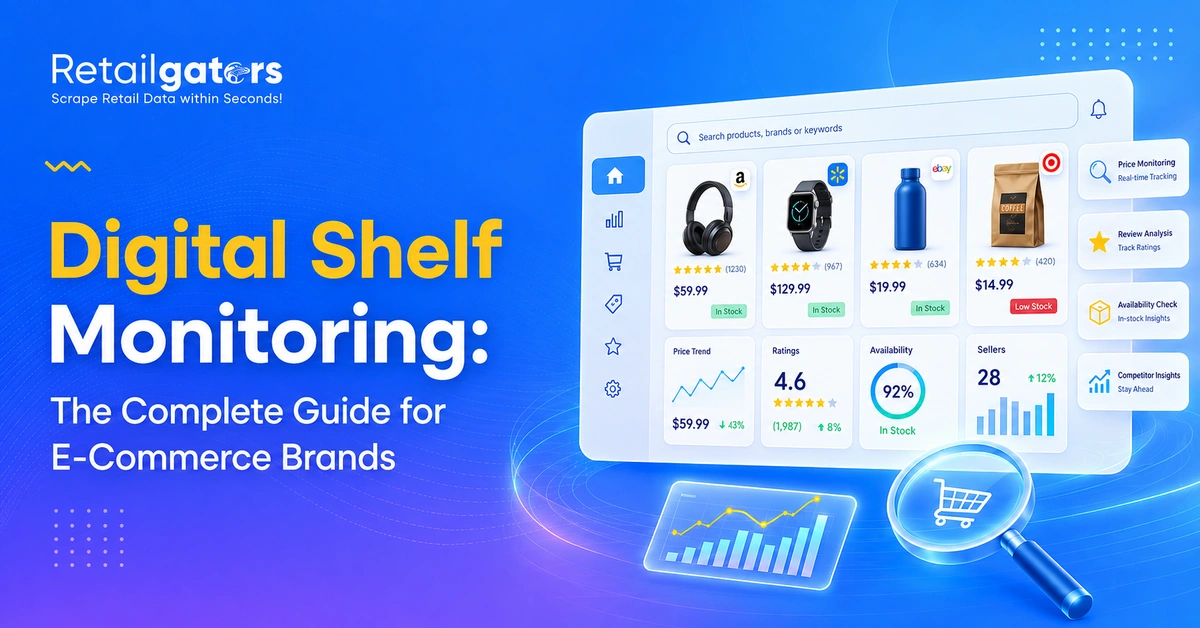
A strong digital shelf monitoring program tracks details such as:
- Product titles
- Images and descriptions
- Pricing and discounts
- Product availability
- Seller information
- Ratings and reviews
- Search ranking
- Buy Box ownership
- Promotions and coupons
- Product content consistency
- Competitor positioning
The goal is simple: understand what customers actually see before they decide to buy.
What customers see online often matters more than what the brand intended internally.
Why the Digital Shelf Matters So Much
The modern shopper is impatient.
They compare options quickly. They scan images before reading descriptions. They trust ratings. They notice price differences. They switch brands if a product is out of stock. And they seldom give a listing a second chance if the first impression is lacking.
This creates a real challenge for brands.
You might have a great product, but if your listing has missing images, inconsistent pricing, weak content, poor visibility, or stock issues, the customer may never reach the checkout.
A small issue can lead to a large commercial impact.
For example, a personal care brand might run a national campaign for a new shampoo. Traffic increases. Search demand rises. But on one marketplace, the product title is incorrect. On another, the hero image is outdated. A third retailer shows the item as unavailable. Meanwhile, a competitor has clear images, strong reviews, and a limited-time discount.
The campaign may look successful from a traffic standpoint, but sales may still fall short.
The problem isn’t marketing. The problem is shelf execution.
Digital shelf monitoring helps brands spot these gaps early.
The Real Problem: E-Commerce Teams Are Working Blind
Most e-commerce teams work hard, but they lack visibility.
One team manages pricing. Another handles content. A different team monitors inventory. A separate team looks at reviews. Sales teams focus on retail partners. Leadership reviews high-level revenue dashboards.
The issue is that digital shelf problems rarely stay within one department.
A stockout affects search ranking. A wrong price impacts conversion. Poor reviews harm paid campaign performance. Missing content can reduce customer trust. Losing the Buy Box might shift sales to another seller overnight.
When data is scattered, teams respond slowly.
A pricing analyst may not know that a competitor changed prices multiple times this week. A category manager may not see that a key SKU is losing search visibility. A brand manager might not realize that third-party sellers are using inconsistent product content.
This is why manual tracking doesn’t work well at scale.
Checking a few product pages once a week only provides a snapshot. It doesn’t reflect the full market movement. By the time someone notices a problem, customers may have already switched to another brand.
Key Metrics Brands Should Track on the Digital Shelf
Digital shelf monitoring becomes effective when brands know what to track. Not every metric matters equally, but certain signals directly impact visibility, conversion, and revenue.
Product Availability
Availability is one of the most critical signals on the digital shelf.
If a product is out of stock, it can’t sell. This may seem obvious, but the damage goes beyond the lost sale. On many marketplaces, stockouts can decrease search visibility and hurt future performance, even after inventory returns.
Customers also remember unreliable availability. If they search for your product twice and can’t buy it, they may permanently switch to a competitor.
Brands should monitor whether products are in stock, out of stock, low in stock, unavailable by region, or missing from key retailer pages.
For fast-moving categories like grocery, beauty, consumer electronics, pet products, and health products, tracking availability can make a significant difference.
Pricing and Discounts
Price is one of the most dynamic aspects of the digital shelf.
Retailers frequently change prices. Competitors run promotions. Sellers use coupons. Marketplaces show different prices based on availability, location, and fulfillment type.
A product may seem reasonably priced in your internal system but appear pricey when customers compare it online.
Digital shelf monitoring helps teams track price changes across channels and compare them with competitor products. This supports better pricing decisions without pushing the brand into constant discounting.
The goal isn’t always to be the cheapest. The goal is to know your position and the reasons behind it.
Product Content Accuracy
Product content acts as your online salesperson.
If the title is unclear, the image is subpar, or the description is missing information, customers hesitate. If product specifications vary across platforms, they may lose trust. If images are missing, they may scroll past.
Content accuracy matters because customers cannot touch or test the product online. They rely on the listing to answer their questions.
Brands should monitor titles, descriptions, bullet points, product images, pack sizes, specifications, ingredients, dimensions, and compliance-related information.
Even minor errors can create confusion. A wrong pack count, a missing size detail, or an outdated image can lower conversions.
Ratings and Reviews
Reviews aren’t just feedback; they represent buying signals.
A product with strong ratings and helpful reviews can outperform a similar product that has a lower price. Conversely, a product with declining sentiment may struggle even if traffic is high.
Digital shelf monitoring helps brands track review volume, average rating, negative review themes, customer complaints, competitor ratings, and product sentiment over time.
For instance, if multiple customers mention damaged packaging, delayed delivery, or missing accessories, the brand can address the issue before it becomes a broader reputation problem.
Reviews often reveal problems that dashboards miss.
Search Visibility
If customers can’t find your product, they can’t buy it.
Search visibility shows where your products rank when customers search for important category terms. For example, a coffee brand may want to know where it stands for “medium roast coffee,” “organic coffee beans,” or “cold brew coffee.”
This is especially crucial on marketplaces where search position can directly affect sales.
A product that shifts from page one to page three could see a considerable drop in traffic. Without monitoring, the team might only notice after revenue dips.
Tracking search visibility helps brands understand if product content, pricing, reviews, and availability support discoverability.
Buy Box Ownership
For marketplace sellers and brands, owning the Buy Box can determine who gets the sale.\
Even if several sellers offer the same product, customers often buy from the default seller shown by the platform. If your brand or authorized seller loses the Buy Box, revenue may shift elsewhere.
Buy Box performance can be influenced by price, fulfillment speed, seller rating, availability, and platform rules.
Digital shelf monitoring helps teams identify who owns the Buy Box, when ownership changes, and which factors may be causing those shifts.
This is particularly important for brands dealing with unauthorized sellers or channel conflict.
Competitor Positioning
Your product doesn’t exist in a vacuum.
Customers compare it to other options in the same category. They evaluate price, reviews, images, delivery options, promotions, and brand trust.
Monitoring competitor positioning helps category teams see how their products stack up against similar items.
Are competitors using better product images?
Are they offering larger pack sizes?
Are they priced lower during weekends?
Are they winning more reviews?
Are they ranking higher for important keywords?
These insights help brands move from guesswork to practical decisions.
Common Digital Shelf Monitoring Challenges
Digital shelf monitoring sounds straightforward until the catalog grows.
A brand with 20 products on two platforms can manage basic checks manually. A brand with 5,000 SKUs across 30 retailers cannot.
That is where the real challenges begin.
Different Platforms Show Data Differently
Every marketplace has its own layout, product structure, pricing format, review system, and seller data presentation.
Amazon does not display products like Walmart. Grocery platforms do not behave like fashion marketplaces. Regional retailers may show location-based pricing and availability.
This makes data collection and comparison difficult without a structured process.
Product Matching Can Be Complicated
One of the biggest challenges is matching the same or similar products across platforms.
A product may have different titles, abbreviations, pack descriptions, image styles, or seller names. For example, one retailer may list “12 oz body lotion,” while another may call it “hydrating lotion 354 ml.”
If product matching is wrong, the insights become unreliable.
Accurate matching requires careful use of product identifiers, brand names, size, packaging, images, descriptions, and other attributes.
Data Changes Quickly
Digital shelf data is not stable.
Prices may change in hours. Stock status can shift during peak demand. Reviews can appear daily. Promotions may go live without notice. Competitors can adjust content before a major sale.
A monthly report is not enough. In many categories, even weekly checks are too slow.
Brands need a monitoring rhythm that matches the speed of their market.
Manual Tracking Creates Errors
Manual tracking becomes messy fast.
Teams copy prices into spreadsheets. Screenshots are saved in folders. Product links break. Different people track different details. Historical data becomes inconsistent.
This wastes time and creates doubt.
A retail intelligence team should not spend most of its week cleaning spreadsheets. It should be analyzing what the data means.
How Digital Shelf Monitoring Turns Data Into Action
Collecting data is only the first step.
The real value comes when teams use digital shelf insights to make better decisions.
A pricing team can adjust strategy when competitor discounts become aggressive. A content team can fix weak product pages before campaigns go live. A supply chain team can prioritize restocking when important SKUs go unavailable. A brand protection team can identify unauthorized sellers. A category manager can see where the brand is losing visibility.
This is where digital shelf monitoring becomes more than reporting.
It becomes an operating system for e-commerce execution.
The best teams build workflows around the data. They do not wait for a quarterly review. They use alerts, dashboards, and regular performance checks to act while problems are still small.
For example, if a product drops below page-one ranking for a high-value search term, the team can review content, pricing, stock, and reviews together. If a competitor starts winning with a lower price, the team can decide whether to adjust pricing, improve the offer, or hold position.
Good monitoring does not replace human judgment. It gives teams better evidence.
Benefits of Digital Shelf Monitoring
Digital shelf monitoring helps brands make better decisions across several business areas.
Better Visibility Across Retail Channels
Teams can see how products appear across marketplaces, retailer websites, and digital commerce platforms. This helps identify gaps that may be invisible in internal sales reports.
Faster Issue Detection
When prices change, products go out of stock, content breaks, or reviews drop, teams can respond quickly. Speed matters because small problems can become expensive if ignored.
Stronger Conversion Performance
Clean content, accurate pricing, better availability, and stronger search visibility all support better conversion. Digital shelf monitoring helps brands improve the details that influence buying decisions.
Improved Competitive Intelligence
Brands can understand competitor pricing, product positioning, promotions, search rankings, and customer sentiment. This makes category planning more informed.
Better Retail Partner Management
For brands selling through multiple retailers, monitoring helps ensure product content, pricing, and availability remain aligned across channels.
More Confident Decision-Making
Instead of debating opinions, teams can work from shared data. Pricing, marketing, sales, content, and category teams can align around the same market reality.
How RetailGators Supports Digital Shelf Monitoring
RetailGators helps e-commerce brands and retail teams collect structured product, pricing, seller, availability, and marketplace data from online sources.
For digital shelf monitoring, this kind of data foundation is important. Brands need clean, reliable, and recurring data to understand what is happening across platforms.
RetailGators can support use cases such as competitor price monitoring, product availability tracking, seller monitoring, review and rating analysis, product content checks, marketplace intelligence, and custom retail dashboards.
The advantage is flexibility.
A beauty brand may want to track image consistency, ratings, and unauthorized sellers. A grocery brand may care about stock availability and regional pricing. A consumer electronics company may focus on Buy Box ownership and competitor discounts. A marketplace seller may need daily pricing and ranking intelligence.
Digital shelf monitoring is not one-size-fits-all. RetailGators helps teams build data workflows around the metrics that matter to their business.
Building a Digital Shelf Monitoring Strategy
A strong strategy does not start with tracking everything. It starts with knowing what matters most.
Begin with your priority products. These may be bestsellers, high-margin items, new launches, seasonal products, or SKUs where competition is intense.
Next, identify the platforms that influence your sales. For some brands, that may be Amazon and Walmart. For others, it may include Target, Instacart, Kroger, eBay, niche retailers, or regional marketplaces.
Then define the metrics that matter. A pricing team may care most about competitor price changes. A content team may care about listing accuracy. A sales team may care about retailer compliance. Leadership may want a dashboard that combines availability, price, search visibility, and competitor position.
After that, decide how often the data needs to refresh. Fast-moving categories may need daily or near-real-time monitoring. Slower categories may work with weekly updates.
Finally, connect insights to action. Monitoring is only useful when someone owns the response.
If pricing drops, who reviews it?
If a product goes out of stock, who gets notified?
If content is wrong, who fixes it?
If reviews decline, who investigates?
Clear ownership turns monitoring into business impact.
Digital Shelf Monitoring is Not Just for Large Enterprises
Many mid-sized brands assume digital shelf monitoring is only for major enterprises with huge catalogs. That is no longer true.
Even smaller brands can lose sales because of poor visibility, inconsistent content, or competitor pressure.
If your brand sells online through multiple channels, you already have a digital shelf. The question is whether you are watching it closely enough.
A growing brand with 100 SKUs may benefit from monitoring its top products and key competitors. A large enterprise may need a full-scale system across thousands of SKUs and multiple countries.
The scale may differ, but the need is the same.
You cannot improve what you cannot see.
The Future of Digital Shelf Monitoring
The digital shelf will only become more competitive.
Retail media is growing. Marketplaces are becoming more crowded. AI-driven search and recommendations are changing product discovery. Customers expect accurate information, fast delivery, strong reviews, and competitive pricing.
Brands will need more than basic product reporting.
They will need connected retail intelligence that shows how pricing, content, availability, search visibility, and customer sentiment work together.
The future is not just tracking what happened yesterday. It is understanding what is changing now and what action should come next.
Digital shelf monitoring will play a major role in that shift.
Conclusion
The digital shelf is now one of the most important places where e-commerce brands compete for customer attention, trust, and sales. Your product may have strong quality, better pricing, and a well-planned marketing strategy, but if it is not visible, available, well-presented, and competitively positioned online, customers may choose another brand within seconds.
Digital shelf monitoring helps brands stay aware of what is happening across product pages, search results, marketplace listings, reviews, pricing, stock availability, and competitor activity. It gives e-commerce teams the visibility they need to identify issues early, improve product performance, protect revenue, and make faster decisions backed by real market data.
For modern e-commerce brands, success is not only about being present online. It is about understanding how your products appear, how competitors are performing, and what customers actually see before they buy.
If your brand wants to monitor digital shelf performance, track competitors, analyze product availability, and improve retail intelligence across online marketplaces, RetailGators can help you collect accurate and structured e-commerce data.
Contact us today to discuss your digital shelf monitoring requirements and discover how RetailGators can support smarter e-commerce decisions.