Keeping track of competitor prices is becoming increasingly difficult for online retailers. Prices change throughout the day, product catalogs expand, and manually checking multiple competitor websites can quickly consume valuable time. This is why businesses are turning to automated price monitoring solutions to stay competitive.
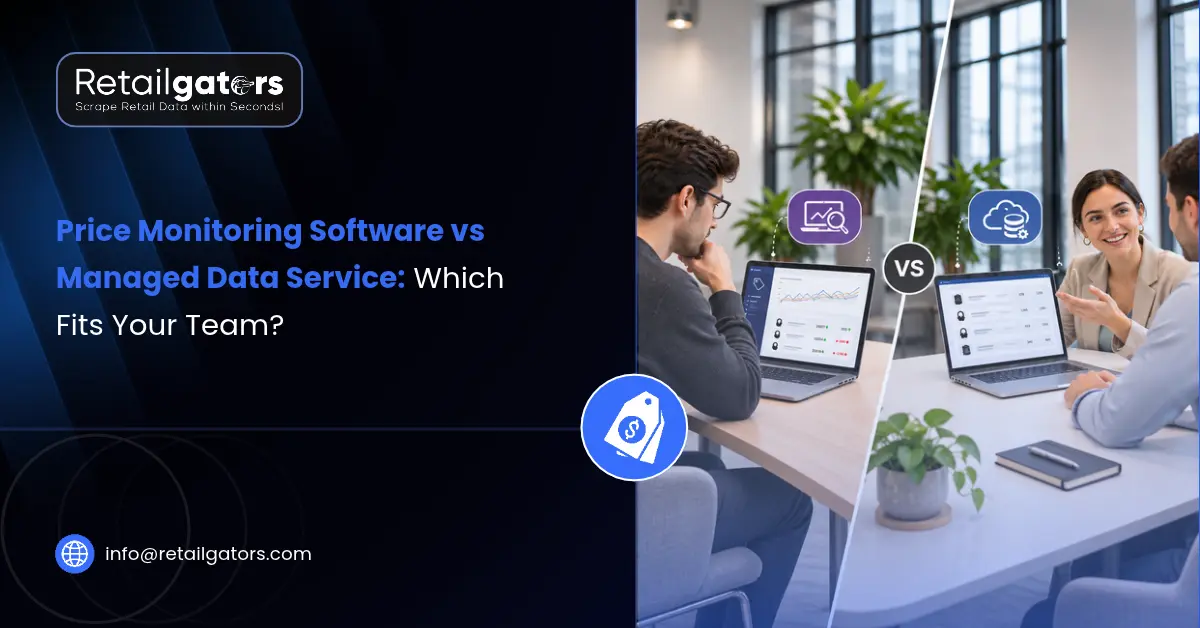
However, choosing the right approach is not always straightforward. Price monitoring software gives your team access to a platform for tracking competitor prices, while a managed price monitoring service takes care of data collection, product matching, validation, and delivery on your behalf.
Both options can help retailers make better pricing decisions, but they differ in cost, control, maintenance, and scalability. This guide compares price monitoring software and managed services, explores their actual costs, and explains which approach makes sense based on your catalog size, technical resources, and business requirements.
What Does Price Monitoring Software Actually Do?
Price monitoring software is a self-service platform that helps retailers track competitor prices, product availability, and promotional changes across online stores and marketplaces. Instead of checking competitor websites manually, teams can add product URLs, configure monitoring schedules, and receive automated updates through a dashboard.
Most price monitoring tools include features such as:
- Competitor price tracking: Monitor product prices across selected retailers and marketplaces.
- Product matching: Match your products with equivalent competitor listings.
- Price change alerts: Receive notifications when competitors increase or reduce their prices.
- Stock monitoring: Identify when products become unavailable or return to stock.
- Historical price tracking: Review previous pricing trends and promotional activity.
- Reporting and analytics: Compare competitor prices and identify market opportunities.
Platforms such as Price2Spy and Prisync offer these capabilities through subscription-based plans. They allow businesses to manage their monitoring activities directly, although the level of automation, customization, and technical support varies by provider and subscription tier.
This approach works well when businesses have manageable catalogs and employees who can oversee product matching, monitoring schedules, and data quality.
What Is a Managed Price Monitoring Service and How Does It Work?
A managed price monitoring service flips that model around. Rather than running a tool, you pass the entire job to a provider that gathers, cleans, and delivers your pricing data. This setup also goes by the name managed data service, and it typically spans product matching, data validation, and the technical work of reaching sites that fight automated access. Because the provider owns the crawlers, the servers, and the quality checks, your team receives finished data in the exact shape you request, whether that is a dashboard, an API, or a scheduled file. Large or untidy catalogs gain the most here, since the maintenance load simply disappears. You do trade away some direct control, as adjustments route through the provider rather than a setting you toggle yourself. In return, the data lands cleaner, which counts for plenty when margins ride on it.
How Does Automated Price Monitoring Collect and Process Competitor Data?
Both models rest on the same technical backbone, and understanding it explains the price gap between them. A handful of moving parts do most of the work:
- Product matching, which pairs your SKU with the correct competitor listing even when titles, images, and bundle sizes differ. Weak matching is the single biggest source of unreliable pricing data.
- Scraping frequency, meaning how often each page gets re-checked. A stable niche may be fine with daily passes, while a volatile marketplace can need several each day.
- Data validation, where prices, currencies, and stock flags are cross-checked before anything reaches a report, so one formatting glitch never triggers a bad repricing move.
- Anti-bot handling, since large retailers deploy IP blocks, rate limits, and CAPTCHAs that stop naive crawlers cold.
Self-service tools manage the easier end of this comfortably. The harder end, namely heavy matching and guarded enterprise sites, is where a managed data service usually pulls ahead, because that work is its entire business.
Price Monitoring Software vs Managed Service: Key Differences Explained
With the mechanics in view, a side-by-side look makes the trade-offs concrete. The table sums up how the two models stack up on the factors that decide most purchases.
| Factor | Price Monitoring Software | Managed Price Monitoring Service |
| Who runs it | Your in-house team | The provider’s data team |
| Setup effort | Moderate, handled by you | Low, handled for you |
| Ideal catalog size | Small to mid-size | Large or complex |
| Data cleaning | Your responsibility | Included in the service |
| Typical cost model | Flat plan, ~399+/month (USD) | Custom quote, scoped to your catalog |
| Day-to-day control | High, full dashboard access | Moderate, through requests |
| Hard-to-scrape sites | Limited by the tool | Strong, provider handles blocks |
For a closer look at how these pieces fit a real pricing program, the RetailGators guide to competitive pricing and promotion intelligence makes a useful next read.
Price Monitoring Software vs Managed Service: Cost Comparison
The cost of price monitoring depends on how many products you track, how frequently you need updates, and how much technical work your team can manage internally.
Self-service price monitoring software generally follows a subscription model. For example, Prisync publishes plans starting at $99 per month, with higher tiers offering additional product capacity and features. Price2Spy also provides subscription tiers, with premium and enterprise pricing available on request.
Managed price monitoring services follow a different pricing structure. Instead of paying for a standard software subscription, businesses receive a project-specific quote based on their monitoring requirements.
Factors that influence managed service costs include:
- Number of SKUs and competitor websites.
- Product matching complexity.
- Required monitoring frequency.
- Website structure and data accessibility.
- Number of countries and currencies.
- Data validation and enrichment requirements.
- API integration and delivery formats.
- Ongoing maintenance and support.
For smaller catalogs with straightforward monitoring requirements, a subscription tool may be more economical.
For larger programs, businesses should compare the managed service quote against the full cost of operating software internally, including employee hours, technical maintenance, data correction, and integration work.
The most cost-effective option is the one that delivers the required data quality and coverage without creating unnecessary operational expenses.
When Does Price Monitoring Software Fit Your Team?
Not every retailer needs a managed partner. For the following teams, a self-service tool is the better value:
- Smaller catalogs of a few hundred SKUs, manageable from one dashboard without extra hires.
- In-house teams with someone who enjoys data work and can own product matching.
- Predictable budgets, since flat monthly pricing rarely surprises the finance team.
- Fast experiments, because competitors can be added or dropped within minutes.
- Standard retail sites that seldom block automated price tracking or rework their layouts.
When Is a Managed Data Service the Smarter Call?
Other retailers bleed hours into upkeep, and that hidden cost usually tips the scales. A managed data service tends to pay off when these apply:
- Thousands of SKUs across many rival sites, where matching alone could occupy a full-time analyst.
- Protected targets such as major marketplaces, whose anti-bot defenses defeat most off-the-shelf tools.
- Small teams with no data engineer, so upkeep never steals time from core work.
- Specific delivery needs, from custom fields to feeds that drive a dynamic pricing engine.
- Fast expansion, when fresh regions or categories would overwhelm a simple tool.
RetailGators builds these feeds through its pricing intelligence service, which keeps scaling as catalogs grow.
When Should You Switch From Price Monitoring Software to a Managed Service?
Many retailers begin with price monitoring software because it offers an affordable way to track competitors and understand market pricing. However, the same solution may become difficult to manage as the business expands.
Consider an electronics retailer initially tracking 800 products across three competitor websites. Its in-house team can comfortably manage the monitoring process through a subscription platform.
Over time, the catalog grows to 2,500 products, additional marketplaces become important, and product matching becomes more complicated. The team also starts spending more time correcting missing prices, checking product variations, and resolving monitoring failures.
At this point, the original software may no longer meet the business’s operational requirements.
Some signs that it is time to consider managed monitoring include:
- Employees spend more time maintaining data than analyzing it.
- Product matching errors frequently affect pricing decisions.
- Monitoring coverage becomes inconsistent across marketplaces.
- Technical maintenance requires additional resources.
- The business needs customized data delivery or integrations.
- Software limitations affect the ability to expand monitoring coverage.
The transition makes sense when the total cost of maintaining the existing setup exceeds the value it provides. Businesses should compare alternative solutions before switching rather than assuming that a managed service will always be more economical.
How to Choose Between Price Monitoring Software and Managed Services
The decision ultimately depends on how much responsibility your team wants to retain. Price monitoring software works well when employees can manage the platform and maintain data quality internally. A managed service is more suitable when data collection, product matching, and technical maintenance have become operational challenges.
Some businesses may also benefit from a hybrid approach. They can use price monitoring software for straightforward competitor tracking while outsourcing complex data collection requirements to a specialized provider.
Before selecting a solution, assess your current catalog, expected growth, technical resources, monitoring requirements, and total cost of ownership.
Final Verdict: Which Model Should You Trust?
Choosing between price monitoring software and a managed service depends on your catalog size, internal resources, and data requirements. Software provides direct control and predictable subscription costs, making it suitable for businesses with straightforward monitoring needs. Managed services offer greater operational support for complex catalogs, customized data collection, and ongoing data maintenance.
If your team spends more time collecting and correcting competitor pricing information than analyzing it, outsourcing may be worth considering. RetailGators helps businesses monitor competitor prices, promotions, and product availability through managed price intelligence solutions. Explore its price monitoring services or request a free pilot to evaluate data coverage and quality against your business requirements.