Introduction
Having a grasp on how customers feel about your brand is important in any competitive market, and today, online reviews are often the primary source of consumer feedback. Reviews are a valuable source of insight for companies, offering not just product satisfaction, performance, and experience feedback, but a view into public perception of a company’s ability to deliver value. If you know how to look, the data holds valuable insights into the customer experience.
Businesses can scrape and analyze product reviews to gather this information at speed and scale. By scraping product reviews, companies can support research on the customer experience without the need to manually scroll through pages of feedback. Instead, they can automatically capture and analyze thousands of unbroken review texts, thereby gathering meaningful insights to support improvements in product development, customer service, and marketing decisions.
In this blog, we’ll walk you through the tools, techniques, and best practices for scraping reviews and evaluating brand sentiment.
Why Review-Based Brand Sentiment Matters?
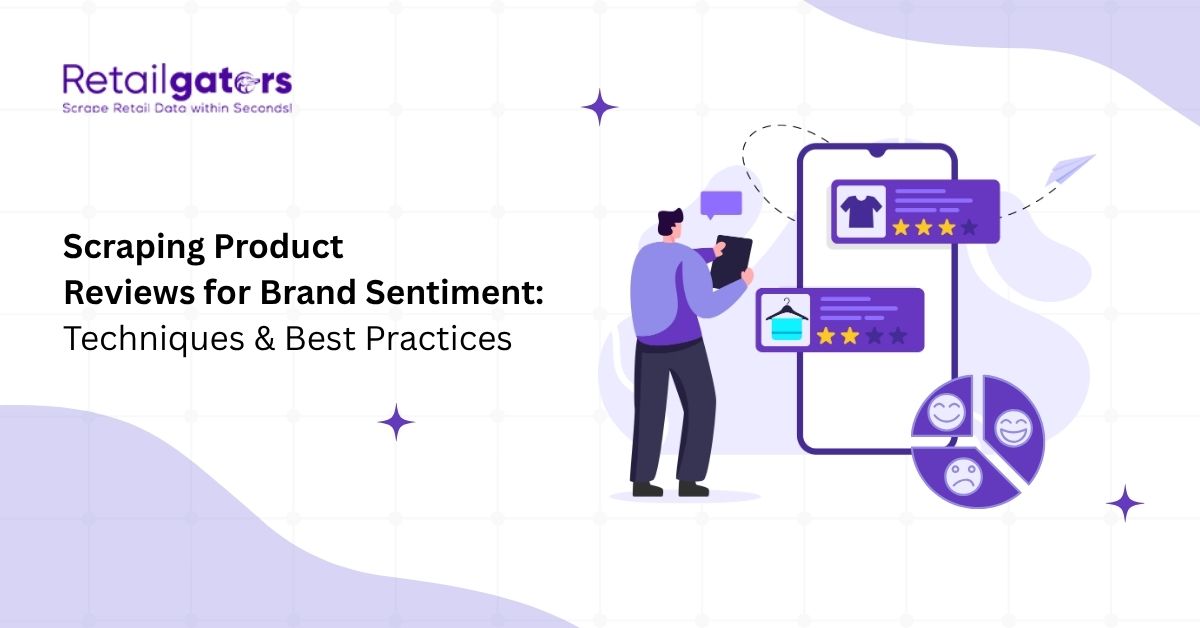
Customer reviews are more than a star rating; they express actual feelings and emotions, opinions, and experiences. If a customer is enjoying prompt delivery or upset about poor packaging, they are expressing something and the feeling adds valuable information for the brand to evaluate. Because reviews are usually extremely explicit, it is quite useful to understand what customers really dislike or really love.
A brand’s sentiment (formed from reviews), gives you a fuller view of the public perception of a brand more than a score alone would. When scrutinized, reviews will usually show trends over time, signal how your changes are affecting customer satisfaction, and highlight the benefits or pitfalls of your product or service. Listening for the emotional tone behind what customers are saying will also allow brands to be more proactive in their course of action and allow brands to create stronger relationships with the customers.
What Are The Methods & Tools For Scraping Product Reviews?
The preliminary step in gaining an understanding of sentiment is collecting reviews, and the technique of web scraping allows this process to be achieved at scale. Web scraping is the process of scanning data from websites and gathering it to analyze later. Businesses typically use tools such as BeautifulSoup, Selenium, or browser automation frameworks to extract review text, star ratings, user information, and dates from e-commerce sites like Amazon and review sites like Yelp.
In a quest for the best method to collect reviews, it is important to understand the ethical harvesting methods to collect reviews through web scraping. This includes following robots.txt, rotating proxies, and using appropriate delays between requests. Custom web scrapers can be built in Python to handle these tasks. After web scraping is accomplished, the data should be saved to a specified format that can later be processed. The typical format for raw web-scraped files is CSV or JSON. Reliable and clean data is the backbone for proper sentiment analysis.
Sentiment Analysis: Techniques After Scraping
After you scrape the reviews, it’s time to find out how customers are actually feeling—i.e., sentiment analysis. Sentiment analysis is a form of natural language processing (NLP) that classifies the emotional tone of text as positive, negative, or neutral. You can use an automation tool like TextBlob or VADER or even more robust natural language processing models to do this.
Sentiment analysis can happen in a few different ways. You can do document-level sentiment analysis that interprets the sentiment of an entire review, or you can do sentence-level analysis that parses a review down to be more specific. Or aspect-based analysis, where the opinions on specific aspects of the product, such as “delivery,” “price,” or “quality,” are identified.
Cleaning the data also enhances the accuracy of any model you use to analyze sentiment. For example, prior to analysis, you might clean the review text to remove non-essential text, including noise like emojis, links, and punctuation. Having a proper analysis of your review returns, you are able to not only see the general feeling your customers express but also what parts or conditions of your product impact their opinion to one degree or another.
What Are The Best Practices and Challenges?
To optimize the results you can get from review-based sentiment analysis, you need to follow best practices. First, there is a significant benefit to having a diverse dataset, meaning one that is collected from multiple sources and time spans, so that you can mitigate bias.
Second, you will want to periodically validate your sentiment outputs through sampling and manually reviewing and checking at least some of them for accuracy. Not only does such validation make your overall process more reliable, but it also helps you adjust your analysis models and algorithms as you move forward.
Nonetheless, despite best practices, there are still issues you may encounter along the way. Fake reviews, various writing styles, sarcasm, etc., can all interfere with reviewing results. Automated systems are far better at identifying subtle language, but they can totally misread meaning, and you may end up drawing unfortunate conclusions.
Therefore, you should combine automation with occasional manual review. Finally, you should also be aware of legal and ethical boundaries when scraping from certain websites. Overall, if you plan and account for these challenges, companies will be able to address issues and leverage sentiment insights to drive real changes over the customer journey.
From Insight to Strategy: Using Sentiment Data
Sentiment analysis goes beyond discovering emotion; it is all about how you act on that data. Now that we know how customers feel, we can use that data to change how we operate. For example, are customers saying the same negative things in their reviews regarding delivery? You may need to alter your logistics. Conversely, do any customers mention the durability of your product in their reviews? You may want to fully leverage this in your marketing materials.
It is also important to point out that using sentiment over time allows brands to see if there has been an effect on new policies, features, and campaigns. The score can be shared on dashboards, and departments—marketing, product, and customer service—can see and take in real-time what customers are feeling.
A brand should not compartmentalize these insights; they should operate as part of a broader company strategy. If you use what your customers are telling you as a focus for action, you can do away with churn, improve experiences, and grow customer loyalty.
Advanced Tips & Pitfalls
As sentiment analysis grows more sophisticated, there are some important considerations to keep in mind. Language is dynamic, and models must change along with it. Be sure to keep your system up to date with new sources of data to make sure it grasps modern expressions, slang, or evolving customer expectations.
For international brands, the scenario is sometimes even more complex; sentiment analysis needs to account for language and cultural context. Such an instance is when multilingual models or translation tools can help maintain the integrity of the data.
Finally, be aware of some of the challenges of fake or biased reviews, as they may derail your sentiment findings. Use platforms with effective filters or pattern detection processes to look for unnatural content, such as repetition of phrases or bulk submissions within a short timeframe. And remember, do not rely solely on automation.
The subtlety in sentiment often calls for human processing. A blended approach, with automation, manual review, and intelligent filtering, will keep your sentiment analysis accountable and worth trusting.
Conclusion
Customer feedback from reviews is the most robust source of brand-level feedback you can collect. Fleeting shopper sentiment is insightful. If they are collected and analyzed correctly, you can appreciate shopper sentiment and behavior in real time. When you scrape and analyze customer reviews, you’ll know where your strengths are, how to save weaknesses, and perfect product-market fit.
We are all about building your business with data-enabled decisions at RetailGator. We make sure every review you collect is more than a comment to you. Every review is a tool you can use to improve your product, service, and brand preference in the market. With the right combination of scraping/search strategies, sentiment models, and best practices, you can represent actual feedback to optimal growth.
Let RetailGator help you leverage the voice of your customer to give you a competitive advantage.