How Many Abercrombie & Fitch Stores Are in the US?
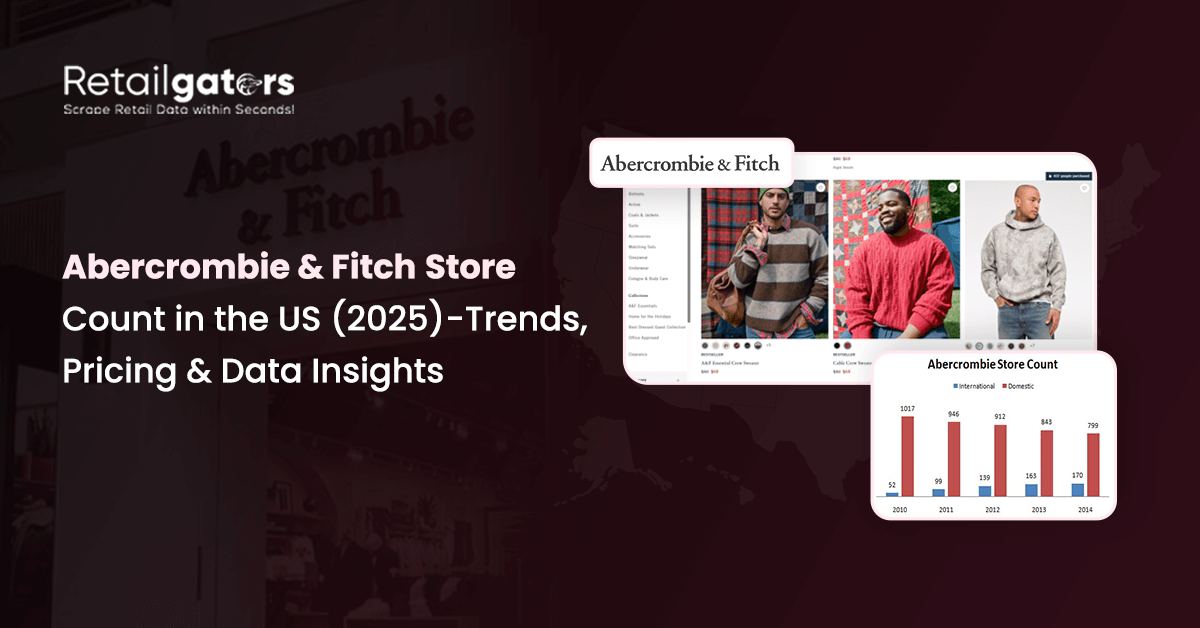
As of 2025, Abercrombie & Fitch operates 239 stores across the United States. This figure represents a strategic retail presence that balances physical locations with digital commerce. Therefore, the brand maintains a significant footprint in American retail despite industry-wide shifts toward online shopping.
The current store count reflects years of strategic adjustments. Moreover, since 2015, Abercrombie & Fitch-branded locations have decreased from 393 to 278 stores. However, this consolidation has strengthened the brand’s financial performance rather than weakened it.
RetailGators data shows that Abercrombie & Fitch’s measured approach to store expansion demonstrates retail maturity. Consequently, the brand focuses on profitable locations rather than maximum coverage.
What States Have the Most Abercrombie & Fitch Stores?
California leads all states in Abercrombie & Fitch store count. Specifically, California has 46 stores, representing 19% of all US locations. This concentration makes sense given California’s population of 39.5 million residents.
Texas ranks second with 29 stores (12%), while Florida holds third place with 26 stores (11%). Therefore, these three states collectively account for approximately 42% of all US Abercrombie & Fitch locations.
The regional distribution breaks down as follows:
- Northeast Region: 75 stores (31.4%)
- West Coast: 56 stores (23.4%)
- Midwest: 54 stores (22.6%)
- South: 54 stores (22.6%)
Meanwhile, major cities like Las Vegas, New York City, Houston, and San Antonio each house multiple locations. RetailGators analysis indicates that urban centers with strong tourism and commerce drive store placement decisions.
How Is Abercrombie & Fitch’s Store Strategy Changing?
The company is actively expanding its physical footprint. In fact, Abercrombie & Fitch plans to open 60+ stores in 2025. This expansion includes both new locations and strategic remodels of existing stores.
However, the growth strategy emphasizes profitability over quantity. Management stated that stores must be profitable from day one to justify capital expenditure. Consequently, each new location undergoes rigorous financial analysis before approval.
The expansion includes approximately 20 store closures alongside new openings. Therefore, the net growth remains measured and strategic. RetailGators tracks these changes to provide accurate retail intelligence.
Furthermore, the company delivered 125 new store experiences in fiscal 2024, including 65 new stores, 12 rightsizes, and 48 remodels. This comprehensive approach refreshes the brand’s physical presence while optimizing existing assets.
What Are Abercrombie & Fitch’s Financial Trends?
Revenue performance has exceeded expectations consistently. Abercrombie & Fitch achieved record revenue of $4.95 billion in fiscal 2024, representing 16% year-over-year growth. This performance marked the highest annual revenue in the company’s 133-year history.
Each store generates approximately $17.33 million in annual revenue. This impressive per-store productivity demonstrates operational efficiency. Moreover, it justifies the company’s selective expansion strategy.
The Americas region dominates revenue generation. Specifically, over 80% of total revenue comes from the Americas, with EMEA contributing 16% and APAC adding 3%. Therefore, US stores remain the financial backbone of the business.
Recent quarterly performance shows continued momentum. Q3 2025 revenue reached $1.29 billion, beating analyst estimates by 0.9%. Meanwhile, the company raised its full-year guidance based on sustained demand.
RetailGators data indicates that Abercrombie & Fitch’s financial turnaround represents one of retail’s most successful brand repositioning stories.
How Does Abercrombie & Fitch Price Its Products?
Abercrombie & Fitch employs mid-range pricing that balances quality perception with accessibility. The brand positions above fast-fashion retailers to emphasize quality while remaining below luxury brands. This strategic positioning targets young adults who value both style and durability.
The pricing approach incorporates several key elements:
- Value-Based Pricing: Products are priced according to perceived customer value rather than production costs alone. This allows the brand to maintain premium positioning while delivering quality.
- Seasonal Promotions: Strategic discounts attract price-sensitive shoppers without undermining brand image. However, the company carefully manages promotional frequency to protect margins.
- Regional Price Adjustments: International markets often command higher prices than US stores. This reflects import costs and stronger brand perception abroad.
Despite price optimization, the brand faces margin pressures. Tariffs imposed approximately $90 million in costs for 2025, impacting operating margins by 170 basis points. Nevertheless, management has avoided broad price increases that might alienate customers.
RetailGators pricing intelligence shows that Abercrombie & Fitch maintains competitive positioning against peers like American Eagle and Gap. Therefore, strategic pricing remains central to the brand’s growth strategy.
What Challenges Does Abercrombie & Fitch Face?
Tariffs represent the most significant near-term challenge. The company continues navigating cost pressures through supply chain optimization and vendor negotiations. However, these headwinds affect profitability despite revenue growth.
Inventory management requires careful attention. The Abercrombie brand experienced a 5% sales decline in Q2 2025 due to inventory level management and lower average unit retail. Meanwhile, the Hollister brand delivered strong performance with 19% growth.
Competition remains intense across the casual apparel sector. Traditional rivals and emerging direct-to-consumer brands pressure market share. Therefore, continuous innovation in product and experience becomes essential.
Mall anchor struggles continue affecting traffic patterns. Although Abercrombie & Fitch has adapted successfully, the shift away from indoor malls and troubles at anchor tenants have historically challenged the brand. Consequently, store location strategy emphasizes high-performing centers.
How Is Abercrombie & Fitch Performing Compared to Competitors?
Abercrombie & Fitch has outperformed many traditional mall-based retailers. The brand’s same-store sales growth demonstrates strong customer engagement. Over the past two years, the company averaged exceptional year-over-year same-store sales growth of 11.9%.
This performance contrasts sharply with struggling peers. While retailers like Gap face challenges, Abercrombie & Fitch has successfully repositioned for contemporary consumers. RetailGators comparative analysis shows the brand gaining market share in the young adult casual wear segment.
The stock market has recognized this turnaround. Shares have risen 75% year-to-date, significantly outperforming the Russell 2000 Index’s 21% gain. Therefore, investors view the brand transformation favorably despite short-term challenges.
What Does the Future Hold for Abercrombie & Fitch Stores?
The company projects continued growth through 2025 and beyond. Management targets 6% to 8% compound annual growth for Abercrombie & Fitch-branded stores. Meanwhile, digital sales are expected to reach 60% of total revenue by year-end.
Omnichannel integration drives the growth strategy. Customers can browse online, try products in-store, and complete purchases through either channel. This seamless experience improves satisfaction and loyalty.
Sustainability initiatives will attract environmentally conscious consumers. The brand’s commitment to sustainable practices aligns with younger demographic values. Therefore, these efforts support long-term brand relevance.
International expansion offers additional growth opportunities. While the US remains dominant, European and Asian markets present untapped potential. However, the company maintains its measured approach to ensure profitability.
RetailGators forecasts indicate that Abercrombie & Fitch will continue optimizing its store fleet. The focus remains on high-performing locations that support both physical and digital customer engagement.
Key Takeaways About Abercrombie & Fitch Store Count
Abercrombie & Fitch operates 239 US stores as of 2025, with California, Texas, and Florida leading state-level counts. The brand is strategically expanding with 60+ planned store openings while maintaining rigorous profitability standards.
Financial performance has reached record levels, with $4.95 billion in fiscal 2024 revenue and approximately $17.33 million per store annually. Mid-range pricing balances quality perception with market competitiveness, though tariff pressures affect margins.
The company successfully navigates retail transformation through omnichannel integration and brand repositioning. Strong same-store sales growth and stock performance demonstrate market validation of the turnaround strategy.
RetailGators data shows that Abercrombie & Fitch exemplifies successful legacy brand evolution. The measured store expansion, combined with digital investment, positions the company for continued growth in competitive retail markets.