Restaurant operators and food delivery platforms face constant pressure to stay competitive. Menu prices shift daily, new items appear without notice, and customer ratings fluctuate in real time. Therefore, businesses need reliable menu intelligence systems to track these changes across thousands of locations worldwide.
RetailGators delivers comprehensive restaurant and food delivery menu monitoring solutions that capture pricing data, item availability, and customer feedback in real time. This intelligence helps restaurants optimize their menus, food delivery platforms benchmark their offerings, and market researchers identify industry trends before competitors do.
What Is Restaurant Menu Intelligence?
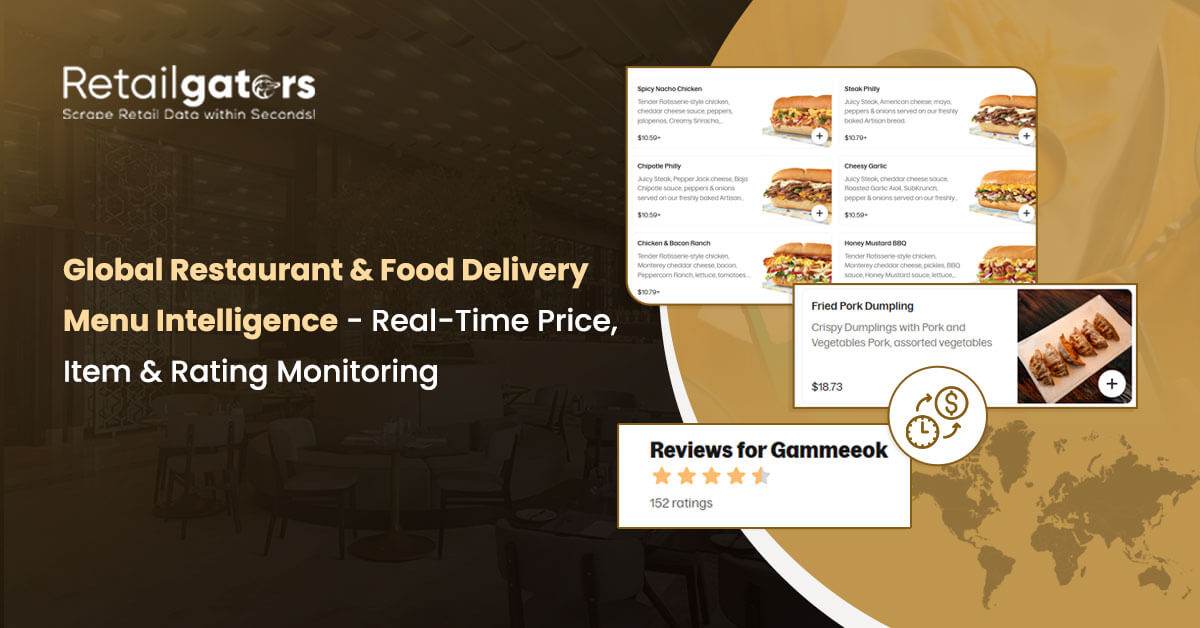
Restaurant menu intelligence refers to the systematic collection and analysis of menu data from restaurants and food delivery platforms. This includes tracking menu items, prices, descriptions, images, availability, and customer ratings across multiple locations and brands.
Menu intelligence systems monitor data from restaurant websites, mobile apps, and third-party delivery platforms like Uber Eats, DoorDash, Grubhub, and international services. RetailGators specializes in extracting this data at scale, providing businesses with actionable insights into competitive pricing, menu innovation, and consumer preferences.
The process involves automated data extraction, real-time monitoring, and structured data delivery. As a result, businesses receive clean, standardized datasets that enable quick decision-making without manual research.
Why Do Businesses Need Real-Time Menu Monitoring?
Dynamic Pricing Requires Constant Vigilance
Restaurant prices change frequently based on ingredient costs, seasonal availability, demand patterns, and competitive pressures. However, manually tracking these changes across hundreds or thousands of competitors proves impractical.
Real-time monitoring from RetailGators alerts businesses when competitors adjust their pricing strategies. For instance, if a local burger chain drops prices by 15% during lunch hours, nearby restaurants can respond immediately rather than losing market share for weeks.
Menu Innovation Drives Customer Acquisition
New menu items generate customer interest and media coverage. Meanwhile, businesses that track competitor menu launches can identify trending ingredients, preparation methods, and flavor profiles before they become mainstream.
RetailGators captures menu updates within hours of publication. This speed allows product development teams to analyze successful items, understand ingredient combinations, and test similar concepts in their own markets.
Rating Trends Predict Performance Issues
Customer ratings on delivery platforms directly impact visibility and order volume. Therefore, monitoring rating changes across competitor locations reveals operational problems, quality issues, or service improvements.
When a competitor’s rating drops suddenly, it signals an opportunity. Conversely, rising ratings indicate successful operational changes worth studying. RetailGators tracks these metrics continuously, providing context around rating shifts with review volume and timing data.
How Does Menu Intelligence Work?
Automated Data Collection Systems
Menu intelligence platforms use specialized web scraping technology to extract data from restaurant websites and delivery apps. These systems navigate complex site structures, handle dynamic content loading, and process multiple data formats.
RetailGators employs proprietary extraction methods that adapt to site changes automatically. This ensures continuous data flow even when restaurants redesign their websites or delivery platforms update their mobile apps.
Data Standardization and Quality Control
Raw menu data arrives in inconsistent formats with varying structures and naming conventions. Consequently, standardization processes clean this data into uniform schemas that enable comparison and analysis.
The platform normalizes item names, categorizes menu sections, converts prices to consistent currencies, and validates data accuracy through multiple checks. RetailGators maintains data quality standards that exceed 98% accuracy across all monitored sources.
Real-Time Alert and Reporting Systems
Once collected and standardized, menu data flows into alert systems that notify users of significant changes. These alerts trigger based on customizable thresholds for price changes, new item additions, rating drops, or availability shifts.
RetailGators delivers data through API integrations, automated reports, and dashboard interfaces. Users access historical trends, competitive benchmarks, and predictive analytics through intuitive visualization tools.
What Can You Track With Menu Intelligence?
Price Monitoring Across Markets
Track menu prices for identical or similar items across different brands, locations, and delivery platforms. This reveals geographic pricing strategies, platform-specific discounts, and competitive positioning.
RetailGators monitors price variations for the same restaurant across Uber Eats, DoorDash, and direct ordering channels. Many restaurants charge different prices on each platform to offset commission fees, creating opportunities for consumer apps and comparison services.
Menu Item Availability and Inventory
Monitor which items appear on menus at specific times, locations, or platforms. Availability tracking identifies limited-time offers, seasonal items, regional specialties, and out-of-stock situations.
For example, RetailGators can track how many locations carry a new promotional item during a national campaign. This helps franchisors ensure compliance and helps competitors gauge rollout success.
Rating and Review Analytics
Collect star ratings, review counts, and sentiment data from delivery platforms and review sites. This intelligence reveals customer satisfaction trends, service quality issues, and reputation management effectiveness.
RetailGators aggregates ratings from multiple platforms to create comprehensive reputation profiles. Users identify which competitors maintain consistently high ratings and which struggle with customer satisfaction.
Menu Structure and Category Organization
Analyze how restaurants organize their menus, categorize items, and present offerings to customers. Menu structure influences ordering behavior and average ticket sizes.
Successful restaurants optimize menu layouts to highlight high-margin items and guide customers toward profitable choices. RetailGators captures these structural elements, enabling businesses to benchmark their own menu designs against top performers.
Who Benefits From Menu Intelligence?
Restaurant Chains and Franchises
Multi-location restaurant brands use menu intelligence to ensure pricing consistency, monitor franchise compliance, and benchmark against competitors. This data supports strategic decisions about menu changes, promotional pricing, and regional customization.
RetailGators helps restaurant chains track their own locations to verify that franchisees implement corporate pricing strategies correctly. Meanwhile, competitive intelligence reveals how rivals position similar offerings in shared markets.
Food Delivery Platforms
Third-party delivery services need comprehensive menu data to improve search functionality, recommendation algorithms, and marketplace completeness. Accurate menu intelligence enhances user experience and increases order conversion rates.
Delivery platforms working with RetailGators gain access to standardized menu data that fills gaps in their catalogs and corrects outdated information. This improves customer satisfaction and reduces order errors.
Market Research Firms
Research companies serving the restaurant industry require extensive data to analyze trends, forecast demand, and advise clients. Menu intelligence provides the foundation for reports on pricing trends, menu innovation, and competitive dynamics.
RetailGators supplies research firms with historical data spanning years, enabling longitudinal studies of menu evolution, price inflation, and category growth. These datasets support authoritative industry reports and consulting recommendations.
Investment and Financial Analysis
Investors analyzing restaurant stocks and private equity firms evaluating acquisition targets need operational data beyond financial statements. Menu intelligence offers insights into competitive positioning, pricing power, and operational execution.
By tracking menu prices and customer ratings across portfolio companies and competitors, investors identify operational trends before they appear in quarterly earnings. RetailGators data has informed investment decisions involving billions in restaurant sector capital.
How Do You Implement Menu Intelligence Solutions?
Define Monitoring Scope and Objectives
Start by identifying which competitors, markets, and data points matter most to your business objectives. Focused monitoring delivers better ROI than attempting to track everything at once.
RetailGators works with clients to prioritize data collection based on strategic goals. For example, a burger chain expanding into new cities might focus on local burger competitors’ pricing and ratings rather than monitoring the entire restaurant industry.
Integrate Data Into Existing Systems
Menu intelligence delivers maximum value when integrated with business intelligence platforms, pricing systems, and operational dashboards. API connections enable automated data flows that update decision-making tools continuously.
The RetailGators API provides flexible integration options that work with popular business intelligence platforms like Tableau, Power BI, and custom-built analytics systems. This allows teams to combine menu intelligence with internal sales data, inventory systems, and financial metrics.
Establish Alert Protocols and Response Plans
Configure alert thresholds that trigger notifications for significant changes requiring immediate attention. However, avoid alert fatigue by filtering out minor fluctuations that don’t warrant action.
Successful RetailGators clients establish clear protocols for responding to different alert types. For instance, a 10% competitor price drop might trigger an immediate pricing review meeting, while a new menu item might go into a monthly innovation report.
Train Teams on Data Interpretation
Menu intelligence generates value only when teams understand how to interpret data and translate insights into action. Therefore, invest in training that helps marketing, operations, and product development teams use intelligence effectively.
RetailGators provides onboarding support and best practice guidance to help teams maximize the value of menu intelligence. This includes training on competitive analysis frameworks, pricing strategy development, and trend identification methods.
What Are the Key Challenges in Menu Intelligence?
Data Volume and Processing Complexity
Monitoring thousands of restaurant locations across multiple platforms generates massive data volumes. Processing this information quickly enough for real-time decision-making requires sophisticated infrastructure.
RetailGators handles billions of data points monthly, maintaining processing speeds that deliver updates within hours of menu changes appearing online. This scale requires advanced cloud infrastructure and optimized data pipelines.
Site Changes and Technical Obstacles
Restaurants and delivery platforms regularly update their websites and mobile apps, potentially disrupting automated data collection. Adaptive systems must detect and respond to these changes quickly.
The RetailGators platform employs machine learning algorithms that detect site structure changes and automatically adjust extraction methods. This minimizes data gaps and maintains collection reliability despite frequent technical changes.
Data Accuracy and Validation
Menu data must be accurate to support critical business decisions. However, errors can occur during extraction, processing, or when source data contains mistakes.
RetailGators implements multi-stage validation processes that cross-reference data from multiple sources, flag anomalies for human review, and maintain audit trails for quality assurance. This rigorous approach ensures data reliability.
How Is Menu Intelligence Evolving?
AI-Powered Predictive Analytics
Advanced menu intelligence platforms now incorporate artificial intelligence to predict future trends based on historical patterns. These systems identify early signals of menu innovations, pricing shifts, and category growth.
RetailGators is developing predictive models that forecast which menu items will gain popularity based on early adoption patterns, social media sentiment, and ingredient trend analysis. This gives clients a competitive edge in menu development.
Image Recognition and Visual Analysis
Modern systems analyze menu item images to extract additional intelligence about portion sizes, presentation styles, and ingredient visibility. Visual analysis complements text-based data extraction.
Computer vision technology enables RetailGators to track visual menu trends, identify presentation innovations, and compare portion sizes across competitors. This creates new opportunities for menu optimization and competitive differentiation.
Integration With Supply Chain Data
Forward-thinking applications combine menu intelligence with ingredient pricing and supply chain data. This integration helps restaurants understand cost pressures facing competitors and predict likely pricing changes.
By connecting menu data with commodity prices and supplier information, RetailGators helps clients understand the economics behind competitor decisions. This context improves strategic planning and pricing decisions.
Why Choose RetailGators for Menu Intelligence?
RetailGators specializes in restaurant and food delivery data intelligence with proven expertise across global markets. The platform monitors tens of thousands of restaurant locations and delivery platforms daily, providing comprehensive coverage that individual businesses cannot replicate internally.
The service combines technical excellence with industry knowledge, delivering not just data but actionable insights that drive business results. Clients receive dedicated support from experts who understand restaurant operations, competitive dynamics, and market research needs.
Moreover, RetailGators maintains the highest standards for data quality, privacy compliance, and security. The platform adheres to all relevant data protection regulations and implements enterprise-grade security measures to protect client data.
Getting Started With Menu Intelligence
Implementing menu intelligence starts with a clear understanding of your competitive landscape and business objectives. Identify which competitors influence your pricing decisions, which markets require constant monitoring, and which data points directly impact your strategy.
RetailGators offers flexible engagement models including full-service monitoring, self-service platforms, and custom data delivery solutions. The team works with clients to design monitoring programs that fit specific needs and budgets.
Contact RetailGators today to discuss how real-time menu intelligence can transform your competitive strategy, optimize your pricing, and accelerate your menu innovation. The restaurant industry moves fast—your intelligence should move faster.