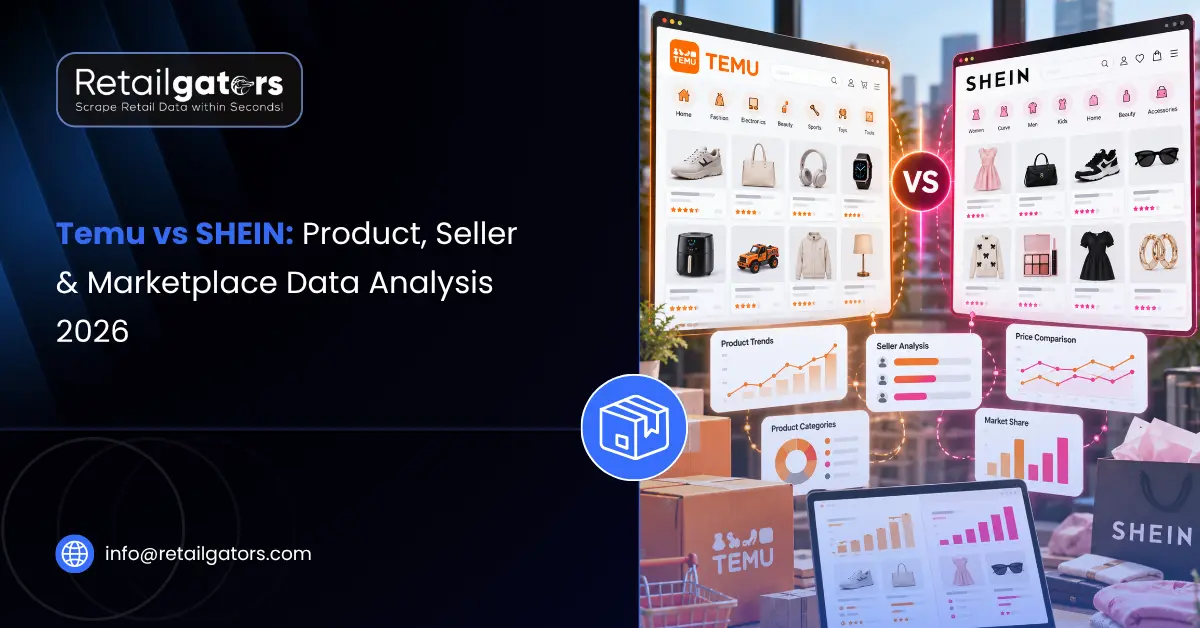
A pricing analyst who spends a week watching Temu and SHEIN side by side notices something that catalog reports don’t capture: the same category of product can behave completely differently on the two platforms. A $6 phone case on Temu might sit at that price for a month, while a trending SHEIN dress can swing through three different discount tiers in a single week. For ecommerce teams trying to benchmark against either marketplace, or both, that kind of volatility makes manual tracking almost useless — which is usually the point where businesses start looking at ecommerce data scraping as a way to keep up.
Temu and SHEIN get lumped together constantly, and in some ways that’s fair — both are fast-growing, China-linked marketplaces built around aggressive pricing and rapid product turnover. But the data each platform generates tells two different stories. Temu operates more like a broad discount marketplace spanning dozens of categories, while SHEIN is still fundamentally a fashion-first platform, even as it expands into home goods and lifestyle products. A useful Temu vs SHEIN data analysis isn’t really about declaring one platform “bigger” or “cheaper.” It’s about understanding what each marketplace’s product, seller, and pricing data actually looks like, and which of those signals matter for the decision you’re trying to make.
Temu vs SHEIN Data Analysis: What Makes These Marketplaces Different
The clearest starting point is catalog breadth. Temu built its growth around a consumer-to-manufacturer model that pulls in products across electronics, home goods, tools, pet supplies, and apparel — essentially positioning itself as a general discount marketplace rather than a specialty retailer. SHEIN, despite expanding its assortment in recent years, still generates the bulk of its traffic and product volume around apparel, accessories, and beauty, with a catalog built around fast fashion cycles rather than broad category coverage.
That difference in catalog philosophy shapes how pricing behaves on each platform. Temu listings commonly show a slashed “before” price next to a current price, often paired with countdown timers and quantity-based discounts that change frequently enough to make static price-checking almost pointless. SHEIN relies heavily on stacked promotions — sitewide percentage-off codes, flash sales tied to specific categories, and a points or rewards system that effectively changes the real price a shopper pays depending on when and how they check out. Neither platform’s “list price” is a particularly stable number on its own, which is exactly why structured tracking matters more here than it does on more price-stable marketplaces.
Product variation data also diverges. Temu listings typically group color and size options under a single product page, similar to how larger marketplaces structure variations. SHEIN does the same for apparel, but adds size-chart data, model measurements, and “complete the look” product pairings that are specific to fashion retail and don’t have a clean equivalent on Temu’s more general catalog.
Seller and brand data is becoming more relevant on both platforms, though it’s still less central than it is on marketplaces like eBay. Temu has started opening listings to third-party sellers in some markets, while SHEIN runs its own marketplace program alongside its core private-label catalog — meaning that “who actually sells this” is a field businesses increasingly need to account for rather than assume away.
Temu Product Data: What Businesses Can Analyze
For teams building out a Temu product data strategy, a handful of fields consistently matter more than the rest.
Product titles and descriptions on Temu tend to be keyword-dense, reflecting how heavily the platform relies on search and category browsing rather than brand recognition to drive discovery. That makes title data useful for understanding how sellers are positioning similar products against each other.
Pricing and discount structure is arguably the most important field to capture, given how often Temu prices shift. The relationship between the struck-through “original” price and the current price is itself a data point worth tracking over time, since it reveals how aggressively a given listing is being discounted relative to its own history.
Ratings and reviews are aggregated per product, similar to Amazon’s model, and tend to accumulate quickly given Temu’s order volume. Review counts and rating trends can act as an early signal for which products are gaining traction versus which ones are seeing quality complaints pile up.
Product variations, images, and specifications round out the core fields, with shipping information (local warehouse versus overseas fulfillment) increasingly worth capturing too, since delivery speed varies enormously depending on which fulfillment path a listing uses — a factor that affects both customer experience and how directly comparable a listing is to competing products elsewhere.
SHEIN Product Data and Marketplace Data Analysis
SHEIN product data asks for a slightly different lens, mostly because of the fashion-first catalog structure underneath it.
Product titles, descriptions, and category tags carry real weight here, since SHEIN’s catalog depth means similar items are often distinguished mainly by style descriptors and trend-related keywords rather than by brand.
Size and fit data is more prominent on SHEIN than on most general marketplaces — size charts, model height and measurements, and fit-related review comments all factor into how a shopper evaluates a listing, and by extension, how a business should evaluate a competing product’s positioning.
Pricing and promotion data is genuinely complex on SHEIN, since the “real” price a customer pays often depends on stacked coupons, flash-sale windows, and loyalty points that aren’t visible in a simple price scrape. Capturing promotional context alongside the base price is necessary if the resulting data is going to reflect what shoppers are actually paying.
Reviews, including photo and video reviews, are a notably rich data source on SHEIN, since fashion buyers rely heavily on seeing how an item looks on different body types before purchasing — which makes review sentiment and review media volume a meaningful product-intelligence signal in its own right.
Seller or brand attribution matters more now than it used to, as SHEIN’s marketplace expansion means a growing share of listings come from third-party sellers rather than SHEIN’s own private-label supply chain, with different quality and fulfillment implications depending on which is the case.
Marketplace Seller Analysis: Temu vs SHEIN
Seller-level data hasn’t traditionally been the headline use case on either platform, the way it is on eBay or Etsy, but that’s changing as both marketplaces lean further into third-party seller participation.
On Temu, seller analysis mostly centers on identifying which listings are fulfilled through Temu’s own logistics network versus listings tied to specific manufacturer partners, along with how consistently a given seller’s pricing and stock levels hold up over time. Because much of Temu’s catalog still runs through centralized fulfillment, seller-level variation tends to be less dramatic than on marketplaces built entirely around independent sellers.
On SHEIN, seller analysis is more directly tied to distinguishing SHEIN’s own private-label products from marketplace-seller listings, since the two can carry different quality expectations, different return policies, and different pricing behavior. For a business trying to benchmark against SHEIN specifically, knowing whether a competing listing is SHEIN-owned or a third-party seller operating on SHEIN’s platform changes how that comparison should be weighted.
Neither platform currently offers the kind of deep, standalone seller profile that eBay or Etsy do, but the gap is narrowing, and businesses doing marketplace seller analysis across Temu and SHEIN should expect seller-level data to become a more reliable field over time rather than less.
Ecommerce Product Analysis for Pricing & Trend Tracking
Where Temu and SHEIN data gets genuinely useful is in trend tracking — both platforms move fast enough that static, one-time comparisons go stale within days.
Pricing analysis benefits from historical tracking more on these two marketplaces than on most others, precisely because list prices shift so often. A single price check tells you what a product costs today; a tracked price history tells you whether that price represents a genuine discount pattern or just one snapshot in a constantly moving cycle. This is where structured pricing intelligence work earns its keep — turning noisy, fast-changing price data into something a pricing team can actually act on.
Trend tracking goes beyond price, too. Watching which product categories are expanding on Temu, or which styles are gaining review volume on SHEIN, gives a business an early read on where consumer demand is heading before it shows up in their own sales data. That kind of signal is especially valuable for private-label brands and retailers trying to anticipate fast-fashion or impulse-buy trends before they peak.
Product matching across the two platforms is worth flagging as its own challenge. Comparing a Temu listing to a SHEIN listing for “the same” product requires confirming they’re genuinely equivalent — same specifications, same variation, same condition — before treating their prices as comparable. Skipping that step is an easy way to produce numbers that look precise but aren’t actually measuring like-for-like.
Temu vs SHEIN Data Comparison Table
| Data Area | Temu | SHEIN | Business Use |
| Catalog focus | Broad, multi-category discount marketplace | Fashion-first, expanding into lifestyle categories | Assortment planning, category benchmarking |
| Pricing structure | Slashed pricing, countdown timers, quantity discounts | Stacked coupons, flash sales, loyalty points | Pricing intelligence, promotion tracking |
| Product variations | Grouped under parent listing (color, size) | Grouped under parent listing, plus size charts and fit data | Catalog optimization, product matching |
| Reviews | Aggregated per product, high volume | Aggregated per product, strong photo/video review presence | Sentiment analysis, trend detection |
| Seller/brand data | Mostly centralized fulfillment, growing marketplace presence | Mix of private-label and third-party marketplace sellers | Seller analysis, quality benchmarking |
| Shipping/fulfillment | Local warehouse vs. overseas shipping flags | Standard fulfillment, less fulfillment variability shown | Delivery and availability comparison |
| Promotion data | Frequent, time-limited discounts | Coupon stacking, sitewide and category-specific sales | Promotion monitoring, margin analysis |
| Trend signals | Category and listing growth patterns | Style and fashion-cycle trend data | Market research, demand forecasting |
Marketplace Intelligence: Turning Temu and SHEIN Data into Decisions
Collecting Temu and SHEIN data is the easy part compared to structuring it into something a team can act on. Raw price points and review counts are just records until they’re compared over time, matched against competitor data, and tied to an actual business question.
For a retailer trying to understand pricing pressure, the useful output isn’t “Temu lists this item at $7.99 today.” It’s a tracked history showing how that price has moved over the past month, how it compares to SHEIN’s equivalent listing, and whether the gap is widening or narrowing. That kind of marketplace intelligence turns scattered data points into an actual pricing narrative.
The same logic applies to product and trend research. A single data pull can tell a merchandising team what’s currently popular on SHEIN. A structured, recurring feed can tell them how that popularity is trending — accelerating, plateauing, or fading — which is a far more useful input for deciding whether to chase a trend or let it pass.
Why Automated Data Collection Matters for Temu and SHEIN
Manual tracking runs into real limits on these two platforms faster than it does almost anywhere else in ecommerce, mostly because of how often prices and listings change.
Frequency is the first problem. A promotion on SHEIN might run for six hours; a Temu flash discount might reset overnight. A team checking prices once a day, let alone once a week, is going to miss most of what actually happened in between — which makes any manual price comparison more of a guess than a measurement.
Scale compounds the issue. Tracking a handful of SKUs by hand is manageable. Tracking a meaningful slice of either platform’s catalog, across categories and over time, isn’t something a person can do consistently without it becoming a full-time job on its own. Automated, scheduled collection is what makes the difference between a one-off snapshot and a dataset a business can actually rely on for ongoing product intelligence work.
That said, collection still needs to be done responsibly — respecting the applicable terms of each platform, technical access constraints, and relevant legal requirements. That’s a baseline consideration regardless of which marketplace is involved, and it’s worth confirming feasibility before committing to a large-scale collection effort.
How RetailGators Supports Temu and SHEIN Data Needs
Once a business has a clear sense of which Temu and SHEIN signals actually matter for its goals, the remaining question is usually operational — how to collect that data consistently without building and maintaining the infrastructure in-house.
RetailGators works with ecommerce teams on exactly that layer, offering product data scraping across fast-moving marketplaces, structured to the fields a business actually needs rather than a generic one-size-fits-all export. That includes product titles, pricing and discount data, variations, reviews, and available seller or brand attribution, collected on a schedule that matches how quickly a given platform’s listings actually change.
For businesses tracking multiple discount and marketplace platforms at once, broader ecommerce marketplace data scraping support covers the collection side, while competitive pricing and promotion intelligence work helps turn that raw data into something pricing and merchandising teams can use directly, rather than another spreadsheet that needs its own cleanup before anyone can act on it.
Data is delivered in the format that fits an existing workflow — CSV, Excel, JSON, or API-ready feeds — on a frequency the business sets. Teams that are still working out which fields matter most can start with a free pilot run to see sample output before committing to full-scale collection.
Conclusion
Temu and SHEIN aren’t interchangeable just because they’re both fast-growing, aggressively priced marketplaces. Temu’s strength is breadth — a wide catalog spanning categories, with pricing that moves in discount cycles. SHEIN’s strength is depth in fashion — rich size and fit data, strong review media, and promotion mechanics built around stacked discounts rather than simple price cuts. A genuinely useful Temu vs SHEIN data analysis treats them as two distinct data sources, each suited to different questions, rather than trying to force one comparison framework onto both.
The businesses that get the most out of this data are the ones that automate collection early, track history rather than snapshots, and match the fields they’re gathering to the decision they’re actually trying to make. If your team needs a clearer, ongoing read on Temu and SHEIN pricing, products, or sellers, RetailGators can help build a collection approach around what you’re trying to decide.