Introduction
Across every retail category and eCommerce vertical, the businesses pulling ahead share one operational trait that rarely makes it into leadership presentations but shows up clearly in quarterly performance numbers. They are not working with better teams or bigger budgets in most cases. They are working with better, more current information than their competitors, and they are acting on it before the market shifts again.
Data collection used to mean scheduled exports, vendor reports, and analyst hours spent cleaning spreadsheets before anyone could draw a single conclusion. That model worked when markets moved slowly, and competitive windows stayed open long enough for a weekly report cycle to matter.
AI real-time scraping is the technology that closes this gap between market activity and business response, and understanding how it works is now a practical requirement for any organization competing in data-intensive commercial environments.
What Is AI Real-Time Scraping, and Why Does It Matter Now?
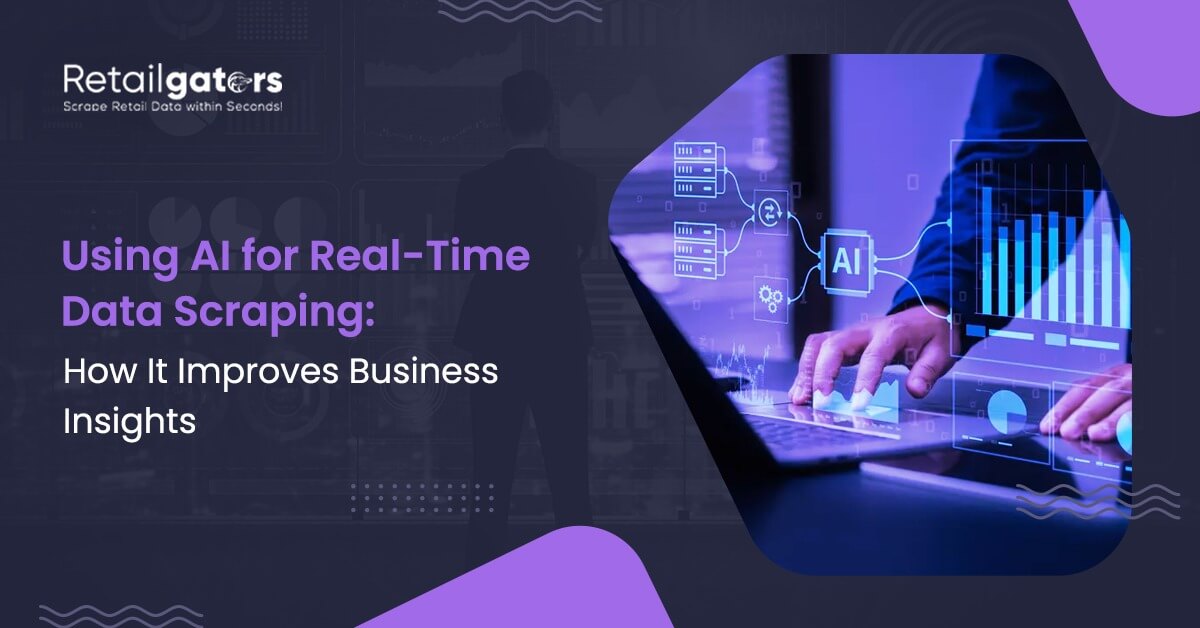
AI real-time scraping is the automated, continuous extraction of publicly available web data using artificial intelligence systems that collect, parse, validate, and deliver structured information as source conditions change rather than on predetermined collection schedules.
The distinction between scheduled scraping and real-time data collection matters more than it might initially appear. A scheduled scraper running nightly captures a snapshot of pricing, availability, or review data as it existed at 2:00 AM. Competitors making changes to pricing, launching promotions, or changing inventory will not have their changes reflected in the data for the next 23 hours, leaving companies severely disadvantaged in dynamically pricing or responding to trends.
An AI-powered scraping solution solves this problem by using an event-driven collection method. It means data pipelines start running when there are changes to the source content, rather than relying on a set schedule.
The result of merging this type of architecture with a natural language processing model, which can extract fields from unstructured HTML in volume, is a business intelligence system that provides accurate business intelligence on the state of the market as it exists now, and not when it last scheduled the extraction of that data.
How Does the AI-Powered Scraping Pipeline Actually Work?
Most businesses evaluating automated web scraping platforms encounter a gap between marketing language and technical reality.
Intelligent Crawling with Browser Emulation
At the collection layer, AI systems browse target websites using full browser emulation rather than simple HTTP requests. This distinction matters because a significant portion of commercially relevant web content, including dynamically loaded product listings, JavaScript rendered review sections, and interactive pricing modules, does not appear in raw HTML responses. Browser emulation renders pages as a human visitor would experience them, making this content accessible to the extraction layer that follows.
Natural Language Processing for Structured Extraction
Once a page is rendered, NLP models identify and extract the data fields relevant to a given use case. A product page across five different retailers might present price information in five completely different structural formats. One retailer buries it in a schema tag, another puts it in a styled div with a custom class name, and a third renders it dynamically from an API call. NLP extraction models normalize all of these variations into consistent, comparable output fields without requiring manual reconfiguration every time a source site updates its layout.
Automated Validation and Anomaly Detection
Raw scraped data contains errors. Prices return as formatting strings rather than numeric values. Product titles include HTML artifacts. Duplicate records appear when pagination logic fires incorrectly. Before any data reaches a RetailGators client dashboard, automated validation models review every record against defined quality parameters and quarantine anything that does not meet the standard. Clients receive clean, structured datasets rather than raw output requiring additional processing.
Delivery into Client Infrastructure
Validated data flows into client systems via API connections, database integrations, or dashboard interfaces depending on how the client’s existing infrastructure is configured. Our experts handles this integration layer during onboarding so that data is accessible through the tools clients already use without requiring dedicated internal engineering resources to build a bridge between the scraping platform and the business systems where decisions actually get made.
What Business Insights Does Real-Time Data Collection Actually Deliver?
The categories of business insights from data that AI real-time scraping enables are specific and commercially direct, particularly for retail and eCommerce operations.
- Competitive Price Intelligence: Track competitor SKU pricing in real time and respond to promotional events or undercuts within minutes, not days. RetailGators clients use this to protect margins during peak seasons.
- Consumer Sentiment Analysis: Extract feature level feedback from reviews, forums, and social content to understand exactly what customers value or reject about your product and your competitors’.
- Emerging Trend Detection: Real-time data collection surfaces category shifts in search and social data weeks before they appear in industry reports, giving buying teams critical lead time on inventory decisions.
- Supply Chain Intelligence: Automated web scraping collects supplier announcements, raw material price shifts, and logistics disruption reports continuously, so procurement teams act on signals rather than react to problems.
- Ad and Promotional Intelligence: Monitor competitor campaign activity and promotional calendars through AI-powered scraping to time your own campaigns strategically and identify underserved market windows.
How Does Real-Time Scraping Change Business Decision Making Speed?
The impact of AI real-time scraping on decision making is best understood not as a speed upgrade to existing processes but as a structural change in the information environment where decisions are being made. Processes designed around weekly reports assume that relevant market conditions are stable enough for a seven day lag to be acceptable. Real-time data collection removes that assumption and replaces it with a continuous intelligence feed that reflects current conditions whenever a decision needs to be made.
The operational difference across business functions looks like this in practice:
| Business Function | Without AI Scraping | With AI Real-Time Scraping |
|---|---|---|
| Price Adjustments | 1 to 3 days via manual review | Minutes via automated alert |
| Competitor Monitoring | Monthly audits | Continuous tracking |
| Trend Identification | Weekly or biweekly reports | Hourly or daily data feeds |
| Sentiment Analysis | Quarterly surveys | Live review and social data |
| Inventory Forecasting | Historical averages | Predictive, live demand signals |
| Ad and Promo Intelligence | Ad hoc, periodic research | Ongoing campaign monitoring |
RetailGators clients consistently report that the most significant operational shift after deployment is not any single data point the platform surfaces but the change in how teams approach decisions that previously required a research cycle before they could begin. When current data is already structured and accessible, the decision window opens immediately rather than after a two day data preparation process.
What Are the Compliance and Legal Considerations for AI-Powered Scraping?
Any serious discussion of AI real-time scraping needs to address the legal framework directly because the compliance question is one of the most frequently cited reasons businesses delay adoption, often based on a conflation of regulated personal data collection with the collection of publicly available commercial data.
Publicly accessible product listings, published pricing, consumer reviews, and news content are generally legal to collect under U.S. and EU legal frameworks. The legal analysis does not hinge on the act of automated collection itself but on what category of data is being collected, whether the collection method complies with the source site’s access controls, and whether the collected data falls within personally identifiable information categories subject to GDPR, CCPA, or equivalent regulations.
The practical compliance framework for responsible automated web scraping involves honoring robots.txt directives that specify which sections of a site may or may not be crawled, applying rate limiting that prevents collection activity from degrading source server performance, excluding any data fields that identify individual users rather than aggregate commercial activity, and reviewing each target platform’s terms of service for explicit scraping restrictions before collection begins.
RetailGators builds compliance review into the onboarding process for every client engagement. Collection boundaries are established through a legal assessment before any pipeline goes live, and the platform’s architecture separates publicly available commercial data collection from regulated personal data categories at the infrastructure level rather than relying on client teams to manage the distinction manually.
What Challenges Does Real-Time Data Collection Present, and How Are They Addressed?
Businesses evaluating real-time data collection platforms benefit from understanding the technical obstacles involved because the quality difference between platforms often comes down to how effectively they solve these specific problems rather than whether they have solved them at all.
Anti-Bot and Detection Systems
It represents the most technically demanding challenge in AI-powered scraping infrastructure. Websites across retail and eCommerce deploy increasingly sophisticated bot detection systems including CAPTCHA challenges, IP reputation scoring, behavioral analysis, and device fingerprinting. Modern AI-powered scraping systems address this through rotating residential proxy networks, browser fingerprint randomization, and behavioral pattern modeling that makes automated collection traffic statistically indistinguishable from organic human browsing activity at the network level.
Structural Inconsistency Across Source Sites
It creates extraction accuracy problems for scraping systems that rely on rigid rule based parsing. When a source site updates its layout, a rule based parser fails silently, returning empty fields or malformed data without flagging the failure.
NLP based extraction models at RetailGators are trained to identify data semantically rather than structurally, which means a price field is recognized as a price field regardless of where in the page markup it appears or how the surrounding HTML has changed since the model was last updated.
Data Volume Management
It is a practical operational challenge at scale. Collecting millions of records per day from hundreds of source sites generates raw data volumes that overwhelm analysis workflows if delivered without filtering.
RetailGators applies AI filtering layers that reduce raw data volume by 70 to 80 percent before delivery by removing records that fall outside defined relevance parameters, ensuring that what reaches client dashboards is signal rather than unfiltered collection output.
Freshness and Trigger Logic
Determines whether real-time data collection actually delivers current data or merely faster scheduled data. Event driven triggers that activate collection when source page content changes produce genuinely current data.
Scheduled triggers running at short intervals produce data that is current only as of the last interval, which can still mean a one hour or two hour lag during active market periods. RetailGators uses event driven architecture so that clients receive updates reflecting actual source changes rather than arbitrary schedule increments.
How Do RetailGators Deliver Business Insights from Data Differently?
RetailGators positions its approach to business insights from data around outcomes rather than technical deliverables. Retail and eCommerce businesses do not need raw HTML at scale. They need structured, validated, analysis-ready intelligence that integrates with the reporting and decision-making systems they already operate.
The platform’s retail-specific AI extraction models are trained on the structural patterns, terminology, and data formats specific to retail and eCommerce sources, producing more accurate and complete extraction from these sites than general-purpose scraping tools that were designed for broader use cases and repurposed for retail applications.
Anomaly detection runs before every delivery, quarantining records that do not meet quality thresholds rather than passing data quality problems downstream to client teams.
Custom data schemas are built around each client’s existing reporting structure so that data arrives in a format compatible with the KPIs and analysis frameworks the business already uses. The scalable infrastructure supporting RetailGators handles millions of data points per day without performance degradation, and compliance architecture is embedded at the infrastructure level rather than managed as a client-facing configuration option.
Conclusion
The businesses gaining durable competitive advantages in retail and eCommerce markets are not operating with fundamentally different strategies from their competitors in most cases. They are operating with better information, and more specifically, with information that reflects current market conditions rather than conditions from the last report cycle.
AI real-time scraping is the infrastructure that makes this possible at commercial scale, combining continuous automated web scraping with AI extraction, validation, and delivery systems that produce actionable business insights from data without requiring large internal data engineering teams to build and maintain the collection infrastructure.
RetailGators provides this infrastructure specifically for retail and eCommerce businesses, with platform capabilities built around the data sources, extraction challenges, compliance requirements, and reporting frameworks that define the operational context these businesses actually work within.
The value case for AI-powered scraping is no longer a forward-looking argument about future competitive dynamics. It is a description of the gap that has already opened between businesses operating on current data and those still working from delayed reports. Closing that gap is what RetailGators is built to do, and the businesses that have made that decision are already operating with a structural information advantage that compounds with every week that passes.