Introduction
Price changes happen fast on major retail platforms; competitors update product prices dozens of times throughout a single business day. Shoppers, meanwhile, have access to tools that show them the lowest available price across the web in seconds. Any retailer still working off a weekly pricing review is not just behind; they are likely losing margin on their best-selling products right now.
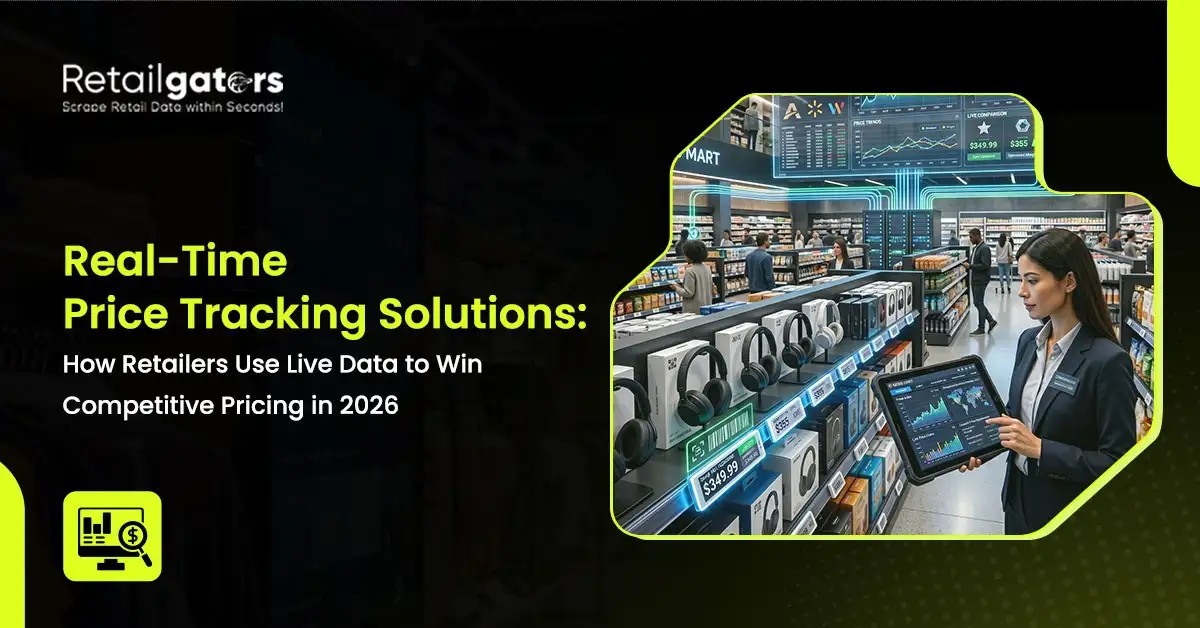
Structured investment in real-time price tracking solutions addresses this problem at the operational level. Rather than reacting to pricing gaps after the fact, retailers gain continuous visibility into market conditions and can act before revenue is lost. The sections below outline how these systems function, what outcomes they produce, and what procurement criteria actually matter.
What Are Real-Time Price Tracking Solutions?
At a practical level, a real-time price tracking solution is software that monitors competitor pricing data across multiple retail channels without interruption. Product prices are captured as they change, not on a fixed weekly or monthly schedule. That data then feeds into dashboards, alert systems, or repricing engines, depending on how the platform is configured.
The operational difference is significant. Manual tracking is limited by headcount and attention; automated tools track tens of thousands of SKUs across many channels simultaneously, providing consistent, current data regardless of the time of day or day of the week.
Research from Forrester in 2025 shows retailers that deployed dynamic pricing monitoring tools achieved, on average, a 14% gross margin improvement over those still relying on periodic manual audits. That figure reflects what access to faster, more current pricing intelligence actually produces at scale.
Why Does Pricing Speed Matter This Much in 2026?
The competitive pricing environment has not gradually shifted. It has been restructured. A few data points illustrate the current reality:
- Boomerang Commerce research from 2024 estimates Amazon processes roughly 2.5 million price updates per day across its catalog.
- Walmart and Target now use competitor price tracking software internally. Their systems detect and respond to competitor price moves in under 10 minutes in many categories.
- Browser extensions and comparison platforms such as Google Shopping, Honey, and Capital One Shopping are now embedded in how a large portion of online consumers shop.
- Pricing decisions at leading retailers are increasingly linked to real-time inventory data, fulfillment cost inputs, and conversion metrics, not just catalog price lists.
Consequently, a pricing gap that goes unaddressed for even half a day can produce meaningful revenue and margin loss, particularly during high-traffic periods or when a competitor runs a clearance event on a shared category.
How Do Real-Time Price Monitoring Tools Actually Operate?
Data Collection
Most competitor pricing software uses web crawlers to gather structured pricing information from product pages. Enterprise-grade technologies generally complement crawl-based collection with retailer API connectors or licensed data partnerships that deliver faster inputs with fewer gaps.
Product Matching and Normalization
Matching competitor products accurately is technically harder than it appears. The same item may carry different titles, bundle options, or seller attributions across platforms. Mature retail price intelligence solutions use machine learning models to resolve these discrepancies before any comparison is presented to the user.
Alert Delivery and Automated Repricing
Once a monitored price crosses a configured threshold, the platform either notifies your pricing team or executes a repricing rule directly. Rules are defined in advance: for example, match a competitor’s price if it falls more than 4 percent below your current listing, but maintain a floor equal to landed cost plus a defined margin percentage.
Trend Reporting and Historical Archives
Live alerts capture the moment. Historical archives explain the pattern. Capable ecommerce price tracking solutions retain months of pricing history, enabling teams to identify competitors that price aggressively before holidays, categories where price sensitivity is highest, and time windows when margin protection is most at risk.
Price Tracking Tool Comparison by Operational Profile
| Tool Type | Best Fit | Refresh Rate | Automation |
|---|---|---|---|
| Manual Spreadsheet | Catalogs under 100 SKUs | Weekly or monthly | None |
| Basic Web Scraper | Mid-market retailers | Daily | Low |
| Real-Time SaaS Platform | Enterprise retailers | Every 15 to 60 minutes | High |
| AI-Powered Repricing Engine | Omnichannel brands | Continuous | Full |
What Should Retailers Prioritize When Selecting a Price Tracking Platform?
Not all real-time price monitoring tools are built to the same standard. These six criteria distinguish platforms that deliver measurable ROI from those that produce data without direction:
- Channel coverage scope: The online platform should encompass all applicable channel types for your category. These could include Amazon, Wal-Mart, brand-direct sites, regional chains, and specialty retailers.
- Data refresh frequency: Currently, a standard refresh cycle for competitive retail is every 15 minutes. If these cycles are longer, it can leave many gaps in your competitive intelligence when market change is rapid.
- Product matching precision: If product matches are incorrect, there will be misinformation when comparing the two products. Request that your chosen provider demonstrate the accuracy of their product matching relative to your catalog before finalizing the contract.
- Repricing rules functionality: The platform will include configurable logic and automated management of each repricing action. All responses that fall outside of the predetermined thresholds set by your team do not need to be approved manually.
- Integration architecture: To determine how much manual data handling is required, it depends on the vendor’s current integration with your e-commerce platform (eCommerce), Enterprise Resource Planning (ERP) system, or Product Information Management (PIM) system.
- Historical Data Depth: Access to a vendor’s historical data can provide additional insight and a value-added service to support future product category planning and decision-making.
At RetailGators, each of these criteria is addressed within a unified platform built around the specific operational needs of retail pricing teams.
RetailGators: A Dedicated Retail Price Intelligence Solution
RetailGators is an eCommerce and multichannel retailer business solution for monitoring your competitors’ prices. Retailgators monitor the large number of products offered by competitors, as well as the many various types of competition, such as price, service, and delivery.
Key platform capabilities include:
- Price monitoring across more than 50 retail channels, including Amazon, Walmart, Best Buy, Target, and direct brand storefronts
- Alert delivery within 20 minutes of a detected price change via email, Slack, or API webhook
- Automated MAP (Minimum Advertised Price) violation detection with enforcement reporting built in
- Visual pricing history dashboard covering up to 12 months of competitive price movement
- A configurable automated price tracking system that executes repricing within guardrails defined by your pricing team
Beyond platform features, RetailGators provides structured implementation support. New clients configure their product catalogs and competitive monitoring sets within 48 hours of onboarding, which means value realization begins quickly rather than weeks into deployment.
Verified Outcomes: What Retailers Have Measured Using Live Pricing Data?
Gross Margin Recovery in Consumer Electronics
One regional electronics retailer ran a single overnight price update cycle. That schedule left prices stale throughout the morning hours, during which a key competitor was raising prices by 12% on 40 shared SKUs every Friday. After deploying a real-time price tracking solution, the team identified this pattern within the first week and aligned their pricing accordingly. We expect to recover 8% of our gross margin in the next 60 days.
MAP Enforcement for a Direct-to-Consumer Apparel Brand
Unauthorized sellers were undercutting authorized retail pricing across multiple venues, eroding consumer trust in authorized retailers. Less than one week into deploying competitor price tracking software, they uncovered 23 non-compliant listings. The brand quickly sent out compliance correspondence, and within 30 days, pricing stabilized in the authorized retail channel.
Amazon Buy Box Performance Improvement
A home goods retailer was consistently losing the Amazon Buy Box to sellers pricing marginally below their listed price during peak traffic hours. Their dynamic pricing monitoring tool adjusted their prices precisely during those windows. Buy Box win rate moved from 61% to 84% within the first month of active repricing.
Is Automated Dynamic Pricing Legally and Ethically Compliant?
Dynamic pricing has a long commercial history across industries including aviation, hospitality, and retail. Practiced within documented boundaries, it raises no legal or ethical concerns. The relevant limits are these:
- Price gouging during declared state or federal emergencies is prohibited under applicable consumer protection statutes in most U.S. jurisdictions.
- MAP policies must be applied consistently across all channels. Selective enforcement creates legal exposure and damages retailer relationships.
- Repricing logic must not disadvantage protected consumer classes. Differential pricing based on demographic inference is both legally risky and ethically indefensible.
Outside those boundaries, deploying ecommerce price tracking solutions to monitor competitors and align pricing with live market data is standard commercial practice. Most large U.S. retailers already operate this way.
Metrics That Quantify Pricing Tool ROI
| Performance Metric | What It Measures |
|---|---|
| Gross Margin Improvement | Revenue retained per unit following repricing actions |
| Price Response Time | Elapsed minutes between competitor change and your adjustment |
| Buy Box Win Rate | Share of time holding the featured offer position on Amazon |
| MAP Compliance Rate | Proportion of active listings priced at or above MAP |
| Price Competitiveness Index | Your average price relative to the lowest observed market price |
How to Configure a Real-Time Price Tracking System: Four Decisions?
Implementation of a real-time price monitoring tool does not require months of preparation. Four decisions made at the outset determine how quickly the platform generates usable intelligence.
- Define competitors: determine which of your competitors impact the pricing of your category. Typically start with 5-10 competitors.
- SKU Prioritization: Monitor only the top 20% ($$) of revenue-generating SKUs initially; this will give you 80% of the average catalog’s total margin exposure.
- Alert thresholds: Set the price difference that triggers an alert. Many retailers set alerts at a 3-5% delta until they can assess the results from their first price watch program.
- Response workflow choice: determine whether price changes should be reviewed by humans before responding or have the system respond automatically based on certain parameters.
The implementation team at RetailGators works through each of these decisions with new clients as part of a structured onboarding process. Most retailers reach a fully operational configuration within two business days.
Conclusion
The quality of pricing decisions in 2026 is directly proportional to the quality of pricing data available at the time of decision. Retailers without real-time price tracking solutions are working from information that is already hours old, and in fast-moving categories, that delay has measurable consequences for both revenue and margin.
The documented outcomes across use cases, gross margin recovery, MAP enforcement resolution, and improved Buy Box performance all trace back to a single operational shift: replacing periodic manual reviews with continuous, structured retail price intelligence. That shift is now accessible to retailers at every scale, not only those with enterprise-level resources.
For retailers ready to operate with the same pricing intelligence their largest competitors already use, visit RetailGators and request a complimentary pricing audit to identify where live data can produce the most immediate impact for your catalog.