Introduction
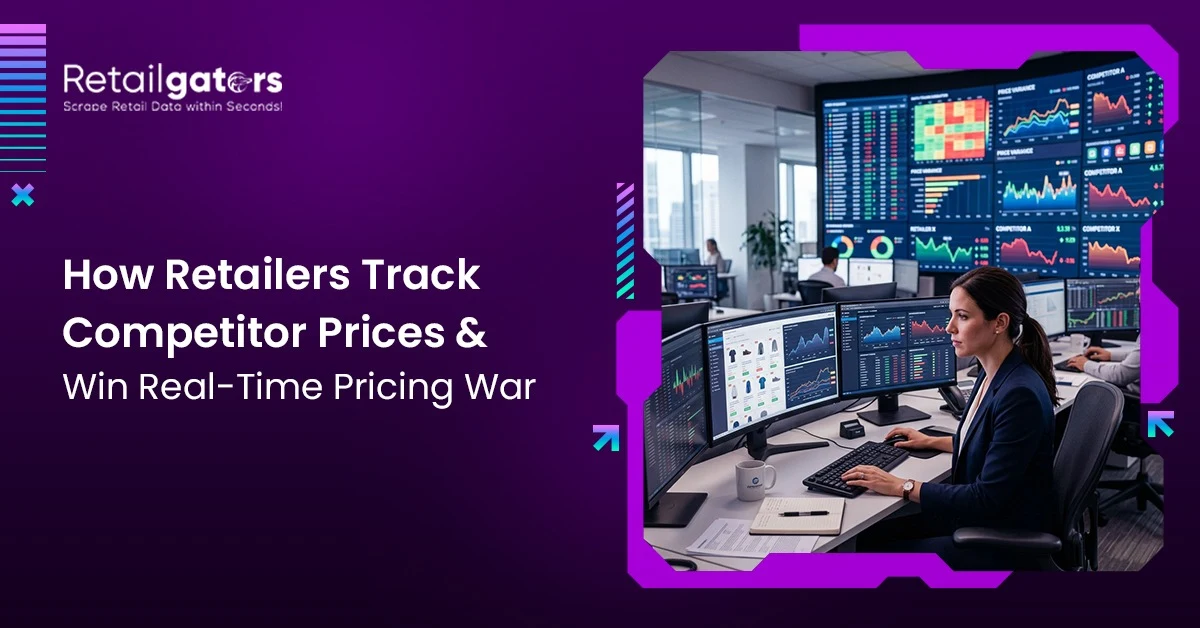
Retail pricing has never been more competitive. Margins are thinner, shoppers are more informed, and price changes happen faster than most teams can manually track. The retailers pulling ahead right now are not guessing at their pricing. They are running structured intelligence operations that capture what competitors charge, process that data quickly, and act on it with defined rules.
This piece covers the core mechanics behind competitor price monitoring, what separates good real-time pricing data from noise, and how dynamic pricing strategies actually get built and executed in practice.
Why Competitor Price Monitoring Has Become a Business Necessity?
Ten years ago, checking a handful of competitor websites weekly passed as competitive research. That approach no longer holds up. Pricing velocity across retail has increased dramatically, and the gap between what a retailer knows and what the market is doing has real financial consequences.
The core issue is timing. A competitor adjusting prices on your shared SKUs at 8 AM means nothing to you if you find out at the end of day. Automated competitor pricing analysis closes that gap. It captures changes as they happen and surfaces them to whoever owns the pricing decision.
How Retailers Actually Collect Competitor Pricing?
Understanding the mechanics matters because the method determines data quality, freshness, and coverage. These are the four primary approaches retailers use today.
Automated Web Crawlers
Crawlers remain the workhorse of price tracking for ecommerce operations. They visit competitor product pages on scheduled intervals, extract current pricing, and push that data into a central system for processing.
Today’s crawlers provide modern solutions to many of the long-standing issues faced by web scraping tools of the past. Some of the more technical challenges include rendering JavaScript-based pages, IP rotation to avoid detection, and using AI to perform product matching, which lists products from competing retailers with their respective catalog identifiers, such as UPCs or EANs.
Typical data gathered by crawlers will include:
- current selling price and any previous changes in a period of time
- discount levels and any special price promotions.
- stock availability of different item choices
- delivery fees and shipping type.
Third-Party Price Intelligence Platforms
Building and maintaining crawling infrastructure requires engineering resources that many retail teams do not have. Third-party competitor pricing analysis platforms solve that by aggregating real-time pricing data from thousands of sources simultaneously, covering direct retail websites, marketplaces, and price comparison engines.
RetailGators regularly evaluates these platforms across dimensions like product matching accuracy, data freshness, category coverage, and reporting quality. The differences between providers are significant and category-specific.
Marketplace Monitoring Tools
Selling on Amazon, Flipkart, or Google Shopping introduces pricing dynamics that general crawlers often miss. Marketplace-specific tools track Buy Box ownership, third-party seller pricing behavior, and fulfillment-driven price variance within those platforms.
This form of price tracking for ecommerce is particularly valuable during promotional windows when marketplace prices can shift several times within a single hour.
Manual Verification
Manual checks serve a narrow but legitimate role. Teams use them to verify flagged data points, spot-check high-value SKUs, or assess pricing that automated systems could not cleanly capture. They do not replace automated competitor price monitoring at any real scale. They supplement it.
What Real-Time Pricing Data Means in Practice?
The term gets used loosely. In practice, real-time pricing data means competitor price changes are captured and available to act on within minutes to a few hours of occurring, not the following morning or at the end of week.
That distinction matters operationally. A price drop from a key competitor at 9 AM can be met with a calibrated response by 9:20 AM if the infrastructure exists to support it. Without that infrastructure, the same price change surfaces days later through a dip in conversion data, by which point the damage has already accumulated.
| Data Frequency | Typical Refresh Rate | Works Best For | Key Limitation |
|---|---|---|---|
| Real-time | Minutes to 2 hours | High-velocity SKUs, flash sales | Higher infrastructure cost |
| Daily batch | Every 24 hours | Standard catalog monitoring | Misses same-day price moves |
| Weekly reports | Once per week | Category strategy reviews | Too slow for tactical response |
| Manual spot checks | On demand | Specific SKU verification | Cannot scale across large catalogs |
Choosing the right frequency is a function of category velocity. Electronics, consumer goods, and marketplace categories typically require near-real-time feeds. Slower-moving product lines can operate effectively on daily data without meaningful competitive disadvantage.
How Dynamic Pricing Strategies Use Competitor Intelligence?
Dynamic pricing strategies take competitor price inputs and combine them with internal data including inventory levels, demand patterns, margin floors, and historical conversion rates to adjust prices continuously without requiring manual intervention on every SKU.
There are four main execution models in use today.
The starting point for most retailers is normally rule-based repricing. The retailer establishes a condition, such as maintaining a certain percentage of a certain competitor on certain SKUs, never going below cost-linked floor pricing, or limiting any upward pricing to a certain price ceiling. Once data from a new competitor becomes available, the rules automatically execute.
With algorithmic pricing models, a retailer goes beyond this level of sophistication through the use of machine learning; i.e., by analyzing price elasticity, demand seasonality, competitor reaction patterns, and margin contribution all at once rather than applying the same rules to each independent of the others as would occur under a rule-based model.
In channel and segment pricing, a retailer applies multiple price points based largely on geographic location (e.g., United States vs. Canada vs. Europe), customer tier (e.g., consumer vs. resale vs. enterprise), or sales channel (e.g., bricks-and-mortar vs. web vs. direct).
RetailGators can track how large brands with established distribution networks manage their pricing strategies at varying levels of complexity, especially in protecting their pricing on direct-to-consumer sales while remaining competitive on third-party marketplaces.
Governance controls exist as an overarching structure to all other execution layers. These controls set floor pricing, ceiling pricing, and human review thresholds, so that automation does not make pricing decisions beyond acceptable risk limits. This is especially important during periods of extremely volatile market activity.
Building a Competitor Pricing Analysis Framework That Holds Up
Collecting data is the easy part. Turning it into consistent, defensible pricing decisions requires a framework that the whole organization can operate within.
Identify Your Actual Competitors
Not every retailer in your category is a meaningful pricing competitor for every SKU. The competitive set should be defined at the product and channel level, not the brand level. A retailer’s direct website competitive set often differs substantially from its marketplace competitive set.
Use Multiple Data Sources
Relying on a single source for competitor pricing analysis creates structural blind spots. The strongest programs combine direct crawling, marketplace feeds, and comparison engine data to build a complete and cross-verified picture of the market.
Build Alert Logic Around Decision Thresholds
Alerts work when they are specific. A trigger set at “any price change by any competitor” generates noise. A trigger set at “competitor A reduces price by more than 5% on any SKU ranked in your top 50 by revenue” generates actionable intelligence.
Document Response Protocols in Advance
Decisions made under time pressure with no prior guidance are often poor decisions. Define in advance how to respond to different competitive scenarios: when to match, when to hold, when to move in the opposite direction, and who carries the final authority.
Close the Loop With Outcome Measurement
Track what happened after each pricing decision. Conversion rate changes, margin impact, and volume shifts following a repricing event tell you whether the response was right. That feedback systematically improves both the dynamic pricing strategies and the intelligence inputs over time.
What Breaks Price Tracking Programs in Practice?
Pricing below cost to match competitors is the most common and most damaging mistake. Automated systems need hard floor prices or they will follow competitors into unprofitable territory without any resistance.
Weak product matching generates comparisons between non-equivalent items. A competitor’s price on a different bundle, specification, or condition is not a valid benchmark. Poor matching degrades the quality of every decision downstream.
Data lag in fast-moving categories eliminates the timing advantage that real-time pricing data is supposed to provide. If the infrastructure cannot deliver fresh data when the category demands it, the program is not fit for purpose.
No context layer on competitor data leads to reactive decisions that do not reflect reality. A competitor dropping price by 30% may be clearing end-of-line stock. Reacting as though it is a strategic move wastes margin unnecessarily.
Automation without defined limits produces pricing spirals. Two retailers with rule-based systems set to undercut each other will drive prices to the floor within hours if no floor price exists. Guardrails are not optional.
Where Competitor Price Monitoring Creates the Most Value?
| Retail Segment | Core Reason for Priority | Primary Metric to Track |
|---|---|---|
| Consumer electronics | Daily price movement with tight margin structure | Price index vs. top competitors by SKU |
| Fashion and apparel | Markdown timing directly affects full-price sell-through | Markdown velocity and promotional depth |
| Grocery and FMCG | Key item pricing shapes overall basket value perception | KVI price gap relative to primary competitors |
| Marketplace sellers | Buy Box eligibility is directly tied to price competitiveness | Buy Box win rate by SKU and time period |
| D2C brands | Channel pricing consistency and MAP policy enforcement | MAP violation rate across resellers |
Conclusion
Pricing competitiveness is not about being cheapest. It is about being accurate, timely, and deliberate at scale.
Retailers who invest in structured competitor price monitoring, operate on fresh real-time pricing data, and execute well-governed dynamic pricing strategies consistently hold stronger positions than those working from instinct or periodic reports. Competitor pricing analysis done well is not a one-time project. It is an operational capability that compounds over time as the feedback loop between decisions and outcomes improves both the intelligence and the strategy.
RetailGators covers the tools, frameworks, and real-world applications that define what strong retail pricing operations look like today. Whether building a price tracking for an ecommerce program from the ground up or upgrading an existing one, the fundamentals remain consistent: accurate data, clear rules, defined limits, and continuous measurement.