Introduction
Brands that sell across Amazon, Walmart, or their own storefronts deal with a pricing environment that is genuinely difficult to track without dedicated infrastructure. Prices change frequently. Competitors run promotions on short notice. New sellers enter categories and immediately undercut established price points. None of that is new information, but many brands are still responding to it with tools that were not built for this pace.
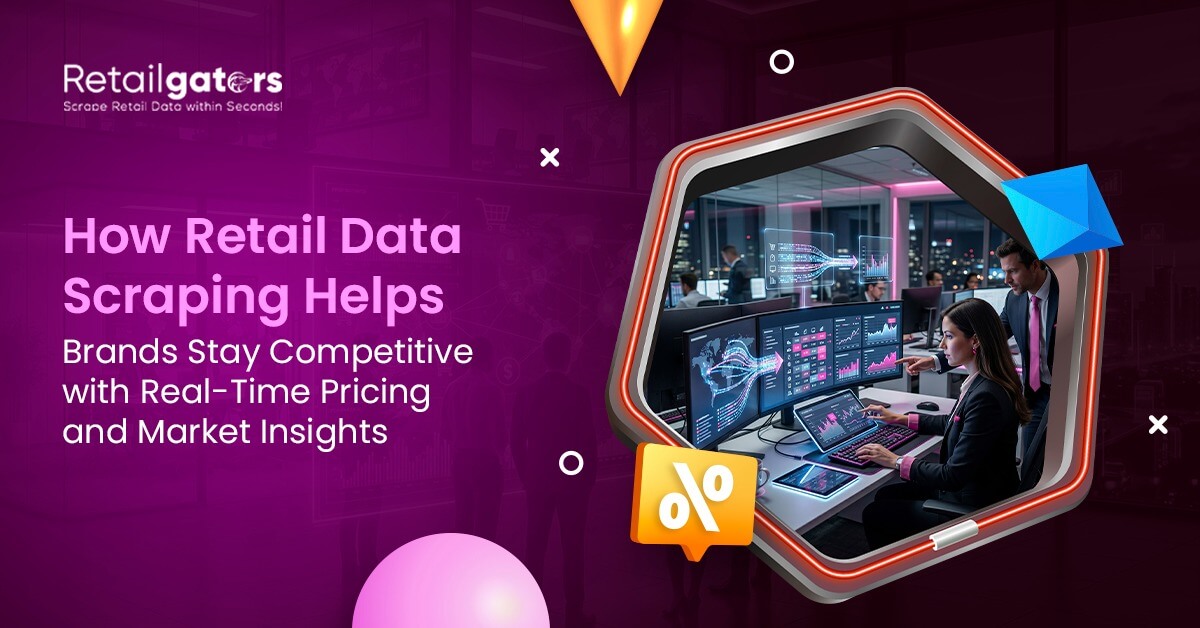
The operational answer to this problem is retail data scraping: automated collection of competitor prices, catalog listings, stock availability, and promotional data from publicly accessible retail pages. When that data flows consistently and is properly structured, it feeds into pricing decisions, brand protection workflows, and category analysis that would otherwise take days of manual effort to produce.
This blog explains what the data includes, how it gets used, and where retail market intelligence programs tend to deliver the most measurable value for brands at different stages.
What Is Retail Data Scraping?
Retail data scraping is the automated extraction of structured information from ecommerce websites and online marketplaces. The data collected covers a wide range: prices, product descriptions, images, stock status, customer ratings, and active promotions. Extraction runs continuously, without manual involvement, across thousands of product pages at intervals defined by the program.
Scale varies considerably by business context. A brand managing a focused SKU catalog might scrape five competitors across a single product category. Others run product data extraction programs across hundreds of thousands of listings and dozens of retail domains. In both cases, the practical benefit is the same: structured, current market data replaces the informal and inconsistent process of checking competitor sites by hand.
Brands running retail market intelligence programs on a continuous basis move from reactive pricing to informed positioning. The difference is not just speed. It is the quality of the decision behind the price change. Teams with current data act on what the market is actually doing. Teams without it act on what they think it was doing last month.
What Retail Data Scraping Captures?
| Data Type | Examples | Business Application |
|---|---|---|
| Pricing Data | List price, sale price, discounts | Competitive pricing, MAP enforcement |
| Product Listings | Titles, descriptions, images, SKUs | Catalog optimization, content gap analysis |
| Stock Availability | In stock, out of stock, low inventory | Supply chain planning, demand sensing |
| Customer Reviews | Ratings, review text, sentiment | Product development, brand positioning |
| Promotional Data | Deals, bundles, coupons, flash sales | Promotional calendar and timing decisions |
How Does Real Time Pricing Data Create Competitive Advantage?
Having access to real time pricing data changes what is possible at the operational level. Most brands understand this in principle. Fewer actually have systems that put current competitor pricing in front of decision makers at the moment the decision needs to be made. The gap between knowing prices matter and having the infrastructure to act on them in real time is where market share tends to move.
Here is what that infrastructure enables in practice:
- Dynamic repricing: Pricing rules update automatically when competitors adjust their rates.
- Promotional tracking: Competitor discount campaigns are visible in the data as they go live. Brand teams assess whether to respond based on actual margin data rather than assumption.
- Price elasticity insight: Historical price records make it possible to measure how volume shifts in response to price changes at specific points in a category. That is data most pricing teams would use if they had it.
- Inventory signal reading: A competitor that drops prices significantly is often clearing surplus stock rather than making a strategic shift. The distinction matters for how you respond.
Ecommerce data scraping tools that were previously accessible only to retailers with large data engineering teams are now available through SaaS platforms at price points that work for mid market and direct to consumer brands. Competitive pricing intelligence is no longer an infrastructure that requires a dedicated technical team to build and maintain.
Retail Price Monitoring vs. Data Scraping: What Is the Difference?
Retail price monitoring is a specific application built on top of retail data scraping infrastructure. The two terms are often used interchangeably, which causes confusion about what each actually involves. Scraping is the technical process of collecting data from websites. Price monitoring is the analytical layer that takes pricing data specifically and turns it into alerts, trend reports, and dashboards that inform commercial decisions.
| Retail Data Scraping | Retail Price Monitoring |
|---|---|
| Collects broad data: prices, reviews, inventory, content | Focused on pricing data and pricing trend analysis |
| Technical layer: crawlers, proxies, APIs, data pipelines | Analytics layer: dashboards, alerts, trend reporting |
| Supports multiple commercial functions | One focused application of scraping data |
| Outputs raw, structured datasets | Outputs actionable pricing intelligence for teams |
The practical implication is straightforward. Retail price monitoring is only as reliable as the data feeding it. A brand that invests in monitoring tooling without addressing the quality and freshness of the underlying data pipeline will get alerts that do not reflect what is actually happening in the market. The scraping infrastructure is what needs to be right first.
Key Use Cases for Ecommerce Data Scraping
Ecommerce data scraping serves a wider range of functions than most brands initially consider. Pricing is the entry point, but the data supports strategic decisions across product, marketing, supply chain, and legal teams when it is structured and delivered correctly.
Competitive Assortment Monitoring
Competitor catalogs change. New SKUs appear. Products get discontinued. Brands that track those changes through structured scraping know when a competitor enters their primary category with new inventory. That intelligence informs assortment planning and promotional timing in ways that waiting for sales data to reflect the shift cannot.
MAP Compliance and Brand Protection
Product Data Extraction is used by manufacturers for confirming whether their authorized resellers are pricing and presenting products in accordance with the manufacturer’s product pricing policy. Any violations are automatically flagged and can also be reported back to the manufacturer. An unauthorized seller is identified before their pricing patterns can spread through the legitimate channels of the manufacturer, therefore undermining margins for all parties involved.
Customer Review and Sentiment Tracking
Product and marketing teams can use data collected from a variety of sources to get quicker feedback than they would get from internal quality processes. For example, there are common themes in customer reviews that have negative sentiments, and those themes show up in web data long before there is a bulk amount of them for use to appear on reports for customer service.
Content and Category Intelligence
By analyzing the product characteristics and keywords that are most prevalent on the highest-ranking competitor listings, brands have tangible direction for how to create their own product content. Continued use of these attributes will increase organic visibility for Amazon and Google Shopping without increasing advertising costs.
Dynamic Pricing Execution
Brands will be able to keep pricing calibrated to competition, while using real-time pricing data to feed into a repricing engine. Brands can use margin floor rules established before the fact to make sure that the repricing engine does not adjust pricing in a way that reduces profitability below their established thresholds.
How Competitor Price Tracking Protects Margins?
The value of competitor price tracking depends on whether teams use it to interpret market signals or just react to them. A price drop from a competitor means something different depending on the underlying cause. Reading that cause correctly changes the response and, in most cases, protects margins that reactive matching would give away unnecessarily.
| Market Signal | What It Typically Indicates | Recommended Response |
|---|---|---|
| Competitor drops price 15% | Inventory clearance in progress | Hold current price; monitor stock depletion rate |
| Multiple competitors discount at once | Category demand softening | Run selective promotions, maintain margin targets |
| Competitor raises price | Cost pressure or supply constraint | Evaluate a measured price increase opportunity |
| New entrant prices aggressively | Market share acquisition push | Compete on value positioning, not price point |
| MAP violations across resellers | Unauthorized channel undercutting | Enforce MAP policy through established processes |
Effective retail price monitoring is a diagnostic tool, not a discounting mechanism. Brands that train their teams to read the business condition behind a competitor’s pricing move respond with strategy. Those that treat every price drop as a prompt to match it will consistently compress margins without gaining proportional volume in return.
Is Retail Data Scraping Legal?
Most brands raise the legal question early in the conversation about ecommerce data scraping. The legal position on scraping publicly available data in the United States is more clearly established than many legal and compliance teams realize.
- The 9th Circuit ruled in hiQ Labs v. LinkedIn that scraping publicly available information isn’t a violation of the Computer Fraud and Abuse Act (CFAA).
- But any website can still create liability for scraping by establishing a website’s terms of service. You should perform a legal review of any new domain before scraping it.
- The General Data Protection Regulation (GDPR) and the California Consumer Privacy Act (CCPA) apply mainly to personal data, not to the publicly accessible pricing, catalog information or advertising material.
- You can reduce your legal and operational risk professionally by scraping data responsibly using rate limits and robots.txt files.
Brands working with RetailGators operate within scraping infrastructure that is built with these compliance requirements addressed from the start. Legal considerations are handled at the architecture and operational level, not managed retroactively after issues surface.
How to Choose a Retail Data Scraping Partner?
The output quality of any retail market intelligence program is determined largely by the data vendor behind it. A few factors consistently distinguish reliable partners from vendors selling access to low quality infrastructure that underdelivers on the metrics that matter.
- Data freshness: Data that is price-related will lose its strategic relevance quickly if it has become outdated (3+ Hours). Verify the vendor’s contractual agreement for refresh rates as opposed to relying solely on their general statement of real-time delivery.
- Platform coverage: Verify that the vendor has coverage of all marketplaces that are relevant for your category. This includes ensuring that there is coverage of regional or niche platforms that may be excluded from a larger provider’s standard offering.
- Normalization quality: All scraped (raw) data will contain errors, duplicates, and inconsistent formats. Vendors who provide cleaned and validated data will relieve your internal team of any need to perform additional pre-processing tasks on the data.
- Scalability: As your catalog expands, you should not be required to renegotiate the terms of service or accept lower refresh rates. Be sure that the vendor’s infrastructure will scale along with the program and will not experience any disruption to service.
- Insight delivery: Vendors who deliver dashboards, configurable alerts, and analyst-ready reports indicate an understanding of how the data is going to be used. Conversely, if a vendor only provides raw file exports without any form of analytical layer, then they are offering you infrastructure without context.
- Compliance standards: Ensure that you have reviewed documentation regarding proxy management, crawl rate governing, and ToS review procedures. Vendors with good compliance practices will answer these questions specifically rather than making general statements.
Brands that run retail data scraping as an ongoing operational function rather than a periodic project consistently report stronger pricing outcomes. RetailGators structures engagements as long term data programs, designed for continuity, not for a single delivery cycle that expires before the insights get used.
Why Real Time Retail Intelligence Is Now a Business Requirement?
The scale of pricing activity across major retail platforms makes manual monitoring an impractical approach. The numbers below reflect what the market actually looks like operationally, not what it looked like several years ago.
- 73 percent of online shoppers compare prices on at least two platforms before completing a purchase.
- Brands using dynamic pricing report conversion rate improvements of up to 25 percent versus those operating on static price lists.
- Amazon processes approximately 2.5 million price changes per day across its catalog. No manual process tracks that at any meaningful level of coverage.
- Brands that respond to MAP violations within 24 hours see 12 to 18 percent fewer repeat violations in subsequent monitoring periods.
- 64 percent of retail executives rate competitive pricing intelligence among their top three operational priorities for 2025.
Conclusion
Brands that price without current market data are always working from a position that is already behind. Retail data scraping changes that by delivering structured, accurate, and timely competitor intelligence to pricing, merchandising, and channel teams on a continuous basis. The data does not make the decision. It makes the decision better by grounding it in what is actually happening in the market right now.
Whether the priority is MAP compliance, dynamic repricing, assortment gap analysis, or tracking category trends, the foundation is consistent ecommerce data scraping across the channels where customers buy and competitors operate.
RetailGators builds and manages these data programs for brands that treat retail market intelligence as an ongoing operational requirement. For teams where the current approach to competitor price tracking has gaps in coverage, accuracy, or freshness, RetailGators designs infrastructure that addresses those gaps within the specific context of the brand’s category and competitive environment.