Introduction
Somewhere between your last pricing update and this morning, a competitor changed three SKU prices, ran a flash discount, and cleared a backlog of slow inventory. Your team probably did not catch it in time. That gap, between what is happening in the market and what your internal systems actually reflect, is exactly the problem retail data scraping addresses.
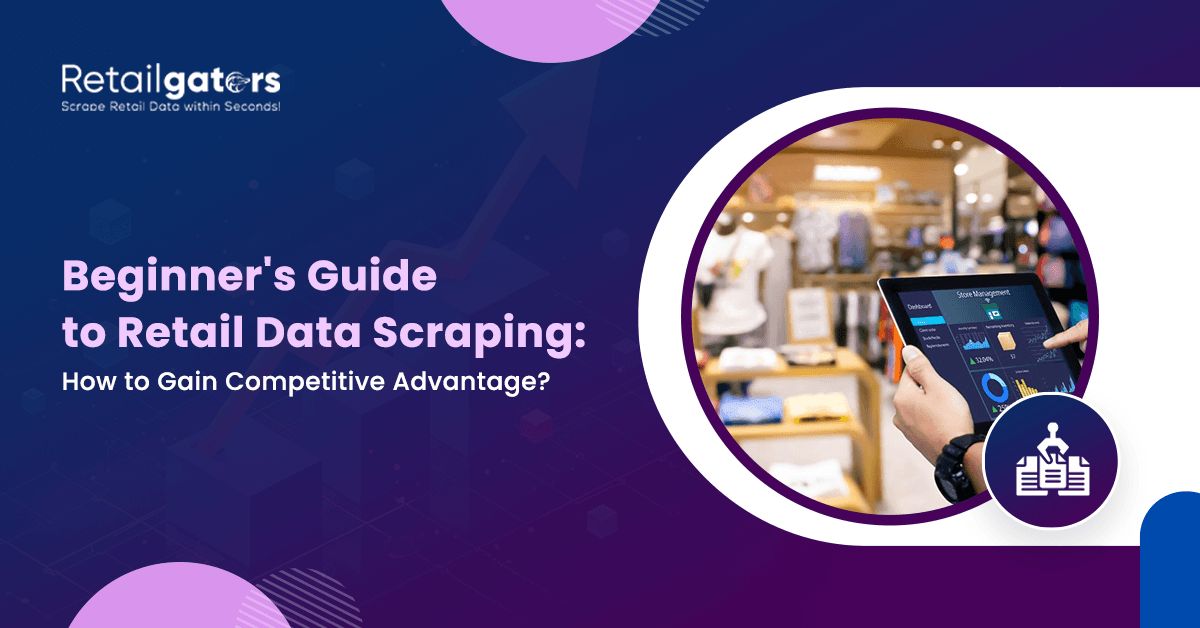
Defined precisely: retail data scraping is the automated collection of publicly available product and pricing data from e-commerce websites. Software programs, called scrapers, visit pages, read the visible content, and extract specific data points into a structured format. Prices, stock status, promotional labels, review scores. Clean, organized, and ready to feed into the tools your team already uses.
What follows is a practical guide covering how to scrape retail data from the ground up. It includes a tool comparison, a breakdown of retail market insights that scraping reliably produces, a walkthrough of the most common beginner mistakes, and a section on legality. If you work in retail and data collection is still mostly manual, this is the right place to start.
What Is Retail Data Scraping?
Retail data scraping is the practice of using automated software to extract product information from publicly visible retail and e-commerce web pages. A scraper is configured to navigate to specific URLs, identify the fields that contain relevant data, and pull that information out into a usable output format.
The data points most frequently targeted through retail data extraction include current prices, historical price records, product availability and stock counts, customer review volumes and scores, promotional tags and discount labels, product title formats, and image counts. Together, these fields build a detailed, updatable picture of how competitors are positioning their catalogs.
For anyone approaching web scraping for beginners, one clarification is worth making early: scrapers only access what is already publicly visible. If a page requires a login to view, it sits outside the standard scope of retail data scraping. Everything on a publicly accessible product page, however, is a legitimate and technically accessible data source.
Why Does Retail Data Scraping Matter for Competitive Advantage?
Consider the scale of the problem first. Profitero’s research puts Amazon’s daily price changes at approximately 2.5 million across its product catalog. A human team assigned to track even a fraction of that manually would need to be enormous, would still lag by hours, and would produce data that is obsolete before it reaches a decision maker. Retail data scraping is not a productivity tool in this context. It is the only viable method.
The business case extends beyond raw volume. McKinsey’s research on data strategy found that organizations with structured data operations are 23 times more likely to acquire new customers and retain existing ones at six times the rate of less data driven competitors.
That performance gap is real and it compounds over time. The businesses driving those numbers are not guessing at competitor behavior; they are measuring it continuously through retail data extraction.
Practically speaking, the competitive advantages that retail data scraping delivers fall into several categories:
- Pricing responsiveness: Live competitor price feeds allow dynamic pricing adjustments without manual review cycles. Price changes that previously took days now take minutes.
- Catalog intelligence: Scraping competitor product listings regularly reveals which SKUs they carry that you do not, and flags gaps in your own assortment worth filling.
- Inventory gap detection: When competitors run low or go out of stock entirely, that demand has to go somewhere. Scrapers that track availability changes give you advance notice to act on it.
- Review based product intelligence: Customer feedback posted on Amazon, Walmart, or Best Buy contains product insight no internal focus group produces. Aggregating it at scale surfaces patterns that single site browsing would never reveal.
- Promotional planning: Discount depth, timing, and frequency across competitor storefronts over months of scraping data produces a promotional pattern map that makes your own planning far more informed.
Each of these represents a practical category of retail market insights that converts directly into decisions. The data is public. Retail data extraction makes it systematic.
How to Scrape Retail Data: Process From Start to Finish?
The mechanics of how to scrape retail data are easier to understand when broken into a defined sequence. Each step in the pipeline has a specific function. Problems that surface later, whether in data quality or system reliability, almost always trace back to a stage that was skipped or compressed.
- Define the data fields you actually need: Start with a list, not a scraper. Identify the exact fields your team will use: current price, list price, availability status, review count, star rating, product title, shipping estimate. Specificity at this stage prevents scope creep and keeps the scraper configuration clean.
- Choose your collection method: Three realistic options exist for most teams. No code visual tools like Octoparse work well for lower volume, less technical projects. Managed services like the RetailGators API handle infrastructure and maintenance for teams that need reliability at scale.
- Study the target site structure: Before building selectors, spend time reviewing how the site organizes its product data. CSS selectors and XPath expressions are the standard tools for locating specific fields within a page’s markup. Most retail platforms follow predictable templates, which makes this step less complicated than it sounds.
- Account for JavaScript rendering: A significant portion of modern retail pages load their product data dynamically after the initial page load. Standard HTML parsers return incomplete results on these pages because they read the source, not the rendered output. Playwright and Selenium solve this by operating a full browser session and reading what actually appears on screen.
- Clean and validate the output before using it: Before you use the result, make sure it is clean and correct. Raw scraped data is not always clean. Product names include HTML tags in them, price fields have currency formatting, and sites with the same source build up duplicate data. Before the analysis starts, validation algorithms stop problems from spreading to all the downstream systems that use the data.
- Connect the output to decision making tools: A CSV file with processed data doesn’t do anything by itself. Send it to a pricing program, a BI dashboard, or an inventory system. That phase of integration is when retail market information becomes valuable in practice instead of just being available for analysis.
The pipeline is only as strong as its weakest stage. Teams that skip data validation routinely discover their pricing models are running on corrupted inputs. Teams that ignore JavaScript rendering are collecting partial data and do not always know it.
Scraping Tools for Retail: Side by Side Comparison
The right scraping tools for retail vary considerably depending on technical resources, budget, and the update frequency the project requires. The comparison below covers the tools most commonly used across different team types:
| Tool | Best For | Skill Level | Cost | Key Strength |
|---|---|---|---|---|
| Scrapy | Dev teams | High | Free open source | Custom pipeline control |
| BeautifulSoup | Solo beginners | Medium | Free | Lightweight HTML parsing |
| Apify | Non technical | Low | Freemium | Pre built scraping actors |
| Octoparse | Business users | Low | Paid tiers | Visual no code interface |
| RetailGators API | Enterprise | Low to Medium | Custom quote | Live retail data feeds |
Teams that want fully managed retail data scraping delivered without building or maintaining internal infrastructure can review service options at RetailGators.
Web Scraping for Beginners: Mistakes That Fails Early Projects
Most early web scraping for beginners projects fail for reasons that are not technically complex. They fail because of process oversights that experienced practitioners have already learned to avoid. The errors below are the most common culprits across new retail data extraction work:
- Not reviewing robots.txt before starting: This file tells automated tools which sections of a site the owner permits crawling. Ignoring it does not just risk an IP ban. It can constitute a terms of service violation before a single record has been collected.
- Sending all requests from one IP address: Major retail platforms actively monitor traffic patterns. A single IP generating large volumes of page requests gets flagged and blocked within minutes. Proxy rotation across residential IP pools is a basic requirement, not an advanced feature.
- No delay settings between requests: Request intervals that reflect human browsing behavior survive far longer on major sites. Machine speed requests with no spacing trigger rate limiting almost immediately on every platform that takes security seriously.
- Skipping the cleaning and validation stage: Price fields arrive with currency symbols and inconsistent formatting. Product names carry HTML remnants. Duplicate records stack up when multiple source pages overlap. Analysis built on uncleaned data produces unreliable outputs that undermine every decision downstream.
- Conflating all data types legally: Product prices, catalog content, and stock status all sit comfortably in the publicly available data category. Personal user information, private account data, and copyright protected content operate under GDPR, CCPA, and related legal frameworks regardless of where they were found.
The cost of getting these foundational things right from the start is minimal. The cost of correcting a blocked scraper or rebuilding analysis after discovering it ran on bad data is considerably higher.
What Retail Market Insights Can You Extract?
The specific retail market insights that retail data scraping consistently delivers fall into five practical categories. Each one has a defined use case within retail operations:
Competitor Pricing Intelligence
Price tracking is the highest volume application of retail data extraction across the industry. Scrapers pull current prices on competitor SKUs continuously, feeding that data into automated pricing engines that update listings without requiring manual review.
Businesses running this kind of system respond to market pricing shifts in near real time rather than discovering them during a weekly review meeting.
Product Availability and Stock Monitoring
Most teams do not realize how strategically useful availability data from competitor pages is at first. People who want a popular item keep purchasing even when a big competition runs out of supply.
Scrapers that keep track of availability across competitor catalogs indicate these times as they happen, allowing procurement and marketing teams enough time to change their spending, change their posture, and grab the demand that has moved before it settles elsewhere.
Customer Review Aggregation
Reviews of products on Amazon, Walmart, Target, and Best Buy show a lot of uncensored user opinion. Retail data scraping throughout review sections collects such feedback into patterns, such as common complaints about a product, features that customers keep asking for, and quality views that are far different from what the company thinks. Brand managers and product development teams can both use this information directly.
Promotional Timing and Discount Pattern Analysis
Competitors don’t launch promotions at random. After months of collecting data on when, how deep, and how often discounts are given, unmistakable trends start to show up.
Promotional calendars line up with changes in inventory cycles, seasonal demand, and times when competition is at its highest. Teams use this information to plan their own promotions instead of responding to what their competitors do after the fact.
Catalog and Listing Quality Benchmarking
The length of the title, the placement of keywords, the depth of the description, the number of images, and the completeness of the attributes all affect how visible and likely to convert a retail platform is.
Retail data scraping lets you compare your competitors’ listings to find the content gaps in your own catalog that need to be filled first. This is one of the least common ways to leverage retail data extraction, but it always has the most effect.
Is Retail Data Scraping Legal?
The legality of retail data scraping gets raised frequently, and the direct answer is that collecting publicly available data through automated means is lawful under U.S. law when conducted within the right parameters.
Staying within the compliant zone requires attention to four specific conditions:
- Only collect data from pages that are open to the public. Pages that require a login have other legal issues. Retail data scraping works well on content that anybody can see on a website without having to log in.
- Stay away from personal and confidential user data. Prices and catalog content for products are definitely okay. Privacy law covers personal data, account information, and private records of activity, even if they are on a public page.
- Before scraping, read the terms of service for the site. Most platforms have rules on automated access. Before starting any project to harvest retail data, you should read those terms.
- Keep the number of requests below reasonable limits. When a site’s usual performance is affected by too much traffic, it can be sued for reasons other than data access. Limiting the number of requests you make is both a good technological practice and a legal one.
At RetailGators, compliance review is completed before any collection scope is finalized. It is a standard step in every project, not an afterthought.
How RetailGators Scales Retail Data Extraction for Business Teams?
The operational reality of running retail data scraping in house is more demanding than most teams anticipate at the start. Proxy pool management, scraper maintenance across sites that update their layouts regularly, CAPTCHA handling, and data pipeline monitoring all require sustained engineering attention. Teams that budget for the initial build often underestimate the ongoing cost of keeping it running reliably.
The infrastructure behind RetailGators was designed specifically for retail data collection, not adapted from a general purpose crawling tool. Retail platforms have distinct data structures, anti scraping implementations, and layout conventions. Systems built around those specifics produce more consistent outputs and require fewer corrections per delivery cycle than generic alternatives.
Key operational capabilities include:
- Retail specific collection pipelines: Scrapers configured for Amazon catalog architecture, Shopify storefronts, and major marketplace layouts are available as standard starting points, which shortens setup time considerably for most projects.
- Flexible delivery scheduling: Hourly, daily, or event triggered data delivery based on how urgently the business needs updated information and how frequently the source content changes.
- Clean, structured output formats: Data is delivered in JSON, CSV, or direct API format, normalized and structured for immediate use in pricing platforms, BI dashboards, or inventory systems.
- Anti block infrastructure: Rotating residential proxies, browser fingerprint management, and CAPTCHA resolution run as standard infrastructure components across every collection pipeline.
- Retail platform expertise: The team at RetailGators has detailed knowledge of how data is structured across major retail platforms. That expertise reduces time between project initiation and first reliable data delivery.
Regardless of whether the project is a single site pricing monitor or a broad retail data scraping program covering dozens of retailers simultaneously, RetailGators provides the infrastructure, compliance framework, and domain knowledge needed to run it reliably.
Final Thoughts: Systematic Data Access Is a Competitive Requirement
The information advantage in retail today is not about having more analysts. It is about having faster, more structured access to data that already exists in public view. Competitor prices, availability shifts, promotional patterns, and catalog quality signals are all there. The question is entirely operational: does your team have a system to collect and use that information, or not?
Retail data scraping is the answer to that operational question. Getting started does not require a large technical investment. What it does require is a clear methodology, the right scraping tools for retail matched to your actual use case, and a compliance aware approach from day one.
For teams evaluating a move from manual tracking to structured retail data extraction, a detailed breakdown of how managed pipelines, live delivery, and dedicated retail expertise combine in practice is available at RetailGators. The retail market insights that drive better decisions are already publicly available. Having the right system to capture them is the differentiator.