Introduction
Selling on Amazon without reliable market data means accepting structural blind spots that better-informed competitors will exploit. Price wars erupt without warning. A competitor undercuts you and takes the Buy Box before your team is even aware. Customer sentiment shifts, and you miss it because manually reviewing thousands of individual reviews at scale is not realistic.
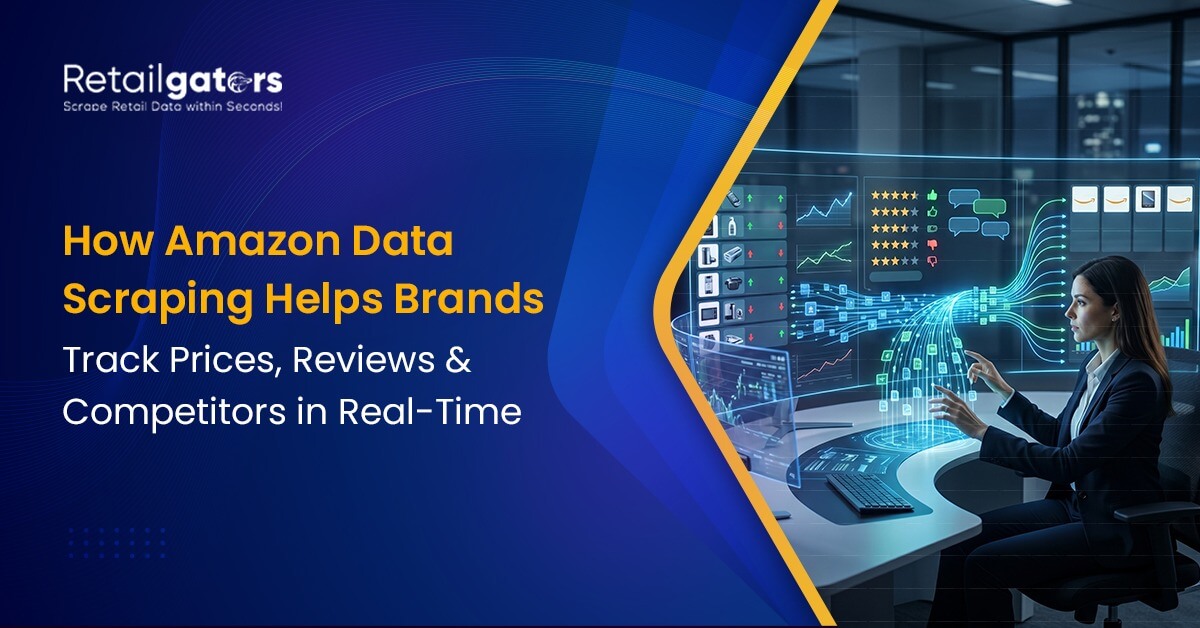
It is the operational reality that makes Amazon data scraping so valuable to brands today. Structured, automated data collection from Amazon's publicly visible pages gives teams market visibility that gut instinct and manual research can never consistently provide. This guide breaks down how Amazon product data scraping works, what it captures, and where brands actually put it to use.
What Is Amazon Data Scraping?
Amazon data scraping is the process of using automated tools to extract publicly available data from Amazon's product pages, search results, and review sections. The tools visit URLs, read page content, and extract structured data such as prices, listings, seller information, ratings, and more.
The breadth of what Amazon product data scraping makes available often surprises brands that have only ever worked with Amazon's native reporting. Some of the key data categories include:
- Pricing and promotions: Current price, Buy Box ownership, active coupons, and discount badges across an entire category or SKU list
- Listing content: Product titles, bullet points, descriptions, and A plus content that reveal exactly how competitors position their products
- Customer reviews: Star ratings, review text, verified purchase flags, and review volume trends across competing ASINs
- Inventory status: Stock availability per seller, which signals potential supply constraints or stockout opportunities
- Seller ecosystem: Number of competing offers per ASIN, third-party seller names, and fulfillment types
Together, these data streams form a competitive intelligence system that would take dozens of analysts to replicate manually. Each category feeds into different business functions. Pricing informs the repricing strategy; reviews inform product development; and listing content analysis feeds SEO and copywriting.
How Does Amazon Price Tracking Data Work?
Amazon price tracking data collection involves sending automated requests to product URLs at defined intervals, parsing the returned page content, and recording a set of price-related fields. Each record gets a timestamp, a seller attribution, and a Buy Box status flag. Repeat that process hundreds or thousands of times per day across a defined ASIN list, and you get a living price history for your entire competitive landscape.
A well-designed price monitoring workflow runs through several stages:
- Create an ASIN list of competitors or browse them in their categories.
- Frequency of data collection: 15-minute intervals work better for volatile categories than once daily for stable categories.
- Utilize a rotating proxy structure to route your requests and reduce the chances of detection and blocking.
- Records collected will need to be stored in a structured database format, with complete timestamps and appropriate seller metadata associated with each record.
- The structured database will feed into an alerting layer that notifies all teams when significant metrics reach thresholds.
RetailGators configures Amazon price-tracking data pipelines with refresh intervals tuned to the volatility of each product category. A supplement brand competing in a crowded health niche needs fundamentally different monitoring cadence than a niche hobby brand with three competitors. Matching collection frequency to category behavior is what separates useful price intelligence from noisy, irrelevant data.
What Does Amazon Review Scraping Reveal?
Most brands underestimate the strategic value of competitor reviews. Without Amazon review scraping, you'd be left with a pile of individual opinions that can't be analyzed. Patterns that would take a team weeks to identify manually surface within hours when reviews are collected and processed systematically.
What systematic Amazon review scraping actually delivers:
- The most frequently mentioned product complaints across competing ASINs, which directly inform your own positioning and feature emphasis
- Shifts in average rating following a competitor's product reformulation, packaging change, or fulfillment transition
- The specific vocabulary buyers use to describe products in a category improves the natural language quality of your own listings.
- Review volume growth trends that signal whether a competitor is gaining or losing market traction
- Recurring one-star and two-star themes that expose persistent product weaknesses you can address in your own offering.
A brand selling blenders, for instance, that finds motor lifespan complaints recurring across the top ten competitor reviews through Amazon review scraping, gains a clear differentiator to build messaging around. Applied inward to your own reviews, the same process surfaces quality or fulfillment issues early enough to prevent lasting rating damage.
What Do You Get When You Extract Amazon Product Listings?
When you scrape Amazon product data at the listing level, you capture the full anatomy of a competitor's catalog strategy. Prices and ratings are visible to any shopper. What becomes genuinely valuable when you extract Amazon product listings systematically is the structural and strategic layer underneath:
| Listing Component | Strategic Insight It Provides |
|---|---|
| Product Title | Primary and secondary keyword targeting choices |
| Bullet Points | Which product features the brand treats as conversion priorities |
| Product Description | Brand voice, secondary keyword depth, and positioning angle |
| ASIN and Browse Node | Category classification and competitive set mapping |
| Image Count and Format | Content investment level and visual merchandising approach |
| A Plus Content Status | Whether the brand uses enhanced brand content capabilities |
| Variation Architecture | How product lines are structured across size, color, or bundle |
When RetailGators extracts Amazon product listings for clients, the deliverable is a structured gap analysis that shows where listings underperform category leaders in keyword coverage, content depth, and completeness, along with specific opportunities in underserved search demand.
Which Seller Types Gain the Most from Amazon Product Data Scraping?
Amazon product data scraping applies broadly, though the value it delivers concentrates around several specific business models:
Private Label Sellers
Unauthorized resellers and listing hijackers pose a persistent threat in the private-label space. Continuous Amazon product data scraping surfaces these threats as soon as they appear rather than days later, giving sellers enough lead time to take action before significant revenue is lost. It also tracks how new competitors position themselves within the first weeks of entering a category.
Wholesale and Arbitrage Operations
Margin discipline is everything for arbitrage sellers. Amazon price-tracking data delivers the early signals they need: a competitor pricing error, a sudden supply constraint, or a promotional window when Buy Box ownership becomes temporarily accessible. Acting on those signals within minutes rather than hours makes a material difference to profitability.
Direct-to-Consumer Brands Building an Amazon Presence
A D2C brand entering Amazon has a limited runway to learn how the category behaves. Scraping Amazon product data across the leading thirty to fifty competitors compresses months of manual research into days of structured, actionable output.
Amazon Agencies and Marketplace Consultants
Agencies serving multiple Amazon brands use Amazon data scraping to deliver data-driven audits and competitor benchmarks at a scale that would otherwise require far larger research teams. The ability to back every recommendation with market data extracted from the market is a meaningful differentiator when competing for client relationships.
How Should You Structure an Amazon Data Scraping Strategy?
Getting real value from Amazon data scraping requires more than setting up a scraper and waiting for data to arrive. A structured approach matters:
- Before you begin collecting data, you need to know what you want out of it. Decide if you want to track prices, read reviews, or compare listings. That decision will affect how often you collect data and where you store it.
- Make a specific list of ASINs. Tracking high-priority competitor products provides more valuable information than collecting data across an entire category.
- Prepare your systems to handle the data you collect. If you are tracking Amazon prices frequently across many ASINs, you will need rotating proxies and multiple computers. If you have less data, simpler tools will work.
- Send data directly to alert systems. Ensure that price changes, Buy Box shifts, and sudden increases in reviews reach the right team members immediately, rather than hours later through manual checks.
- Updated Amazon data scraping will help you keep track of your competition in each category by regularly updating your Online competitors list whenever new entrants enter your space.
Amazon Data Scraping Produces Positive Results for Your Business
By utilizing Amazon data scraping, your business can experience better stats for all aspects of performance:
- When brands use pricing data from Amazon (live) for their price strategy rather than only using dated pricing information from manual checks, they have an increase of 15-25% in the percentage of capture of the Buy Box.
- Using structured data from Amazon product reviews enables product teams to identify and improve product features much faster, potentially reducing development time by up to 50%.
- The use of Amazon product listing data for product catalog research saves about 30% of time (or overhead costs) compared to manually conducting product catalog audits.
- The collection of stock-out windows from Amazon is reported within hours of the stock-out event, rather than waiting until the next time your business conducts its usual observation process.
- As brands compare their product listings to top-performing competitors' listings on Amazon and improve them to address specific deficits, they will improve the quality and organic ranking of their listings in search results.
Conclusion
Amazon is a marketplace where margins, rankings, and customer perception can shift substantially within a single week. Brands that operate on delayed or incomplete data take on avoidable risk every time they make a pricing, listing, or product decision. Amazon data scraping eliminates that structural disadvantage by replacing guesswork with current, verifiable market intelligence.
Whether the need is Amazon price-tracking data for repricing, Amazon review scraping for product strategy, or extracting Amazon product listings for catalog benchmarking, the foundation is automated, structured, and continuously refreshed data from the marketplace itself.
RetailGators builds Amazon product data scraping solutions for brands that take marketplace competition seriously. The teams gaining ground on Amazon right now are not necessarily the best funded. They are the best informed.
Frequently Asked Questions
What is Amazon data scraping?
Amazon data scraping is the automated collection of publicly available data from Amazon pages, covering prices, reviews, product listings, and seller information, using specialized tools at scale.
Do smaller brands get value from Amazon review scraping?
Smaller brands often benefit most. Amazon review scraping exposes specific competitor weaknesses at a level of detail that informs both product development and listing copy, without requiring a large research team or budget to act on.
What fields are available when you scrape Amazon product data?
When you scrape Amazon product data, the available fields include product title, current price, bullet points, full description, star rating, total review count, image URLs, ASIN, browse node path, active seller list, and current stock status.
How do you extract Amazon product listings at volume?
To extract Amazon product listings at scale, headless browser automation handles JavaScript-rendered content, while rotating proxy networks manage detection avoidance. Targeting is done via ASIN list or browse node URL, with structured parsers that output clean, normalized records.







Leave a Reply
Your email address will not be published. Required fields are marked