Introduction
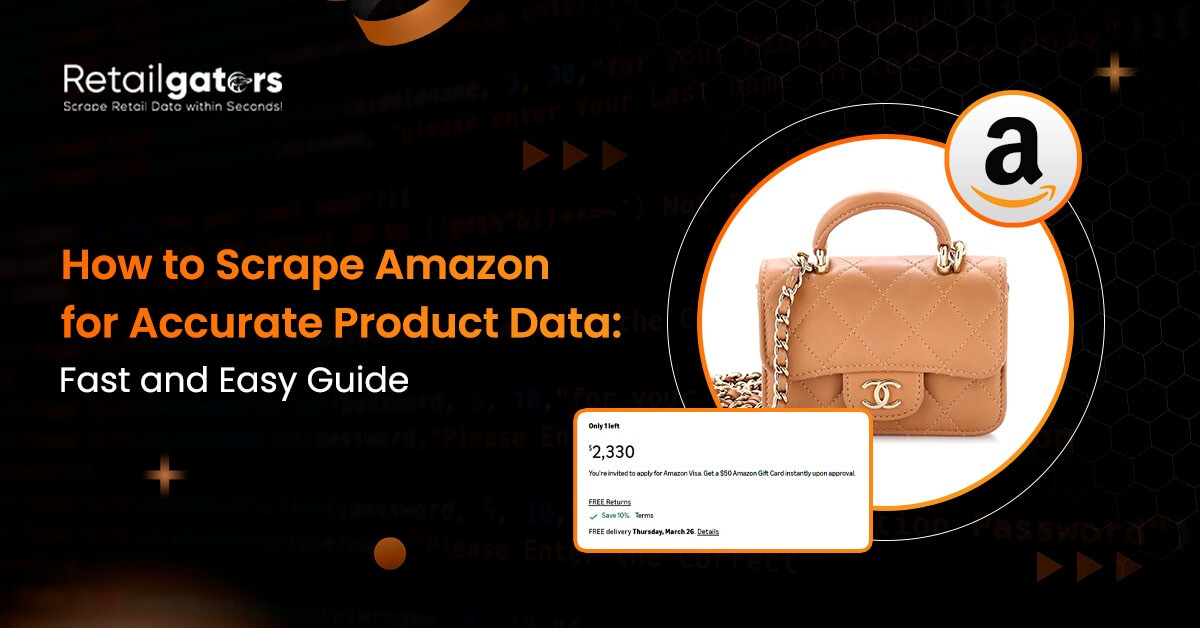
Amazon is one of the most widely used e-commerce websites. It contains millions of products and has the largest global marketplace. Amazon has a strong worldwide buyer-seller base. Scraping Amazon prices and product data enables businesses to stay competitive and improve their business ROI. To gain this benefit, you can either leverage managed data scraping services or develop your own scraper according to your goal. In this blog, we will see how to develop a Python scraper to extract Amazon product data step-by-step.
Understanding Amazon Product Data
What is Amazon Product Data?
Amazon product data is the information, such as title, descriptions, reviews, ratings, SKUs, prices, and more. This data is used by retailers, e-commerce site owners, brands, researchers, analysts, and more for market research and analysis.
Why Amazon Product Data Scraping?
Amazon data can be scraped to fulfill various business needs. The key importance of this data can be:
- Competitor Monitoring: Collecting data from Amazon enables your organization to monitor their competitors to track rivals’ products and stay competitive fast. It helps firms to get market awareness and spot new trends. Amazon product data boosts innovation and inspires new ideas.
- Product Optimization: Product optimizations refer to improving overall product performance and boosting search ranking. Extracting Amazon product data from an e-commerce platform empowers firms to understand competitors’ pricing strategies to adjust their own pricing. They can smartly track sales to identify the best performance.
- Market trend Analysis: Retailers and e-commerce businesses can use Amazon data to analyze market trends, identify shifts in demand, and predict future sales. With the information collected from this platform, they can spot emerging products and gain an early advantage. It helps brands understand the competitive landscape and adjust strategy quickly.
- Improve ROI: By knowing competitors’ pricing trends, you can maximize their profit margins. It enables your online store to review sentiment analysis and reduce return rates. Amazon competitor intelligence gathering is used by enterprises to discover discount patterns to optimize promotions fast.
Why Use Python For Amazon Data Scraping?
Python is a simple and easy-to-use general-purpose programming language. It has rich libraries that can speed up your development process. The syntax of the scripting language is easy to read, which makes for a lower learning curve. Python is a scalable framework, which means it can handle large datasets. Because Python is open source, it is available for free and offers powerful tools to efficiently handle repetitive tasks.
Tools and Methods for Scraping Amazon Product Data
Overview of the Best Amazon Web Scraping Tools
You can extract retail data from Amazon by using the Amazon scraping API or well-known web scraping libraries and tools.
- Amazon scraping API: Many web data extraction service providers offer ready-to-use APIs. This will provide you with direct, structured access for research. Amazon data scraping APIs are available with customizable integration tailored to your business needs. It provides real-time product updates for faster decision-making.
- Web Scraping Libraries and Tools: You can use some Python libraries, such as Selenium and BeautifulSoup. These libraries are open source and therefore available for free. You can use it to accurately harvest Amazon data to drive informed decisions. One of the known and lightweight Python libraries called Requests can be imported to send data-collecting requests to the Amazon server.
Building Your Own Scraper Vs Using Third-Party Services
Scraping data from a competitor’s site reduces guesswork and drives innovation. Therefore, it is important to understand the difference between building a scraper and using third-party services.
- Build Own Scraper: If you are a developer or have good programming knowledge, then you should build your own scraper. It helps you to customize your data scraping logic. However, consider that building your own scraper requires maintenance costs and resources. It also involves legal risk.
- Third-Party Services: Using third-party web data scraping services offers a quick deployment time. This method can even handle compliance and deliver data at scale. You need to hire third-party service providers when fast insights are needed, and you have no technical expertise.
How to Scrape Amazon for Product Data Using Python?
To scrape Amazon data using Python, perform the following steps:
Step 1: Install Required Libraries
pip install requests beautifulsoup4
Step 2: Import Libraries
import requests
from bs4 import BeautifulSoup
Step 3: Send a Request to Amazon
The third step is to send our data scraping request to the Amazon site.
url = "https://www.amazon.in/dp/B09G9BL5CP"
headers = {
    "User-Agent": "Mozilla/5.0 (Windows NT 10.0; Win64; x64)"
}
response = requests.get(url, headers=headers)

print(response.status_code)
In the above code, you can see that we are scraping the https://www.amazon.in/dp/B09G9BL5CP page. Here, B09G9BL5CP is the product ASIN.
To prevent blocking the automated scraping request, you then need to mention the real-browser agents you are using. For example, Mozilla/5.0.
The line response = requests.get(url, headers=headers) will send an HTTP GET request to the Amazon URL.
The last print(response.status_code) statement will print the status code of the response.
Step 4: Parse HTML Content
soup = BeautifulSoup(response.content, "html.parser"
The above code will parse product data with BeautifulSoup. It will help you read HTML structure.
Step 5: Extract Product Data
Now you will extract actual Amazon product data.
title = soup.find("span", {"id": "productTitle"}).get_text(strip=True)
price = soup.find("span", {"class": "a-price-whole"}).get_text(strip=True)
rating = soup.find("span", {"class": "a-icon-alt"}).get_text(strip=True)
print("Title:", title)
print("Price:", price)
print("Rating:", rating)
The code mentioned above will grab the product title, price, and ratings.
Step 6: Handle Missing Data
The try and catch exception handling is helpful to prevent our scraper from crashing, allowing it to handle frequent updates to the Amazon site structure.
try:
    title = soup.find("span", {"id": "productTitle"}).get_text(strip=True)
except AttributeError:
    title = "Not found"
Step 7: Export Data to CSV
import csv

with open("amazon_products.csv", "w", newline="", encoding="utf-8") as file:
    writer = csv.writer(file)
    writer.writerow(["Title", "Price", "Rating"])   # Header
    writer.writerow([title, price, rating])         # Data row

print("Dynamic data exported to amazon_products.csv")
This code will open amazon_products.csv file and write the title, price, and ratings. Once the export is done, our scraper will print the message “Dynamic data exported to amazon_products.csv”.
We have developed a basic Python scraper that extracts data from Amazon. However, you can customize it according to your project.
Use Cases for Amazon Product Data Scraping
Amazon product data extraction can be used for various purposes for your business. Let’s explore them.
Sales Rank Monitoring
Web data collection helps firms to track product performance and measure sales success. They can spot demand changes to adjust inventory quickly. With the data scraped from Amazon, businesses can seamlessly compare with competitors while benchmarking market position.
Market Research & Trend Analysis
Amazon web scraping is a useful approach to collect data at a large scale for research and analysis. It provides the brand with a competitive advantage and drives innovation forward. Collecting information from e-commerce enables retailers to capture new opportunities.
Inventory and Catalog Management
For online and offline stores, data scraping helps to know competitor stock levels to adjust their own inventory. By extracting detailed product information, they can build an accurate catalog. This enables retailers to predict demand and optimize stock replenishment.
The Challenges and Risks of Amazon Data Scraping
Extracting Amazon involves some challenges. You should know some techniques that help you avoid getting blocked while scraping data.
- IP Blocking: E-commerce sites block your IP addresses to prevent misuse of information and prevent cyberattacks. To tackle this issue, you can use any good VPN and extract data anonymously.
- Dynamic Product Pages: To deal with dynamic content, you can use headless browsers that are operated via a Python script. They load dynamic data quickly with the support of user actions such as submission, scrolling, clicking, and more.
- CAPTCHA Challenges: E-commerce websites like Amazon use CAPTCHA to block scrapers. By implementing this technique, they reduce spam and secure their data. Integrate a CAPTCHA solver or validate manually to accomplish your data collection goal.
Legal Considerations for Scraping Amazon
Scraping product data from Amazon helps businesses in many ways. However, it is important to understand legal concerns about it.
Is Amazon Data Scraping Legal?
The legality of Amazon data scraping is in a gray area. You need to consider many aspects when you harvest information from this platform. If you want to stay safe and avoid disrupting your brand image, then you should consider the following points.
- Scrape only publicly available data to avoid lawsuits.
- Follow GDPR and CCPA laws to stay globally compliant.
- Limit your data scraping frequency and prevent server load.
- Check and adhere to robots.txt rules to avoid violations and respect ownership.
- Maintain transparency by attributing data sources.
- Stick to Amazon ToS to maintain access to the site.
Why RetailGators is the Best Choice for Scraping Amazon Product Data
Tailored Scraping Solutions for Your Business Needs
RetailGators understands your business value, and therefore, it can design a solution that matches your business needs. Whether you want to perform competitor analysis, track keywords, scrape reviews, or any other task on your mind, this organization is here to help.
Efficient and Time-Saving Data Scraping
Professionals of RetailGators use cutting-edge technologies and tools to automatically scrape data from Amazon. They deal with all the challenges that come and ensure the timely delivery of data. The organization will efficiently collect product information from e-commerce platforms and save your precious time.
Reliable, Accurate, and Up-to-Date Data
RetailGators always extract accurate and real-time data. You can rely on this organization to extract accurate and error-free data. This organization provides up-to-date data in your desired format.
Ethical and Compliant Data Scraping Practices
Whenever you scrape information from e-commerce platforms like Amazon, adhering to ethical practices is important. RetailGators respects privacy laws to avoid legal penalties. It also follows site policies to prevent account bans.
Conclusion
In this Amazon data collection guide, you saw what Amazon product data is, the importance of Amazon data extraction, and Python. You knew the tools and technologies and developed a simple Python scraper. The blog also describes challenges and risks associated with Amazon data scraping. Don’t you have any technical knowledge? No worries, you can download your free sample data and talk to our scraping specialists.