Why This Decision Matters for CTOs
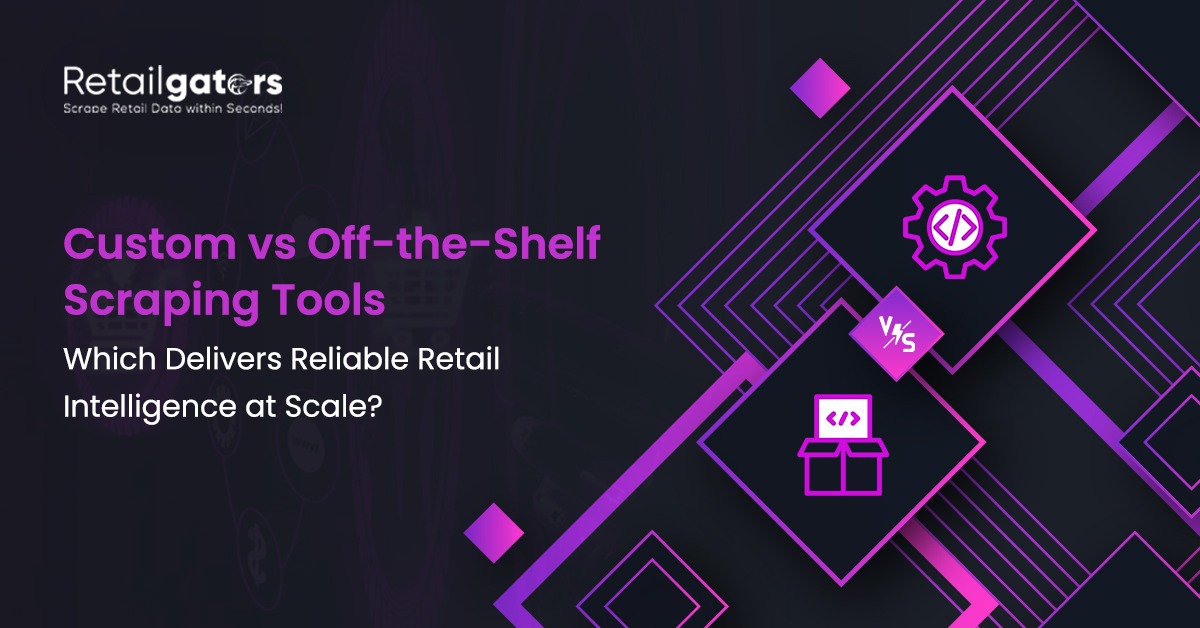
Retail intelligence failures directly impact your bottom line. When pricing data arrives late, incomplete, or inaccurate, you lose margin opportunities and competitive positioning. For enterprise ecommerce teams, the choice between custom vs off the shelf scraping tools isn’t just a technical preference—it’s a strategic business decision that affects revenue, operational efficiency, and market responsiveness.
CTOs face mounting pressure to deliver reliable retail intelligence at scale. Your pricing teams need real-time competitor data across thousands of SKUs. Your assortment planners require accurate inventory visibility across multiple retailers. Meanwhile, your engineering team struggles with constant scraper maintenance, IP blocks, and data quality issues.
The scraping solution you choose determines whether retail intelligence becomes a competitive advantage or an engineering bottleneck. This decision carries significant weight because it affects data accuracy, system scalability, compliance posture, and ultimately, your team’s ability to make informed pricing and merchandising decisions.
Understanding the Two Approaches
What Are Off-the-Shelf Scraping Tools?
Off the shelf scraping software refers to pre-built, plug-and-play SaaS platforms that promise quick deployment for web data extraction. These retail data scraping tools typically offer visual point-and-click interfaces, pre-configured templates, and standardized API outputs.
Common capabilities include basic CSS selector targeting, scheduled crawls, and simple data exports. However, these tools operate on a one-size-fits-all model. They use shared IP pools, generic scraping patterns, and standardized extraction logic that works across multiple use cases but excels at none.
Popular off-the-shelf platforms charge based on page requests, data volume, or monthly subscriptions. While they appear cost-effective initially, their limitations become apparent when you scale beyond simple use cases or encounter anti-bot protections.
What Are Custom Scraping Solutions?
Custom web scraping solutions are purpose-built data pipelines tailored to your specific retail intelligence requirements. Unlike generic tools, these enterprise web scraping tools are engineered to handle the unique challenges of extracting data from particular retailers, marketplaces, and ecommerce platforms.
RetailGators builds custom scraping infrastructure that adapts to each target website’s structure, anti-bot mechanisms, and data formats. This approach involves developing specialized crawlers, implementing sophisticated retry logic, and creating data pipelines that deliver clean, structured information directly into your analytics systems.
Custom solutions handle the complexity that generic tools cannot—JavaScript-heavy sites, dynamic pricing tables, marketplace-specific pagination, and real-time inventory tracking. They’re designed for enterprises where retail intelligence directly impacts strategic decisions.
Core Retail Intelligence Requirements at Scale
Enterprise ecommerce operations demand data collection that meets specific performance and reliability standards. Your teams track millions of SKUs across dozens of retailers and marketplaces simultaneously. This volume requires infrastructure that standard scraping tools simply cannot support.
Real-time price monitoring becomes critical when competitors adjust pricing multiple times daily. You need systems that detect changes within minutes, not hours. Additionally, promotional tracking requires accurate extraction of complex discount structures, bundle pricing, and limited-time offers that generic scrapers frequently miss.
Data accuracy cannot be negotiable. A 2% error rate across 100,000 SKUs means 2,000 incorrect data points driving your pricing algorithms. Consequently, enterprise retail intelligence scraping at scale demands validation mechanisms, quality checks, and SLA-backed delivery guarantees.
Furthermore, seamless integration with your existing BI tools, pricing engines, and analytics dashboards is essential. Raw HTML dumps or inconsistently formatted CSV files create downstream bottlenecks. Your retail intelligence scraping tools must deliver clean, normalized data in formats your systems can immediately consume.
Custom vs Off-the-Shelf — Head-to-Head Comparison
| Evaluation Criteria | Off-the-Shelf Tools | Custom Scraping |
|---|---|---|
| Scalability | Limited by shared infrastructure and rate limits | Enterprise-ready with dedicated resources |
| Data Accuracy | Inconsistent, no guarantees | SLA-backed precision |
| Website Coverage | Generic selectors break frequently | Custom-targeted for each site |
| Anti-Bot Handling | Weak, shared IP pools get blocked | Advanced evasion techniques |
| Compliance Control | Low visibility into practices | High transparency and governance |
| Long-Term ROI | Short-term gains, scaling costs escalate | Strategic investment with declining unit economics |
This comparison reveals fundamental differences in how these approaches handle enterprise demands. Off-the-shelf tools optimize for breadth—covering many use cases superficially. Custom solutions optimize for depth—solving specific retail intelligence challenges completely.
Scalability differences become obvious when you monitor 500+ retailers daily. Generic tools throttle requests, impose arbitrary limits, and increase costs exponentially with volume. In contrast, custom infrastructure scales linearly, maintaining consistent performance regardless of data volume.
Where Off-the-Shelf Tools Break Down
Off the shelf scraping software encounters predictable failure patterns at enterprise scale. Blocked IPs represent the most common issue. These tools use shared proxy pools, meaning your competitors’ aggressive scraping affects your data collection reliability. When one user gets blacklisted, everyone suffers.
Broken selectors plague generic scraping platforms. Retailers update their website structure regularly—sometimes weekly. Off-the-shelf tools rely on visual selectors that break with each redesign. Your data pipelines stop working, and you wait for vendor fixes that may take days or weeks.
Limited crawl frequency restricts competitive responsiveness. Many SaaS platforms cap how often you can refresh data, often limiting updates to once or twice daily. However, dynamic pricing strategies require hourly or even minute-level monitoring to capture competitor moves effectively.
Complex JavaScript-heavy sites defeat standard scrapers entirely. Modern ecommerce platforms load pricing and inventory data asynchronously through API calls. Generic tools capture empty pages or incomplete data because they cannot execute JavaScript properly or intercept API responses.
Marketplace scraping presents another insurmountable challenge. Amazon, Walmart, and Instacart employ sophisticated bot detection that identifies and blocks generic scraping patterns immediately. Off-the-shelf platforms lack the specialized techniques required to reliably extract data from these critical retail channels.
Hidden costs emerge as your data needs grow. That affordable monthly subscription quickly becomes expensive when you exceed included page requests. Pricing tiers jump dramatically, and suddenly your “cost-effective” solution costs more than custom infrastructure while delivering inferior results.
Why Enterprises Choose Custom Scraping for Retail Intelligence
Tailored crawlers per retailer solve the fundamental limitation of generic approaches. RetailGators develops specialized extraction logic for each target site, accounting for unique HTML structures, API endpoints, and data formats. This customization eliminates the broken selector problem entirely.
Real-time monitoring with intelligent retries ensures data continuity. Custom systems detect failures immediately and implement sophisticated retry logic—changing proxies, adjusting request patterns, or switching extraction methods automatically. Your data pipelines maintain 99%+ uptime without manual intervention.
High-volume, high-velocity data pipelines handle enterprise demands efficiently. Custom infrastructure processes millions of pages daily while maintaining sub-second response times. This performance enables real-time competitive intelligence that generic tools cannot deliver.
Built-in compliance and governance provide transparency and control. You understand exactly how data is collected, stored, and processed. Custom solutions implement your specific compliance requirements—whether that’s CCPA, GDPR, or industry-specific regulations. This visibility is impossible with black-box SaaS platforms.
Structured data delivery eliminates downstream processing. Rather than receiving raw HTML or inconsistent CSV files, you get clean, normalized data in your preferred format—JSON, database feeds, or direct API integration. This structure saves significant engineering time and reduces error rates in your analytics pipelines.
Build In-House vs Managed Custom Scraping
Engineering bandwidth constraints make in-house scraping teams impractical for most enterprises. Building and maintaining scalable web scraping platforms requires specialized expertise in distributed systems, anti-bot evasion, proxy management, and continuous monitoring. This expertise is expensive and difficult to retain.
Infrastructure and maintenance burden consumes resources better spent on core product development. Your engineering team should focus on features that differentiate your business, not fighting proxy blocks and parsing HTML. Scraping infrastructure requires 24/7 monitoring, regular updates to handle site changes, and constant optimization to maintain performance.
Managed services like RetailGators outperform DIY scraping teams by providing dedicated infrastructure, specialized expertise, and guaranteed SLA performance. We handle proxy rotation, CAPTCHA solving, site change monitoring, and data quality validation—freeing your team to focus on using retail intelligence rather than collecting it.
Most enterprises don’t fail because of bad tools—they fail because scraping becomes an engineering distraction instead of a data advantage. Therefore, partnering with specialized providers transforms retail intelligence from a technical challenge into a strategic capability.
Cost, Risk & ROI Considerations for CTOs
Total cost of ownership extends beyond subscription fees or development costs. Consider engineering time spent maintaining scrapers, infrastructure costs for proxies and servers, opportunity costs from delayed insights, and revenue losses from inaccurate data.
Off-the-shelf tools appear cheaper initially but hidden costs accumulate rapidly. Scaling fees, API rate limit overages, premium feature charges, and migration costs when you inevitably outgrow the platform create unpredictable expenses. Meanwhile, custom solutions deliver predictable economics that improve with scale.
Downtime and data gaps carry direct revenue impact. When your pricing intelligence goes dark for hours or days, competitors gain pricing advantages you cannot counter. Consequently, stockouts go undetected, promotional opportunities disappear, and margin erosion occurs unchecked. These operational risks far exceed any cost savings from generic tools.
Revenue loss from inaccurate intelligence compounds over time. Incorrect competitor pricing leads to margin erosion or lost sales. Missed promotions mean your customers find better deals elsewhere. Incomplete inventory visibility results in poor assortment decisions. For large retailers, these errors cost millions annually.
Decision Framework — Which Should You Choose?
Choose Off-the-Shelf If:
You’re monitoring fewer than 1,000 SKUs across a handful of stable websites. Your pricing decisions don’t require real-time data, and occasional gaps or inaccuracies won’t significantly impact revenue. You’re conducting short-term market research or proof-of-concept testing before committing to enterprise infrastructure.
Budget constraints limit investment in custom solutions, and you can accept the trade-offs in accuracy, reliability, and scalability. Your target websites use simple HTML structures without sophisticated anti-bot protections.
Choose Custom Scraping If:
You operate at enterprise scale with thousands or millions of SKUs across multiple retailers and marketplaces. Pricing and assortment decisions directly impact revenue, making data accuracy and reliability mission-critical. You need competitive intelligence to drive algorithmic pricing, dynamic assortment, and real-time promotional responses.
Long-term competitive advantage requires proprietary data infrastructure that competitors cannot replicate. Your target websites include complex marketplaces like Amazon, Walmart, or Instacart that block generic scraping tools. You require compliance transparency and governance controls that SaaS platforms cannot provide.
RetailGators serves enterprise clients who need scalable scraping tools for large retail datasets with guaranteed performance, accuracy, and reliability.
Final Verdict — Reliable Retail Intelligence Requires Customization
Scale plus accuracy does not equal generic tools. The mathematical reality of enterprise retail intelligence makes this clear: monitoring millions of SKUs with 99%+ accuracy across dozens of retailers requires purpose-built infrastructure. Off-the-shelf platforms optimize for different objectives—they prioritize ease of setup over reliability at scale.
Custom scraping creates a competitive moat that generic tools cannot provide. Your competitors can purchase the same SaaS platform you use, accessing identical capabilities and limitations. However, custom infrastructure tailored to your specific intelligence requirements becomes a proprietary asset that differentiates your retail strategy.
The custom web scraping vs ready made tools comparison ultimately comes down to strategic priority. If retail intelligence represents a core competitive capability for your business, treating it as a commodity through generic tools undermines that advantage. Conversely, investing in ecommerce data scraping tools purpose-built for your needs transforms data collection from a cost center into a strategic differentiator.
Which scraping solution is best for enterprise ecommerce? The answer depends on whether you view retail intelligence as a temporary experiment or a long-term competitive necessity. For CTOs building durable competitive advantages, custom scraping delivers the reliability, accuracy, and scalability that enterprise retail requires.
Visit RetailGators’ Enterprise Web Scraping Services to learn how custom infrastructure can transform your retail intelligence capabilities.