Introduction
Grocery retail has always been a game of inches. Margins are tight, consumer loyalty is fragile, and pricing decisions carry weight far beyond what most industries experience. A shopper who finds the same cereal 30 cents cheaper at a competing store will switch, and they will not always come back.
What makes this harder is that the pricing in grocery stores moves constantly. Promotions shift weekly. Seasonal demand drives fluctuations. Supply chain disruptions push costs up or down without warning. Retailers who depend on outdated pricing data are not just behind; they are making decisions in the dark.
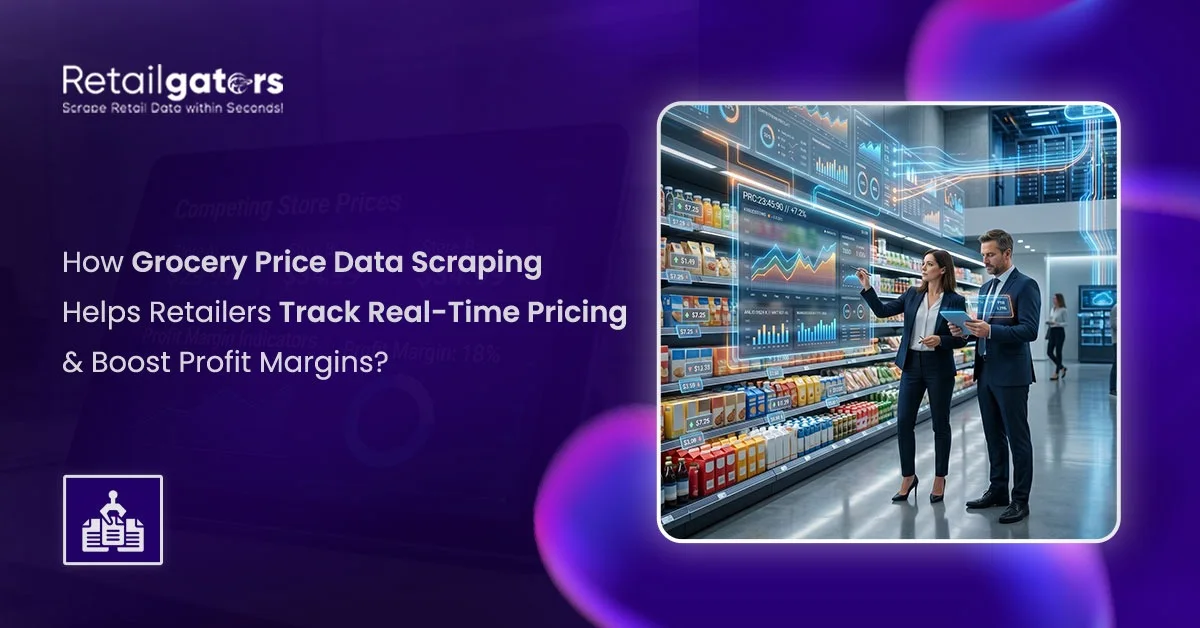
Automated grocery price data scraping changes that equation. It gives retailers structured, timely, and scalable access to competitor pricing across thousands of products, without the cost or delay of manual research. This blog breaks down how the technology works, what it delivers, and where professional solutions make the biggest difference.
What Is Grocery Price Data Scraping?
Grocery price data scraping is the automated collection of product pricing information from the web. This includes scraping information from retail grocery, online supermarket, and food delivery service websites. Bots crawl target pages at scheduled intervals, pull product details including price, SKU, unit size, availability, and promotional offers, and load everything into a database where it can be queried and analyzed.
The term gets used interchangeably with grocery pricing data extraction, and both refer to the same fundamental process. What separates professional scraping from hobbyist scripts is scale, reliability, and the ability to normalize data across sources that structure their pages very differently.
How Does It Differ from Manual Price Monitoring?
A pricing analyst manually reviewing competitor sites can realistically track a few hundred products per week. An automated supermarket price scraping system tracks tens of thousands of products per day, refreshing data every 15 to 60 minutes depending on category volatility. The gap in coverage and speed is not a matter of degree. It is a structural difference that affects every pricing decision downstream.
Why Do Retailers Need Real-Time Grocery Price Tracking?
Real-time grocery price tracking has moved from a niche capability to a core operational requirement for mid-size and large grocery retailers. The reason comes down to how markets actually behave.
Research from Statista shows that over 60% of online shoppers compare prices on two or more platforms before completing a purchase. In grocery specifically, where staples like dairy, cooking oil, and packaged goods are highly substitutable, price comparison is nearly universal. Shoppers know what things cost because they buy the same items every week.
This means pricing errors in grocery are rarely invisible. Overpricing a high-velocity SKU costs transaction volume immediately. Underpricing against competitors with no strategic reason to do so erodes margin without generating any compensating loyalty. Neither outcome is acceptable when margins are already thin.
Retailers using real-time grocery price tracking catch both problems quickly enough to correct them before significant damage accumulates.
How Grocery Price Intelligence Works: A Step-by-Step Breakdown
The practical workflow behind grocery price intelligence follows a sequential process. Each stage builds on the last, and the quality of the final output depends heavily on how well each step is executed.
| Stage | What Happens | What It Produces |
|---|---|---|
| Target Configuration | Competitor URLs and product categories are defined | Structured crawl list |
| Data Extraction | Bots collect price, SKU, pack size, and availability | Raw pricing dataset |
| Normalization | Product names and formats are matched across retailers | Unified product catalog |
| Database Storage | Clean data loads into a queryable, structured system | Centralized price database |
| Analysis and Alerts | Comparison logic runs and flags price movements | Competitive pricing insights |
| Pricing Response | Teams adjust prices or feed data into automated engines | Market-responsive pricing |
Retailers running this workflow on a continuous basis build up historical pricing records that are just as valuable as the live data. Trend analysis, seasonal pattern identification, and category-level benchmarking all depend on data that has accumulated over time.
What Are the Key Benefits of Supermarket Price Scraping?
The business case for supermarket price scraping rests on four outcomes that show up consistently across retail implementations.
Faster Competitive Response
A competitor dropping prices on a high-volume SKU used to go undetected for days in organizations relying on manual checks. With automated price monitoring, the same event triggers an alert within minutes. Pricing teams respond the same day rather than the following week, which is the difference between retaining margin and losing transaction volume unnecessarily.
Margin Recovery on Underpriced Products
This is the outcome most retailers do not expect going in. Grocery price intelligence frequently surfaces products where a retailer is priced below market without any competitive justification. Correcting these underpriced SKUs improves gross margin directly, with no corresponding impact on sales volume because the price is still competitive relative to the market.
Data-Driven Dynamic Pricing
Many large grocery chains now connect grocery pricing data extraction outputs directly to dynamic pricing engines. These systems adjust shelf prices dynamically within a set of predefined guardrails based on competitor behavior and inventory levels. Smaller retailers use the same data for informed manual adjustments. Either way, pricing decisions are based on what the market is actually doing, not on what internal teams assume it is doing.
Procurement and Forecasting Advantages
When prices fall across a category market-wide, it often reflects supply conditions rather than competitive strategy. Retailers who track these patterns through ongoing real-time grocery price tracking can anticipate procurement opportunities, adjust purchase volumes, and avoid getting caught with high-cost inventory when market prices are falling.
How RetailGators Enables Grocery Price Data Scraping at Scale?
RetailGators builds and manages grocery price data scraping infrastructure purpose-built for retail use cases. The platform handles the full technical layer, including JavaScript rendering for dynamically loaded pages, residential proxy rotation, anti-bot bypass, and cross-retailer data normalization, so clients receive structured, analysis-ready data without managing any of that complexity internally.
Coverage spans major grocery platforms including Walmart Grocery, Kroger, Instacart, Whole Foods, Target Grocery, and dozens of regional supermarket chains. Connecting all data delivered in different formats to your existing pricing tools (including your current pricing program, business intelligence tools, or your internal database) is also possible.
RetailGators enables Retailers to set Threshold Alerts for each SKU or category so that if a competitor’s pricing exceeds that Threshold, an alert is sent immediately to the pricing team. This allows pricing changes to be monitored without relying on human memory to detect them.
What Are The Common Challenges in Grocery Pricing Data Extraction (and How to Solve Them)?
Professional grocery pricing data extraction requires solving several technical problems that break naive scraping approaches quickly.
The predominant hindrance to scraping grocery websites is JavaScript-rendered content. Increasingly, grocery platforms present pricing data via JavaScript, executed by the user’s browser, instead of presenting it as HTML. Headless browser tools render a full page before extracting data; thus, they are resolving the problem at the source.
Anti-scraping technology utilized by most grocery websites includes detectable and measurable anti-evasion methods such as rate limiting, automated CAPTCHA challenges, and fingerprinting techniques that evaluate the browser capabilities with which connection requests arrive. Good scraping services have diversified residential proxy servers to prevent IP address abuse, utilized a random pattern of request times, and develop adaptive scraping patterns that anticipate legal user connection request patterns.
The challenge with matching products between retailers is readily described in terms of data quality rather than technology. The same item may be sold on four different websites under four different names, packaging types, or SKU formats. Technology based on the principles of Natural Language Processing (NLP) can provide for product matching based on semantic similarity as opposed to strict matching of string literals.
Site layout and presentation structure can change without notice, breaking commonly used scraping routines. Adaptive scraping services, which continuously verify and maintain structural integrity in the web pages of their data source, can provide continuity of data when their data sources refresh their websites.
Is Grocery Price Scraping Legal?
Many retailers ask this question up front. The quick answer to this question is yes, in most places around the world, you can legally scrape publicly accessible pricing data. While scraping publicly available pricing data is legal for most jurisdictions, retailers should keep the following in mind before they begin their grocery price scraping project:
- Use the robots.txt file whenever possible
- Do not scrape any data that is only available via a login from a third party
- Read the terms of service of any platform you will use before doing any automated data retrieval.
An experienced provider like RetailGators can help ensure that your grocery price scraping efforts comply with all applicable legal requirements and are conducted in accordance with industry best practices for data use.
Conclusion
Grocery price data scraping is a practical, measurable solution to one of grocery retail’s most persistent challenges: knowing what the market is doing before it affects your performance. Retailers who have moved from manual price checks to automated grocery pricing data extraction consistently report faster response times, recovered margin on underpriced SKUs, and pricing decisions grounded in real competitive data rather than assumptions.
RetailGators provides the infrastructure, technical expertise, and ongoing support to run supermarket price scraping programs reliably at any scale. For retailers ready to build a grocery price intelligence capability that actually moves the needle on margin performance, the starting point is accurate, timely, and comprehensive pricing data.