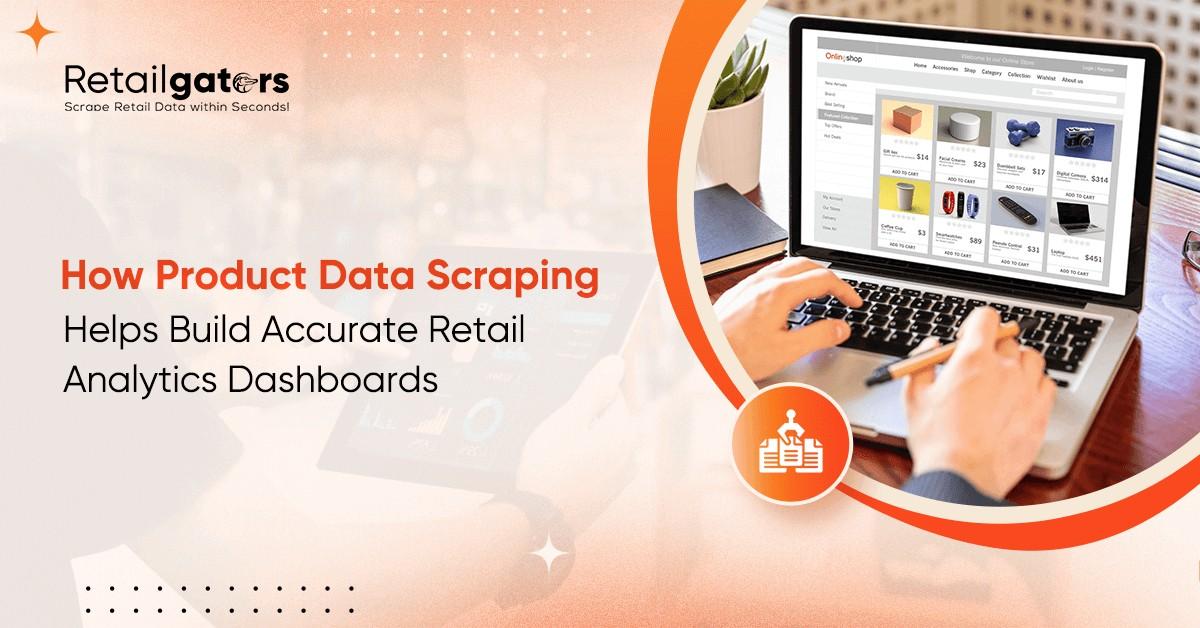
Product data scraping transforms raw online information into actionable insights through retail analytics dashboards and eCommerce BI platforms. Retailers who extract competitor pricing, inventory levels, and product descriptions gain a competitive advantage by making faster, data-driven decisions. RetailGators specializes in turning scattered web data into structured intelligence that drives revenue growth
What Is Product Data Scraping?
Product data scraping is the automated process of extracting product information from websites, marketplaces, and online retailers. This technique collects pricing data, product specifications, customer reviews, stock availability, and seller details at scale.
Modern scraping tools navigate through website structures to identify and extract specific data points. The scraped information feeds directly into retail analytics dashboards where teams analyze trends, monitor competitors, and optimize pricing strategies. Therefore, businesses save hundreds of hours compared to manual data collection.
RetailGators offers enterprise-grade scraping solutions that handle JavaScript-rendered pages, anti-bot measures, and dynamic content loading. Our systems process millions of product records daily while maintaining accuracy rates above 98%.
Why Do Retailers Need Product Data Scraping?
Retailers face intense competition in digital marketplaces. They need real-time visibility into competitor activities to stay relevant. Product data scraping provides this critical intelligence.
Competitive Pricing Intelligence: Scraping reveals how competitors price similar products across different channels. Retailers adjust their pricing strategies based on market positioning data. For example, a fashion retailer might discover that competitors offer 15% discounts on specific categories during weekends.
Inventory Monitoring: Out-of-stock products represent lost revenue opportunities. Scraping tools track competitor inventory levels and alert retailers when rivals face stock shortages. Consequently, retailers can increase marketing spend on products where competitors cannot fulfill orders.
Market Trend Analysis: Product data scraping identifies emerging trends by analyzing new product launches, category expansions, and seasonal patterns. RetailGators’ clients use this data to forecast demand and optimize procurement decisions.
Dynamic Pricing Optimization: eCommerce businesses implement dynamic pricing strategies that respond to market conditions in real-time. Scraped data feeds pricing algorithms that maximize profit margins while maintaining competitiveness.
How Does a Retail Analytics Dashboard Work?
A retail analytics dashboard consolidates data from multiple sources into visual interfaces that highlight key performance indicators. These dashboards transform complex datasets into charts, graphs, and actionable recommendations.
The dashboard connects to various data sources including scraped product data, internal sales systems, inventory databases, and customer relationship management platforms. Modern dashboards update in real-time, allowing managers to respond immediately to market changes.
RetailGators builds custom retail analytics dashboards tailored to specific business needs. Our dashboards feature intuitive filtering options, drill-down capabilities, and automated alert systems that notify teams when metrics exceed predefined thresholds.
Key Components of Effective Retail Analytics Dashboards
Sales Performance Metrics: Track revenue by product category, geographic region, and sales channel. Compare current performance against historical data and forecasted targets.
Competitive Intelligence Panels: Display competitor pricing positions, market share estimates, and promotional activity calendars. These panels help retailers identify gaps in competitor strategies.
Inventory Analytics: Monitor stock levels, turnover rates, and reorder points. Advanced dashboards predict stockout risks using machine learning algorithms trained on historical patterns.
Customer Behavior Insights: Analyze browsing patterns, cart abandonment rates, and purchase conversion funnels. Understanding customer behavior enables targeted marketing campaigns and personalized shopping experiences.
What Is eCommerce BI and Why Does It Matter?
eCommerce Business Intelligence (BI) refers to technologies and strategies that analyze business data to support decision-making in online retail environments. eCommerce BI systems collect, process, and visualize data from digital commerce operations.
Unlike traditional retail analytics, eCommerce BI focuses specifically on digital touchpoints. It tracks website traffic sources, mobile app engagement, email campaign performance, and social media conversion rates. Moreover, eCommerce BI integrates with advertising platforms to measure return on ad spend across channels.
RetailGators implements eCommerce BI solutions that unify data from Shopify, Amazon, WooCommerce, and custom platforms. Our BI tools provide 360-degree visibility into digital commerce performance.
Core Benefits of eCommerce BI Systems
Revenue Attribution: Understand which marketing channels drive the most profitable customers. eCommerce BI tracks the complete customer journey from first touchpoint to final purchase.
Product Performance Analysis: Identify top-selling products, slow-moving inventory, and items with high return rates. This analysis guides merchandising decisions and promotional planning.
Customer Lifetime Value Calculation: eCommerce BI calculates how much revenue each customer generates over their relationship with your brand. Retailers use this metric to optimize customer acquisition costs.
Operational Efficiency Monitoring: Track order fulfillment times, shipping costs, and return processing efficiency. Operational metrics reveal bottlenecks that impact customer satisfaction.
How Do Product Data Scraping, Retail Analytics Dashboards, and eCommerce BI Work Together?
These three technologies form an integrated ecosystem that powers modern retail operations. Product data scraping feeds external market intelligence into retail analytics dashboards. The dashboards combine scraped data with internal metrics to provide comprehensive business views. Meanwhile, eCommerce BI systems analyze the combined dataset to generate strategic recommendations.
Here’s a practical example: RetailGators scrapes competitor pricing data every six hours for a consumer electronics retailer. The scraped data flows into a retail analytics dashboard that compares the retailer’s prices against five major competitors. When the dashboard detects that competitors have reduced prices on popular items, it triggers automated alerts. The retailer’s pricing team reviews the dashboard insights and adjusts prices within minutes. Subsequently, the eCommerce BI system measures the impact of price changes on conversion rates and profitability.
This integration creates a feedback loop where data collection, analysis, and action happen continuously. Retailers who implement this ecosystem respond to market changes 10-15 times faster than competitors relying on manual processes.
What Are the Technical Requirements for Implementing These Solutions?
Successful implementation requires careful planning and technical infrastructure. Organizations need data storage systems capable of handling large volumes of structured and unstructured data. Cloud-based data warehouses like Amazon Redshift, Google BigQuery, or Snowflake provide scalable storage solutions.
Data Pipeline Architecture: Build automated pipelines that extract scraped data, transform it into consistent formats, and load it into analytical databases. These ETL (Extract, Transform, Load) processes run on schedules or trigger based on specific events.
API Integrations: Connect retail analytics dashboards to eCommerce platforms, payment processors, and marketing tools through APIs. Proper integration ensures data flows seamlessly between systems without manual intervention.
Data Governance Policies: Establish rules for data quality, access controls, and retention periods. Strong governance prevents data inconsistencies and ensures compliance with privacy regulations.
RetailGators handles the complete technical implementation on behalf of clients. Our team configures scraping systems, builds data pipelines, and deploys retail analytics dashboards within 4-6 weeks for most projects.
What Legal and Ethical Considerations Apply to Product Data Scraping?
Product data scraping operates within legal boundaries when implemented correctly. Retailers must respect website terms of service, robots.txt files, and data protection regulations.
Publicly Available Data: Scraping publicly accessible product information generally poses minimal legal risk. Pricing data, product descriptions, and availability status displayed to all website visitors fall into this category.
Rate Limiting and Respectful Scraping: Implement delays between requests to avoid overwhelming target servers. RetailGators’ scraping systems include intelligent rate limiting that mimics human browsing patterns.
Data Privacy Compliance: Avoid scraping personal customer information or data behind authentication walls. Focus exclusively on product-level data that competitors display publicly.
Terms of Service Review: Some websites explicitly prohibit automated data collection in their terms of service. However, courts have ruled that scraping publicly available data often falls under fair use principles.
Organizations should consult legal counsel when establishing scraping programs. RetailGators provides guidance on compliant scraping practices tailored to specific jurisdictions and industries.
How Can Retailers Measure ROI from These Investments?
Pricing Competitiveness Index: Calculate how often your prices fall within target ranges relative to competitors. Improvements in this metric indicate effective use of scraped pricing intelligence.
Margin Improvement: Measure gross profit margin changes after implementing dynamic pricing strategies. Many RetailGators clients report 2-5% margin improvements within six months.
Inventory Turnover Rate: Faster inventory turns indicate better demand forecasting and reduced carrying costs. eCommerce BI systems that predict demand accurately increase turnover rates by 20-30%.
Decision Speed: Quantify how quickly teams can access insights and make decisions. Retail analytics dashboards reduce decision latency from days to hours.
Revenue Growth: Track overall revenue growth and attribute specific increases to data-driven initiatives. A/B testing capabilities within eCommerce BI platforms help isolate the impact of individual changes.
What Does the Future Hold for Retail Analytics?
The retail analytics landscape continues evolving rapidly. Artificial intelligence and machine learning increasingly automate insight generation and decision-making. Predictive analytics forecast demand with greater accuracy by analyzing more data sources simultaneously.
Real-Time Personalization: Future eCommerce BI systems will adjust product recommendations, pricing, and promotions for individual shoppers in milliseconds. This hyper-personalization requires sophisticated data processing capabilities.
Voice and Visual Search Integration: Retail analytics dashboards will track product discovery through voice assistants and visual search tools. Understanding these new search patterns helps retailers optimize product listings.
Augmented Analytics: Natural language interfaces will allow business users to query retail analytics dashboards using conversational questions. This democratization of data reduces dependence on technical specialists.
RetailGators invests heavily in emerging technologies to keep clients ahead of market trends. Our research team continuously evaluates new data sources, analytical techniques, and visualization methods.
Getting Started with RetailGators
Implementing product data scraping, retail analytics dashboards, and eCommerce BI requires expertise across data engineering, analytics, and retail operations. RetailGators brings together specialists in each domain to deliver turnkey solutions.
Our implementation process begins with a comprehensive assessment of your current data infrastructure and business objectives. We identify high-value data sources, prioritize analytical use cases, and design custom dashboards aligned with your team’s workflows. Next, we deploy scraping systems and configure data pipelines that feed your retail analytics dashboard. Throughout implementation, we provide training to ensure your team maximizes the value of these tools.
RetailGators serves clients across fashion, electronics, home goods, and specialty retail sectors. Our solutions scale from emerging direct-to-consumer brands to enterprise retailers with thousands of SKUs. Visit RetailGators.com to explore case studies and schedule a consultation with our retail analytics experts.
Conclusion
Product data scraping, retail analytics dashboards, and eCommerce BI form the foundation of competitive retail operations in 2025. These technologies provide the intelligence necessary to compete effectively in dynamic digital marketplaces. Retailers who embrace data-driven decision-making outperform competitors who rely on intuition and delayed reporting.
The integration of external market data through scraping with internal performance metrics creates comprehensive visibility into business health. Therefore, organizations can identify opportunities faster, respond to threats more effectively, and optimize operations continuously. RetailGators specializes in building these integrated analytics ecosystems tailored to each client’s unique requirements.
Success in modern retail demands real-time intelligence, sophisticated analytics, and rapid execution. Partnering with experienced providers like RetailGators accelerates your journey toward data maturity while avoiding common implementation pitfalls. Start leveraging the power of product data scraping, retail analytics dashboards, and eCommerce BI today to secure your competitive position tomorrow.