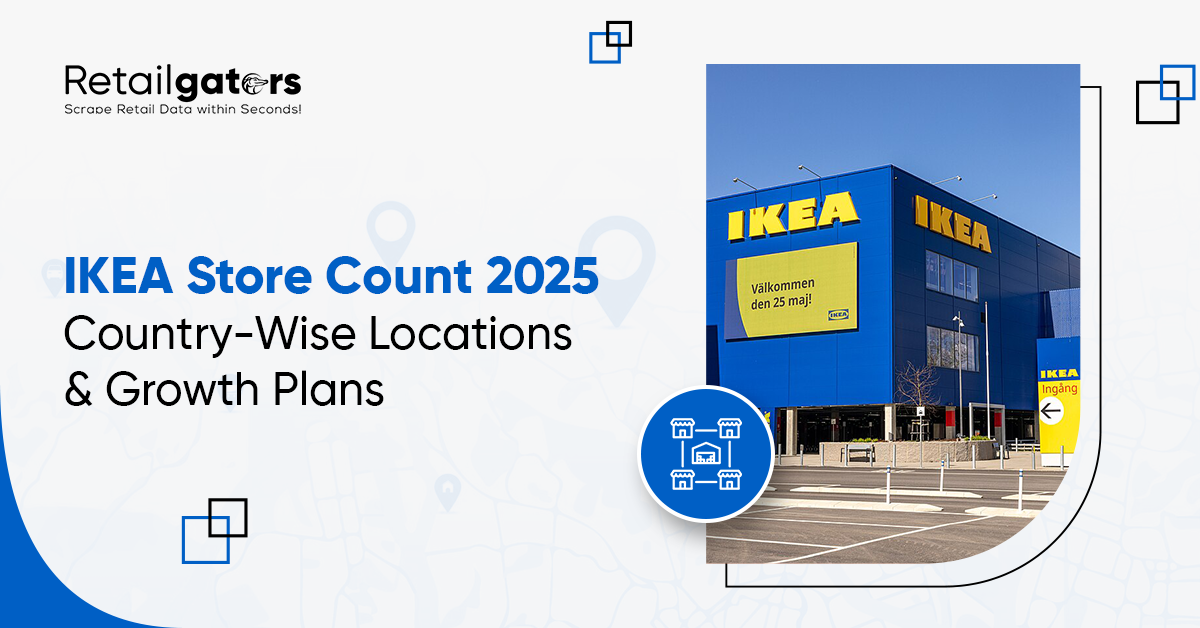
IKEA (Ingvar Kamprad) is a multinational conglomerate that offers a comprehensive range of modern, traditional, and eclectic home furnishing products. With online and offline stores, this global retailer has been the world’s largest seller of well-designed and functional home furnishing products since 2008. IKEA is now operating more than 300 stores around the world. This makes an ideal shopping companion who is looking for ready-to-assemble furniture, household goods, and various related services. This international platform is controlled through several operating companies, nonprofit foundations, and holding companies.
Extracting IKEA allows retailers to efficiently collect and analyze valuable insights for making informed decisions and building a successful business. With web scraping, retailers or e-commerce stores can get on a roll with their sales. They can collect data from IKEA’s SKUs and product listings pages. By extracting this online platform, businesses can maintain their high-quality product offering, understand fluctuating markets, customer preferences, and modern furniture design.
This comprehensive blog gives you a brief idea of the empire of IKEA. It will show you the global presence of the store and help you understand how it has made its mark in the retail industry.
Global IKEA Store Count by Country for 2025
| Country / Region | Approx. Store Count | Notes |
|---|---|---|
| Germany | 53 | Largest European market |
| United States | 50 | Strong presence across major cities |
| China | 35 | Rapid expansion in urban centers |
| France | 34 | High density in metropolitan areas |
| United Kingdom | 27 | Includes small-format stores |
| Italy | 23 | Well-established across regions |
| Sweden | 20 | IKEA’s home country |
| Spain | 16 | Popular in coastal and urban zones |
| Canada | 14 | Mix of large and compact stores |
| Netherlands | 13 | Dense coverage for a small country |
| Poland | 12 | Growing demand in Eastern Europe |
| Australia | 11 | Steady growth in major cities |
| Japan | 11 | Focus on compact urban formats |
| Switzerland | 10 | High per capita store ratio |
| Austria | 9 | Strong regional presence |
| Belgium | 8 | Well-integrated in retail hubs |
| Turkey | 7 | Expanding in urban centers |
| Norway | 7 | High brand affinity |
| Denmark | 7 | Scandinavian staple |
| South Korea | 6 | Popular among young families |
| Saudi Arabia | 6 | Best stores in Jeddah and Riyadh |
Major Countries Having IKEA Stores
| Category | Details | Year / Number | Remarks |
|---|---|---|---|
| Country | Germany | — | Largest IKEA market globally |
| Region | Europe | — | Central hub for IKEA operations |
| Number of Stores | Approx 55 | 2024 | Highest in any country |
| First Store Opened | Munich (Eching) | 1974 | IKEA’s first store in Germany |
| Headquarters | Hofheim-Wallau, Hesse | — | Oversees nationwide operations |
| Large Cities | Includes Munich, Hamburg, and Frankfurt | — | Multiple outlets in each metro |
| Market Significance | Largest by sales volume | — | ~15% of global IKEA revenue |
| Popular Product Segments | Furniture, Home Décor, Kitchen & Storage | — | Consistent bestsellers |
| Sustainability Focus | EV charging and recycling | — | Strong green initiatives |
| Online Sales | Rapidly expanding | — | E-commerce forms a key revenue source |
| Customer Demographics | Families, students, working professionals | — | Wide appeal across ages |
| Employment | Over 19,000 employees | 2024 | Among IKEA’s largest workforces |
| Distribution Centers | Several across Germany | — | Ensures efficient national logistics |
| Store Formats | Standard, small urban stores, and planning studios | — | Adapting to city environments |
| Competitors | Hoffner, Roller, Poco, Home24 | — | Strong domestic furniture competition |
| Future Plans | More city-center and sustainable stores | 2025 onward | Focus on accessibility and eco-design |
United States – Second Most IKEAs
The United States comes very close to Germany in the number of IKEA locations. The following data outlines the expansion of IKEA in the United States.
| Category | Details | Year / Number | Remarks |
|---|---|---|---|
| Total IKEA Stores (US) | Large-format full IKEA stores | 53 (2025) | Nationwide presence |
| States with IKEA Stores | U.S. states with IKEA locations | 27 states | Broad distribution |
| First IKEA in U.S. | Pennsylvania and Plymouth Meeting | Opened in 1985 | U.S. debut |
| New Full Stores (Already planned) | Large-format stores under development | 6 by end of 2025 | Expanding reach |
| Small Format Stores | Planning studios and order points | 10+ locations | Urban focus |
| Pick-Up Locations | Standalone product pick-up & return consumer purchase points | 39+ (2024) | Customer convenience |
| Plan & Order Points | Consultation and ordering formats | Increasing in 2025 | High-touch service |
| New Stores in 2025 | New locations planned | 8+ | Expansion year |
| States Targeted (2025) | CA, TX, OR, PA, AZ, MD | — | Strategic growth |
| Total U.S. Investment | Mainly for technology, stores, and fulfillment | $2.2+ billion (2023–25) | Major commitment |
| Jobs Created (Expansion) | Employment from new stores | 2,000+ jobs | Job growth |
| E-commerce Integration | Store + online coordination | Ongoing | Omnichannel shift |
| Last-Mile Upgrades | Improving delivery infrastructure | 2024–2025 | Faster delivery |
| Customer Planning Services | Home/project planning support | In-store & virtual | Personalized help |
| Store Redesigns | Upgrading existing stores | Nationwide | Modern layout |
| Promote environmental sustainability | EV chargers, solar roofs, etc. | Expanding | Green commitment |
| Urban Store Concept | Compact formats in cities | Ongoing rollout | City-center reach |
| Warehouse & Logistics Hubs | U.S. distribution centers | 10+ hubs | Supply chain boost |
France Loves IKEA
France has more than 30 stores that have been loved by the French for the European style of furniture. The statistics in the following table demonstrate the vast expansion of IKEA stores in France.
| Category | Details | Year / Number | Remarks |
|---|---|---|---|
| Country | France | — | This is IKEA’s strongest European market |
| Region | Europe | — | Key contributor to IKEA’s EU revenue |
| Number of Stores | Around 36 | 2024 | Among the top three in Europe |
| First Store Opened | Paris (near) | 1981 | IKEA’s entry into the French market |
| Headquarters | Plaisir, Yvelines (near Paris) | — | IKEA France head office location |
| Market Significance | One of the top-performing European markets | — | High customer loyalty and steady growth |
| Popular Product Segments | Living room furniture, kitchen systems, storage, décor | — | Strong design-driven consumer demand |
| Sustainability Focus | Waste reduction and renewable energy | — | Key focus area for IKEA France |
| Online Sales | Rapidly expanding e-commerce | — | Boosted by click-and-collect services |
| Customer Demographics | Urban families, young couples, students | — | Wide appeal across income groups |
| Employment | Around 12,000 employees | 2024 | Across retail, logistics, and digital units |
| Distribution Centers | Located in Marseille, Metz, and Lille regions | — | Ensures nationwide coverage |
| Store Formats | Large stores and smaller urban formats in Paris | — | Adapting to compact city living |
| Competitors | Conforama, But, Maisons du Monde | — | Strong domestic and international rivalry |
| Future Plans | More compact city stores and sustainable projects | 2025–2030 | Focus on urban convenience and eco-design |
China and IKEA Stores
China is a major anchor point for manufacturing in IKEA. The table below shows its expansion in China.
| Category | Details | Year / Number | Remarks |
|---|---|---|---|
| Significant urban city | Shanghai, a populous urban region | 4 stores (2025) | High-density market |
| Major City | Beijing urban region | 3 stores (2025) | Capital stronghold |
| Province Region | Guangdong coastal cities | 4 stores (2025) | Coastal growth |
| Province Region | Jiangsu suburban markets | 5 stores (2025) | Suburban expansion |
| Province Region | Zhejiang tourist hubs | 3 stores (2025) | Tourist appeal |
| Northern Province | Liaoning cold regions | 2 stores (2025) | Cold-region presence |
| Western Province | Sichuan inland markets | 2 stores (2025) | Inland reach |
| Central Province | Henan central area | 1 store (2025) | Central access |
| Central Province | Hubei post-COVID recovery | 1 store (2025) | Aftermath of the pandemic |
| Central Province | Hunan emerging cities | 1 store (2025) | Emerging market |
| Northern Province | Heilongjiang northern area | 1 store (2025) | Northernmost area |
| Southwestern Region | Yunnan southwest region | 1 store (2025) | Southwest presence |
| Western Province | Shaanxi historic hub | 1 store (2025) | Xi’an hub |
| Major City | Tianjin satellite city | 2 stores (2025) | Near Beijing |
| Coastal Province | Fujian coastal province | 1 store (2025) | Coastal province |
| Major City | Chongqing inland city | 1 store (2025) | Inland megacity |
| Eastern Province | Shandong economic belt | 2 stores (2025) | Eastern economic belt |
| Emerging City | Changsha regional market | 1 store (2025) | Regional expansion |
What to Expect Going Forward
-
Store counts may grow further: IKEA will continue opening new stores. It will focus on opening small outlets rather than megastores. This will increase the IKEA store count from 550 to 600 in the coming years.
-
India becomes a key battleground: India has a target of having 25 stores by 2025. However, even the partial realization will make India one of the largest markets.
-
Franchise/partnership expansion: In the highly competitive market, IKEA will prefer joint ventures to build its business further.
-
Rationalization and portfolio optimization: IKEA stores may close some of the stores where real estate costs are high. It may also close underperforming stores that depend on foot traffic metrics.
-
Latin America deep dive: IKEA will expand its empire into other regions like Colombia, Peru, and Brazil to take advantage of these markets.
-
Emphasis on metro cities: IKEA’s target would be metro cities for compact showrooms and footprint stores.
How Technology Is Shaping IKEA’s Retail Future?
Technology performs a vital role in shaping IKEA’s retail future. The following are the important technology aspects that have shaped IKEA’s retail future:
Enhancing the In-Store Experience with Digital Tools
-
IKEA has introduced a self-service Kiosk in Australia, the United States, Canada, Thailand, and more. With this Kiosk, customers can find their needed product information in no time. Digital integration has not only streamlined their shopping process but also reduced waiting time and increased convenience.
-
IKEA’s showroom has a digital screen that displays products, their information, and assembly videos. QR code scraping facility helps customers to view product features, type, and specification at a glance. It powers both physical and digital shopping experiences.
Virtual Reality and Its Role in IKEA’s Customer Experience
-
IKEA has introduced a VR Kitchen that helps customers explore and design their kitchen layout in a virtual environment. This tool provides them with a fully engaging experience. It enables customers to see kitchen designs come to life and make adjustments according to their desires.
-
VR is also used by IKEA for employee training. It helps them to gain knowledge about product assembly. Virtual Reality is the most effective tool in providing a deeper understanding and fostering an emotional connection with the customer.
Augmented Reality Enhancements in IKEA’s Customer Experience
-
IKEA launches its application called “IKEA Place”, which enables its customers to rely on Augmented Reality to virtually place furniture in their office, bedrooms, drawing rooms, and more. This mobile application has a powerful and useful feature that provides a 3D representation of furniture, enabling customers to visualize it without any hassle.
-
The IKEA Place mobile application AR helps to build customer trust; therefore, they purchase more products. AR helps stores to increase customer confidence in choosing the products. IKEA provides an interactive shopping experience to customers to build a strong customer relationship.
Personalization and Data Analytics in IKEA’s Customer Experience Strategy
-
IKEA website integrates data analytics into its products and services to provide a personalized customer experience based on customer behaviour and past interaction. It can help customers find products that they have not considered. This way, IKEA is enhancing the customers’ shopping experience so that they purchase related products.
-
Predictive analytics also helps IKEA understand customers and anticipate their future needs. Data is a fuel that is used by IKEA to meet customer expectations. The showroom utilizes data-driven decisions to enhance customer experience, drive satisfaction, and loyalty.
Conclusion
In this blog, you have gained knowledge about the global IKEA store count by country for 2025, and the major countries that have IKEA stores. We also saw how it has leveraged technology to shape the future. By 2025, IKEA will have remained successful, with 487 stores in 63 retail markets. IKEA will increase its global presence more in the coming years. This showroom highly utilizes cutting-edge tools and technology to increase its customer base.
The USA, France, and China are three major countries where IKEA has a significant number of stores. Its growth opportunities can be in countries such as Southeast Asia, India, and others. In the near future, the expansion of IKEA will be based on urban locations and omnichannel integration. IKEA is quickly adapting to local needs, and the speed at which they are doing so is the cherry on top.