Introduction: Why Most Web Scraping PoCs Fail in Production
A successful proof of concept does not guarantee enterprise readiness. Many organizations celebrate their initial web scraping achievements, only to watch those same solutions collapse under real-world demands. The gap between a working demo and enterprise web scraping deployment represents one of the most underestimated challenges in modern data engineering.
PoC scripts often handle hundreds of pages flawlessly. Production environments demand millions. This fundamental mismatch creates cascading failures that CTOs and data platform leaders must address before committing resources to full-scale implementation. The hidden costs of unstable data pipelines extend far beyond engineering hours—they compromise decision-making, damage stakeholder trust, and create compliance vulnerabilities.
RetailGators (https://www.retailgators.com) has observed that organizations frequently underestimate three critical factors: infrastructure elasticity, anti-bot sophistication, and data validation complexity. Understanding how to deploy web scraping at enterprise scale requires addressing each of these dimensions systematically.
CTOs must recognize that production deployment represents a strategic investment, not a simple technical upgrade. The organizations that succeed treat this transition as a formal project with dedicated resources, clear milestones, and executive sponsorship.
What Does “Enterprise-Scale” Web Scraping Actually Mean?
Enterprise-scale web scraping transcends simple scripts and cron jobs. It represents a fundamental architectural shift in how organizations approach external data acquisition.
Key Enterprise Benchmarks
True scalable web scraping architecture must handle:
- Millions of URLs across multiple domains and data sources
- High-frequency refresh cycles ranging from hourly to real-time
- Multi-format data extraction including HTML, JSON, and JavaScript-rendered content
- Integration with existing data platforms, warehouses, and business intelligence tools
Organizations that treat web scraping as a side project rather than a core data platform component consistently underperform their competitors. An enterprise data extraction platform functions as critical infrastructure, not an afterthought.
The Infrastructure Reality
Enterprise deployments require distributed systems capable of horizontal scaling. Single-server solutions cannot meet modern data volume requirements, regardless of hardware specifications. Web scraping infrastructure at scale demands cloud-native architectures, containerization, and intelligent orchestration layers.
Common Failure Points When Scaling Scraping Systems
Understanding failure patterns helps organizations anticipate and prevent production breakdowns. The following issues represent the most frequent causes of enterprise scraping failures.
IP Bans and Anti-Bot Systems
Modern websites deploy sophisticated detection mechanisms. Enterprise scraping systems face fingerprinting algorithms, behavioral analysis, and rate limiting that PoC environments never encounter. Without proper IP rotation strategies and browser emulation, production systems fail within hours of deployment.
Inconsistent Data Quality
Volume amplifies quality problems. A 2% error rate in a PoC becomes 200,000 corrupted records at enterprise scale. Schema drift, encoding issues, and extraction logic failures compound rapidly without automated validation.
Infrastructure Bottlenecks
Memory exhaustion, connection pool depletion, and disk I/O limitations emerge only under sustained load. PoC environments cannot replicate the stress conditions that expose these weaknesses. Production-grade web scraping requires stress testing and capacity planning that most organizations skip.
Manual Error Handling
Human intervention cannot scale. Systems requiring manual restarts, error corrections, or monitoring create operational fragility. Enterprise deployments demand self-healing architectures with automated recovery procedures.
Compliance Blind Spots
Data protection regulations, robots.txt compliance, and ethical scraping practices require systematic attention. Informal approaches acceptable in PoC environments create legal exposure at enterprise scale.
CTO Evaluation Framework: PoC to Production Readiness
Moving from PoC to production requires systematic evaluation across multiple dimensions. The following framework helps CTOs assess deployment readiness.
How Should Organizations Evaluate Scalable Infrastructure and Architecture?
Scalable web scraping for large datasets requires three foundational components:
- Distributed Crawling Systems: Single-point-of-failure architectures cannot achieve enterprise reliability. Evaluate whether your current approach supports geographic distribution, load balancing, and failover capabilities.
- Auto-Scaling Cloud Infrastructure: Traffic patterns vary unpredictably. Cloud-native deployments should scale computing resources automatically based on queue depth and processing demands.
- Queue-Based Orchestration: Message queues decouple URL discovery from content extraction. This separation enables independent scaling and improves fault tolerance.
RetailGators’ enterprise web scraping services implement these architectural patterns to ensure consistent performance regardless of volume fluctuations.
What Ensures Data Accuracy, Validation, and Monitoring?
Data quality at scale requires automated enforcement mechanisms:
- Schema Consistency: Define expected data structures and reject non-conforming records. Schema validation should occur before data enters downstream systems.
- Duplicate Detection: Enterprise systems must identify and handle duplicate records intelligently. Content hashing and temporal deduplication prevent data corruption.
- Alerting and Failure Recovery: Real-time monitoring with automated alerting enables rapid response. Self-healing systems should attempt recovery before escalating to human operators.
How Do Enterprises Handle Anti-Bot and Website Change Resilience?
Enterprise web scraping best practices for anti-bot management include:
- IP Rotation Strategies: Residential proxy networks, rotating datacenter IPs, and geographic distribution prevent detection patterns. Static IP addresses guarantee eventual blocking.
- Browser Automation: Headless browsers with realistic fingerprints bypass JavaScript-based detection. Canvas fingerprinting, WebGL signatures, and timing patterns require careful management.
- Adaptive Scraping Logic: Website structures change frequently. Machine learning-based selectors and visual element recognition reduce maintenance overhead.
What Security, Compliance, and Governance Standards Apply?
Web scraping architecture for data teams must address:
- Ethical Scraping Practices: Respect rate limits, honor robots.txt directives, and avoid overwhelming target servers. Aggressive scraping damages both targets and scraper reputation.
- GDPR and CCPA Considerations: Personal data extraction requires legal basis. Enterprise deployments need data classification, retention policies, and deletion capabilities.
- Audit-Ready Data Pipelines: Regulatory compliance demands complete data lineage. Organizations must document extraction sources, transformation logic, and storage locations.
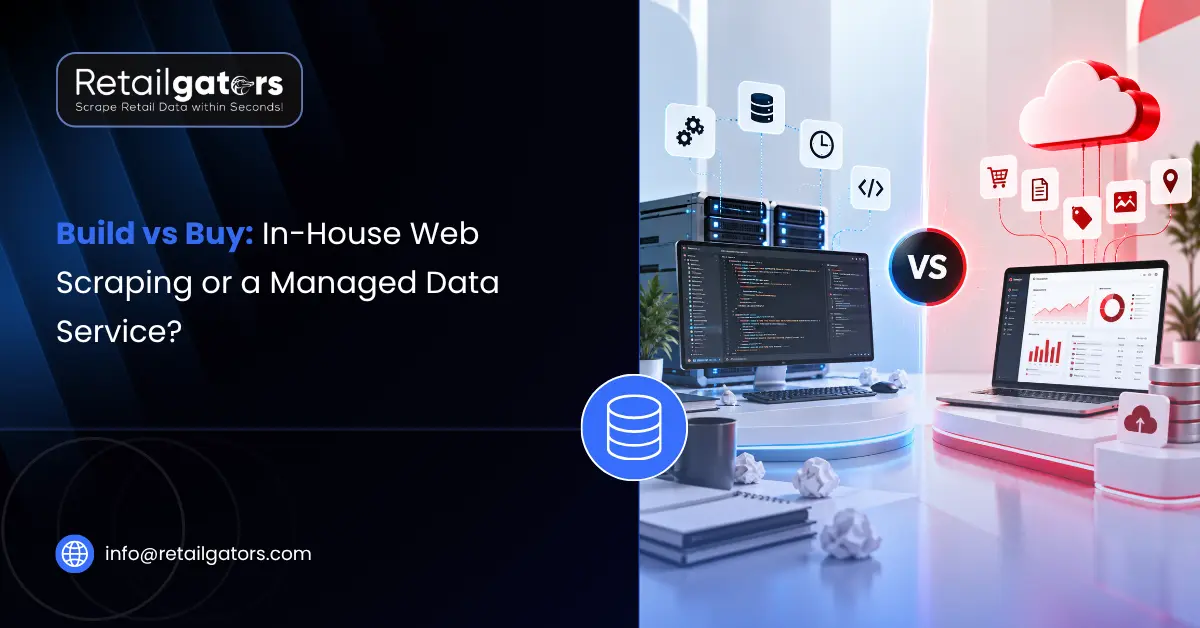
Should Organizations Build In-House or Choose Managed Enterprise Scraping?
The build-versus-buy decision significantly impacts time-to-value and total cost of ownership. Consider these factors:
| Factor | In-House Development | Managed Enterprise Platform |
|---|---|---|
| Time to Scale | Slow (6-12 months typical) | Fast (weeks to deployment) |
| Maintenance Cost | High and unpredictable | Predictable subscription model |
| Reliability | Variable, dependent on team expertise | SLA-backed with guaranteed uptime |
| Compliance Risk | High without dedicated legal review | Controlled through established practices |
| Anti-Bot Expertise | Must be developed internally | Included with platform capabilities |
Organizations choosing in-house development must invest in specialized talent, infrastructure, and ongoing research. RetailGators’ data extraction services (https://www.retailgators.com/data-extraction-services.php) provide turnkey solutions that eliminate these requirements.
Reference Architecture for Production Web Scraping
Moving web scraping from PoC to production requires a well-designed architecture with clearly defined layers:
Data Ingestion Layer
This layer handles URL discovery, prioritization, and scheduling. It maintains crawl queues, manages politeness delays, and coordinates distributed workers.
Scraping Orchestration
The orchestration layer assigns tasks to available workers, manages retry logic, and tracks completion status. It handles worker health monitoring and automatic task reallocation.
Validation and Normalization
Raw extracted data passes through validation pipelines that enforce schema compliance, perform data type conversions, and apply business logic transformations.
Storage and Delivery
Validated data flows to appropriate destinations: data warehouses, APIs, business intelligence tools, or downstream applications. Multiple output formats accommodate diverse consumer requirements.
Monitoring and Alerting
Comprehensive observability includes crawl success rates, data quality metrics, latency measurements, and cost tracking. Dashboards provide real-time visibility while alerts enable proactive intervention.
What Business Impact Does Production-Grade Scraping Deliver?
Organizations implementing enterprise web scraping deployment solutions realize tangible benefits across multiple business dimensions:
- Faster Decision-Making: Real-time competitive intelligence enables rapid response to market changes. Product pricing, inventory monitoring, and sentiment analysis inform strategic choices. Companies with reliable data access consistently outperform competitors relying on manual research.
- Reliable Analytics Inputs: Consistent data quality improves model accuracy. Machine learning systems perform better with clean, structured inputs. Data science teams spend less time cleaning data and more time generating insights.
- Reduced Data Downtime: Self-healing systems minimize disruptions. Automated recovery prevents extended outages that compromise business operations.
- Lower Engineering Overhead: Managed solutions free engineering resources for core product development. Infrastructure maintenance no longer consumes developer capacity.
RetailGators’ analysis of retail analytics implementations (https://www.retailgators.com/blog/product-data-scraping-retail-analytics.php) demonstrates how production-grade web scraping transforms competitive positioning.
Why Do Enterprises Choose Managed Scraping Platforms?
Enterprise organizations increasingly select managed platforms over internal development for several compelling reasons:
- Proven Infrastructure at Scale: Managed platforms process billions of requests monthly. This operational experience eliminates learning curve risks.
- Dedicated Anti-Blocking Expertise: Specialized teams continuously adapt to evolving detection mechanisms. This expertise is difficult and expensive to develop internally.
- Custom Extraction Logic: Enterprise platforms support complex extraction requirements including JavaScript rendering, CAPTCHA handling, and authenticated sessions.
- Enterprise SLAs and Support: Guaranteed uptime, dedicated account management, and 24/7 support provide operational confidence.
For enterprises, production-grade web scraping success depends on reliable data delivery at scale without operational risk. The technology selection matters less than the outcome reliability.
CTO Checklist Before Production Deployment
Before committing to production deployment, evaluate your solution against these criteria:
Can It Scale Beyond Current Volume? Test at 10x anticipated load. Growth frequently exceeds projections.
Does It Handle Failure Automatically? Simulate network outages, target website changes, and infrastructure failures. Measure recovery time and data loss.
Is Data Delivery SLA-Backed? Quantify acceptable latency and completeness thresholds. Document remediation procedures for SLA violations.
Are Compliance Risks Mitigated? Legal review should confirm data collection practices meet regulatory requirements across all operating jurisdictions.
Is the System Future-Proof? Architecture should accommodate new data sources, extraction patterns, and output requirements without fundamental redesign.
Conclusion
The journey from proof of concept to enterprise web scraping deployment challenges even experienced data engineering teams. Success requires systematic attention to infrastructure scalability, data quality, anti-bot resilience, and compliance requirements.
Organizations must honestly assess whether internal development delivers competitive advantage or simply consumes resources better allocated elsewhere. Managed enterprise data extraction platform solutions provide accelerated time-to-value and predictable operational costs.
RetailGators delivers production-ready web scraping pipelines built for scale, compliance, and reliability. Contact our enterprise scraping architects to design a solution matched to your specific requirements.