Introduction
Consumers have become extremely price-sensitive and savvy, and with a few easy clicks can quickly compare prices from several online stores and marketplaces. As a result, businesses must monitor and manage their pricing strategy more than ever.
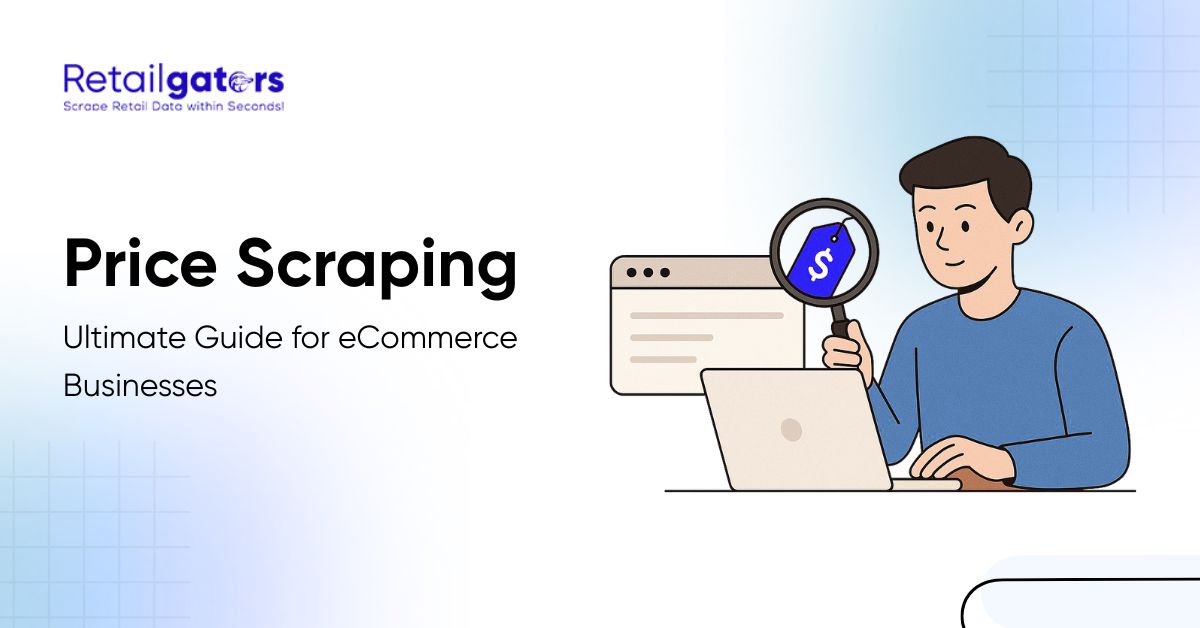
This is when the power of price scraping comes into focus. Price scraping is an automatic process for collecting price data from competitor websites and marketplaces. It enables eCommerce businesses to track their competitors’ pricing, monitor pricing movements, and optimize pricing decisions with clear, data-driven insights.
Over the past few years, the use of price scraping has increased rapidly. As competition has increased and profit margins have narrowed, new trends emerge, and retailers and sellers must adapt quickly to stay competitive. Manually tracking competitor prices is time-consuming, painstaking, and nearly impossible to do on a large scale.
While you could visit each competitor’s site to research their pricing, that soon becomes an unmanageable process, and the accuracy of your data suffers because you are tracking multiple pricing metrics over time. Automated scraping tools help solve this problem by giving eCommerce businesses real-time data that can be trusted.
In this comprehensive guide, we will explain what price scraping is, its importance, how it works, and how you can utilize price scraping to stay ahead of your competition.
Why Price Matters in eCommerce?
In the e-commerce industry, pricing is more than just a number; it’s a crucial factor in consumer buying decisions, profit margins, and brand image. Consumers can now scan multiple sites in just a few seconds to compare pricing; even minor price differences can cause you to lose sales. Today’s consumers are price-sensitive and aware, realizing that underpricing can extend to online companies using various tools, such as comparison sites and deal forums.
In today’s competitive e-commerce marketplace, companies must continually monitor pricing and adjust it accordingly to remain competitive; real-time competitive pricing is essential. Pricing is closely tied to trust perception, brand loyalty, and brand image, as it influences whether consumers perceive you as a premium or budget brand. If you are monitoring thousands of items, price scraping will likely be necessary to stay competitive in today’s fast-moving and rapidly changing online environment.
What is price scraping?
Price scraping is the automated process of extracting pricing data across competitor websites. Price scraping utilizes bots or specialized scraping software to collect product names, prices, discounts, and stock levels, then converts them into predefined processing formats, such as spreadsheets or dashboards, to analyze the collected data. E-commerce companies can now effectively monitor competitors’ pricing without requiring human capital.
Price scraping involves an additional process of scraping attributes such as SKUs, seller names, or shipping prices, providing a more comprehensive range to monitor competitors’ overall strategies. Also known as price monitoring or pricing intelligence, this type of tool enables a business to benefit from pricing options that facilitate rapid price adjustments and promotions, as well as effectively display stock levels to inform better inventory and marketing decisions.
What Are The Types of Data Collected Through Price Scraping?
Price scraping collects much more than just prices. It harvests a substantial amount of specific data, such as product names, descriptions, and SKUs, which helps ensure that a product is matched correctly across those sites. Price scraping collects current prices, original prices, and discount amounts, allowing marketers to determine how competitors are handling promotions.
Stock information informs marketers whether a product is in stock or out of stock. This information is valuable in deciding whether to change their pricing or restock it. Other pieces of meaningful information that price scraping collects include seller information (for marketplaces), their product ratings, reviews, shipping rates and times, and even location pricing—price scraping generally collects all information made public by an online marketplace.
Combined, this data forms an exceptionally powerful dataset that empowers e-commerce companies to leverage automated pricing, anticipate trends, and make smarter and faster decisions in real-time, enabling them to turn weaknesses into competitive advantages and optimize profitability.
Why Is Price Scraping Useful?
Price scraping is an incredibly effective tool for eCommerce businesses that are operating in rapidly changing, competitive market environments. Pricing primarily provides accurate, up-to-date pricing information and eliminates the guesswork in pricing that many businesses face. With this visibility, we can monitor how frequently they change prices, disclose promotional trends, and better grasp pricing with similar competitive prices and profit margins.
Decision-making is easier too—and can support smarter decisions, such as when to introduce discounts, when to replenish particular products, or when to adjust pricing strategies. For businesses with more extensive catalogs, constantly reviewing prices by hand becomes inefficient, burdensome, and risky. For these businesses, scraping can automate the process of price scraping, making it cleaner, more efficient, and scalable.
In addition to pricing, scraping can help businesses when forecasting trends, product planning, and seasonal strategy. Overall, these aspects involve fewer errors and less time-consuming labor—all things that give sellers the power to respond quickly and return to competitiveness for eCommerce sellers in a quick, dynamic marketplace.
What Are The Key Benefits of Price Scraping?
Price scraping offers all sorts of amazing benefits for e-commerce businesses that extend well past competitor tracking. Price scraping gives your business a distinct advantage in an overcrowded eCommerce landscape.
Competitive Advantage
Just knowing what your competitors are charging at the exact time gives you a leg up on the competition. If your competitors raise their prices of products, you may react quickly by either matching or beating their pricing to prevent them from becoming more attractive to their customers.
Higher Profit Margins
With accurate and timely information about the market available to you, you will be able to move up or down with prices with more conviction. For example, if you saw that all of your competitors were currently out of stock and you knew it, you could raise your prices a little bit and still make sales (and obviously increase margins).
Dynamic Pricing
Price scraping allows businesses to automatically change their prices based on competitor behavior, demand, etc., or even just based on the time of day. This flexibility in real time allows businesses to generate more revenue and increase sales quantities.
Efficiency
Scraping saves businesses hundreds of hours in manual research and monitoring. More importantly, it enables businesses to allocate their resources strategically, rather than visiting each of their competitors’ websites individually.
Customer Trust and Loyalty
Consistently fair and competitive pricing establishes trust, which customers use to determine if they want to purchase from you versus your competitors. If you consistently offer customers great deals, they will return.
Better Marketing Campaigns
Use scraping data to run more innovative promotions. For example, consider running a flash sale when your competitors’ pricing is considerably higher, or advertise when your pricing is considered the lowest in the market.
These collectively help your business establish a stronger market position, deliver improved customer experiences, and drive sustainable growth.
Is It Legal To Scrape Pricing?
The legality of price scraping is one of the most frequent areas of concern for businesses when considering its use. To keep it short: yes, it is legal—if done properly.
What’s legal:
Price scraping is typically legal when gathering data from publicly available sources, such as websites that do not require login credentials or provide access behind a paywall. Many court rulings in various jurisdictions worldwide recognize that scraping publicly available data does not violate any laws, as long as it does not infringe upon copyright, privacy, or hacking legislation.
If a competitor’s site provides publicly available pricing, scraping it is equivalent to visiting the site yourself and writing down the price, which is a legal practice.
What to avoid:
- Ignoring rules in robots.txt: Sometimes, a website restricts bots from accessing specific pages or resources. If you violate this, you may be blocked.
- Scraping login-only content or paywall-protected web pages is simply illegal. It is not cool.
- Crashing an overloaded server: If you make too many requests too fast, you could be viewed as a threat.
- Scraping copyrighted content: Product descriptions, reviews, or images may be copyrighted.
Keep on the right side of the fence and practice ethical scraping. The very best practice is using a compliant scraping service like RetailGator, which has built its service around legal and ethical data sharing. This means that your business can collect the data it wants without the risk of potentially breaking the law.
How Does It Work?
Price scraping is accomplished through web crawling, data extraction (scraping), and data structuring, which software programs or bots do automatically. Here’s how it works:
1. Web Crawling
The first step to price scraping is crawling websites to find product pages—which the crawler is known as in the industry. The crawler refers to itself as a bot or spider, and it crawls through all the links on the site, as a human would, but in a more efficient manner. The crawler identifies URLs with the data we are looking for—product listings, category pages, product detail pages, etc.
2. Data Extraction (Scraping)
Once it gets on the correct page, the scraper will extract the specific pieces of data from the website’s HTML or code. Some of the data you can extract are
- Product title
- Current price
- Old price or discount
- Stock level
- Shipping
- Seller name
Although scrapers normally work really well with static content, they are also capable of scraping pages with complex JavaScript-rendered content or pages with dynamic URLs. This is what makes scraping even more powerful.
3. Data structuring
The raw HTML data you have scraped is cleaned up and organized into a readable format. Most users store the data into files, like CSV, Excel, or JSON files. You can also build them into dashboards or feed them directly into an API so that you can view them and monitor prices and automate product prices.
4. Scheduling and frequency.
Scraping tools can be scheduled to run hourly, daily, or weekly based on the extent of price changes that occur in your niche. If the product you are scraping is more competitive, you would run the scraper more frequently.
Which are the 3 Ways to Implement Price Scraping?
There are many different ways to price scrape based on your budget, technical capabilities, and size of business. Below are the three most common methods:
Build a Custom Scraper In-House
If you have a technical team, you can write a price scraper in-house using languages such as Python and libraries like BeautifulSoup or Scrapy. This way you can have complete control of the process (including customization).
Pros: Built exactly as you want. Installation costs are much more affordable if you have developers in-house.
Cons: Legal and ethical implications, maintenance required, and may encounter anti-bot hurdles.
Use a DIY Web Scraping Tool
There are many no-code or low-code scraping tools available that have scraping interfaces, such as Parsehub or Octoparse. These tools enable you to build scrapers without writing code.
Pros: Faster, ease of use.
Cons: Limitations; might default to less reliable options when scraping large itemized URLs or quantities.
Use a Managed Price Scraping Service
The easiest and most scalable option is to use a managed service, such as RetailGator. These companies remove the headache of price scraping by handling everything themselves, including setting up scraping configurations, maintaining scrapers, rotating proxies, and making deliveries.
Pros: Fully automated, reliable, scalable, and compliant.
Cons: Subscription costs, but are outweighed by time and fewer errors.
Each method has its niche applications, but for many e-commerce businesses looking to scale quickly and most efficiently, a managed scraping service is the most effective and reliable option.
Cost Comparison
| Solution Type | Cost Range | What’s Included | Pros | Cons |
|---|---|---|---|---|
| In-House Development | Upfront $5,000–$15,000+ monthly maintenance | Developer salary, server infrastructure, maintenance, and compliance monitoring | Complete control, customized to business needs | High upfront costs, ongoing updates, legal risks |
| DIY Scraping Tools | $100–$1,000/month | Subscription fees, proxy charges, page limits | Affordable for small-scale, flexible | Limited support, may break with site changes |
| Managed Services | Starts at a few hundred dollars per month. | Data extraction, hosting, support, compliance, updates | Scalable, hands-off, accurate, compliant | Higher monthly cost for small-scale use |
What Are The Challenges In Consideration?
Price scraping is a powerful tool, but it doesn’t come without challenges that businesses need to overcome to achieve meaningful results. The most common challenge you need to overcome is that sites do not want you to scrape their data. Therefore, they are deploying anti-bot measures (CAPTCHA, IP blocking, or JavaScript rendering) that you need to overcome, and this sometimes happens with the most sophisticated bot scrapers; advanced technology is sometimes needed in these scenarios, like proxy rotation and headless browsers.
The difficulty with scraping is constant change in website structure and products will break scrapers, which is why it is advisable to have ongoing maintenance to ensure they continue to function properly. Similarly, another large challenge with scraping is the differences between sites in product names, stock-keeping units (SKUs), or descriptions that make matching the data difficult and lead to inaccurate or misplaced comparisons.
Legal and ethical considerations also exist with scraping. Generally speaking, scraping public data is legal; however, there is the issue of violating any terms of use for a site, or continuing to overload a site and clogging their server could result in getting banned. As your products and catalog grow, scalability becomes a concern, where scrapers can become technically demanding. And also, data accuracy is also a concern; old or inaccurate terms can lead to bad decisions. Successful execution, overcoming these challenges, takes reliable tools, good strategies, monitoring, and maintenance.
RetailGator as a Solution
RetailGator is a premier solution for price scraping when you need reliable, scalable, and legal price scraping for your business. RetailGator is designed for eCommerce businesses that want to track their competitors’ prices, monitor their market, and adjust their pricing in real-time.
Why RetailGator?
- Fully Managed Service: RetailGator requires no technical setup whatsoever. RetailGator does it all—from extracting data to delivering it right to you.
- Accuracy: RetailGator’s advanced scraping engine will extract accurate data from your competitors’ websites, even from complex websites and websites that actively use technology to stop scraping (my apologies for the redundancy!).
- Real-Time: RetailGator enables you to schedule crawls to gather the most up-to-date pricing data. Daily? Weekly? Every hour? You tell RetailGator what you want.
- Dashboard: Analyze your competitors at a glance, make competitor data visual, and turn it into usable insights without relying on third-party analytics tools.
- Legally Compliant: RetailGator scrubs ethically and avoids legally sensitive content, including login-only, copyrighted, and trademarked material.
- Scalable: RetailGator will work for you regardless of whether you sell 100 items or 10,000 items.
RetailGator works with all major e-commerce platforms, including Amazon, Walmart, Shopify, eBay, and more. Therefore, whether you are a small seller or an enterprise brand, RetailGator’s data-driven platform enables you to implement data in your pricing strategy, save you time, and increase your profitability.
Future of Price Scraping
The future appears bright for price scraping, as e-commerce continues to evolve and competition intensifies. Many trends will collectively shape the next generation of scraping technology and its strategic role in business:
AI-Powered Insights
The scraped data will not be collected and analyzed; instead, it will be analyzed using AI and machine learning to identify overall pricing trends, predict how competitors may behave, and ultimately provide automatic pricing recommendations.
Integrate Dynamic Pricing
There will be more opportunities for businesses to use scraped data directly in their pricing engines, which allow for dynamic pricing that changes in real-time as competitors change prices or market demand shifts.
Additional Data Layers
In addition to price, future scrapers will also target more complex datasets, including customer reviews, sentiment analysis, and even product attributes in terms of images (visual data for product attributes)—filling out the complete picture of market positioning.
Compliance-First Scraping
As laws regarding databases and privacy continue to increase, as well as rules imposed on scraping by websites, tools like RetailGator will take the lead by using compliance and ethical scraping practices as key differentiators.
Multi-Channel Pricing Intelligence
Companies will begin to track even more than nine separate platforms at once. DTC and marketplace copycats are also added to the mix, along with international competitors.
Conclusion: Stay Competitive with RetailGator
In today’s competitive eCommerce marketplace, price scraping is not optional—it is a requirement. Price scraping involves monitoring competitor pricing, optimizing pricing strategies, and utilizing that information to make informed operational decisions, increase margins, and better serve customers.
We have discussed what price scraping is, how it works, its legal implications, and deployment methods. The key takeaway is that access to reliable and real-time pricing intelligence will give you a competitive advantage in the marketplace.
RetailGator is a fully managed, compliant, and scalable price scraping solution that handles the entire price scraping process and provides actionable intelligence. Whether you are selling on Shopify or Amazon or overseeing a complex retail catalog, RetailGator helps you stay ahead, informed, and profitable.
Don’t leave your pricing strategy to chance; let RetailGator drive your eCommerce growth and provide price intelligence you can rely on.