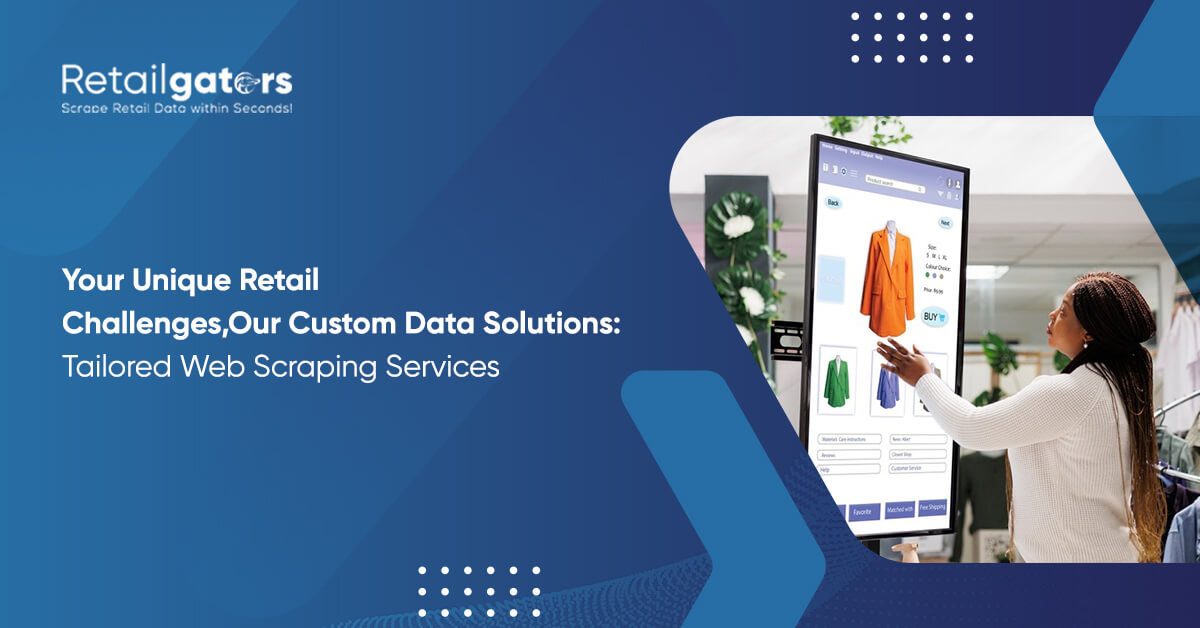
The retail sector has experienced significant changes over the past decade. Retail environments have merged to create an omnichannel shopping experience that meets customer expectations for real-time availability, fair pricing, and personalized service at every stage of the customer journey. As a result, data has become the essential foundation of successful retail business strategies. Suppose you are considering a career in retail. In that case, there has never been a better time to learn how to leverage data for informed decision-making, going beyond just experience and complex market reports. Retailers now require the most accurate, real-time insights to stay relevant in a rapidly evolving marketplace.
Collecting reliable retail data is quite challenging. Retailers often struggle to keep up with their competitors, who may change prices daily, while product availability can fluctuate rapidly, and customer sentiment can shift from minute to minute. Relying on generic reports or seasonal data feeds can leave a retailer behind and increase the risk of making slow or poor decisions.
It is where custom web scraping solutions can be beneficial, allowing for timely decision-making. Unlike standard data sources that provide a one-size-fits-all approach, tailored scraping solutions are designed to meet your specific needs. They can help track competitor discounts, monitor seasonal product trends, analyze customer reviews, and address many other business concerns.
This blog will look at the inadequacies of off-the-shelf data solutions, consider instances of how customizable scraping mitigates modern retail problems, and explore the future of retail data strategies. By the end, you will understand that the adoption of customized web scraping services is about providing solutions to today's issues and capturing the agility to win tomorrow's retail battles.
The Retail Industry: A Data-Driven Battleground
Retail has become a high-stakes, data-driven battleground. Consumer expectations are at an all-time high, and even small amounts of disjointed pricing, availability, or experience can lead shoppers away, causing them to go out of the brand or the retailer they lost them. They need access to all data dimensions from the buying experience.
Pricing is a good example. Consumers evaluate prices across multiple sites while surfing on their device on the go, where there is a digital connection. If you do not have market intelligence on your competitor's pricing, how effective are you? It can lead to price fragmentation across geography, too, and retailers need to evaluate these economic differences as well.
Inventory visibility is essential, too, because out-of-stocks are frustrating to the customer and damaging to brand loyalty. Likewise, having insights from customers through reviews or ratings can help businesses develop a proposition for who resonates with their audience and where they are letting customers down. Companies will be able to leverage products by identifying recent reviews as a trend and avoiding missing out on consumer preferences.
Traditional market reports can have their uses, but by design, they will be far too broad and outdated to answer these questions. Pre-built APIs tend to be much more effective and likely more economical, but when evaluating key areas in competition in a retail market, they will rarely capture the minutiae. Retailers typically function in highly derivative and competitive situations, so what they need is tailored data, suitably updated, and accessible within their workflows. It is where custom web scraping services become the preferred weapon to give a tremendous tactical advantage to businesses that have it as a differentiator in the retail marketplace today.
Why Retail Doesn't Benefit from Standard Data Solutions?
Not all data is the same, and even worse, using standard data solutions can be expensive in retail. Off-the-shelf data solutions, or pre-built APIs, highlight trends, but often not the granular detail retailers need. When inventory levels change daily and prices change by the hour, it's too strict to use a general source of retail data to plan change management operations.
When price and volume change so rapidly, generalized feeds slow down decision-making, while your competitors may move on to new opportunities before you establish the same opportunities. Static data sources don't allow us to shift as quickly as competitors in a fast-paced environment. They also don't scale well--as businesses grow, unbendable source solutions may fall short of what you're trying to achieve due to the range of new products, markets, or competitors.
Custom scraping solves this data adaptation challenge by allowing you to scrape retail data for the challenges you face as a retailer. From specialized product attributes to promotions at scale to geographical differences, there is a deterministic, precise solution for scraping retailers that gives you more flexibility and assurance. Standard data solutions only provide the "what" in retail matrices, whereas custom scraping gives the "why" and "how" for informed retail decision-making.
What Are Retail Challenges and How Web Scraping Can Solve Them?
Retailers know that within their respective markets, there are unique challenges, basically problems, that need to be addressed. Fortunately, these challenges require reliable data that is timely or, better still, in real time. A unique challenge for all retailers is price pressure from competitors.
Today's customers are methodical, price-focused shoppers who compare pricing available from all marketplaces. Retailers need to understand their competitors and plan accordingly for price discounts offered by competitors, bundles provided by competitors, delivery charge offers by competitors, and any stipulations related to those offers. The value of custom web scraping is being able to monitor pricing and pricing adjustments made by competitors with real-time visibility.
Another problem for retailers is inventory visibility. If the product the customer is looking for is sold out or out of stock, they are not just losing customers to competitors, but they risk having a dissatisfied customer. Custom web scraping solutions allow businesses to monitor stock levels of competitors so they can track restock dates and anticipate when products are restocked. It provides retailers with better foresight when forecasting future demand.
Retailers can have hassles with product catalogs, managing thousands of SKUs based on even the ceiling platforms. Custom web scraping will allow retailers to slowly configure the ability to extract product attributes based on the many platforms the retailer must demand reliability from (size, color, specs, and others) to ensure product catalogs are correct and regularly updated.
Customer reviews and sentiments are a pain point where retailers can benefit from scraping. By scraping customer feedback from reviews, ratings, and common themes across many marketplaces, retailers can gauge current customer satisfaction levels, identify unmet needs, and source ideas for future products.
Price pressure from uptrending market trends, monitoring for counterfeit listings, and appropriate localization for new markets are some other challenges where scraping can be helpful.
In the end, every retail problem can be viewed as a growth opportunity, with the assistance of custom, real-time data solutions explicitly designed based on your needs.
What Are The Advantages of Custom Web Scraping Solutions?
The most significant advantages of custom scraping services stem from their high accuracy and flexibility. Pre-fab datasets will have all the fields the company producing them thinks are essential in whatever breakdown they consider is helpful for most purposes. Custom scraping can drill down to exactly what data points a customer is interested in for their business. For example, a clothing retailer may need attributes such as fabric type or season; an electronics brand may be concerned about warranty terms or the details of bundle offers. No detail is too niche to meet, With customized scraping solutions.
Another benefit of custom web scraping solution. Most retailers work in fast-paced environments where yesterday's price or inventory count is irrelevant; we live in the now. Custom scraping offers real-time insights, allowing companies to make dynamic decisions, such as repricing a product or allocating stock.
They scale, in addition to being real-time, which is another crucial consideration. A business may need to track hundreds of products (SKUs), or an electronics brand may track millions of SKUs across multiple international marketplaces. Custom scraping solutions scale easily. They can also integrate seamlessly into CRMs, ERPs, and BI dashboards, which means that data is actioned from whatever report, instead of sitting in a report, which initiates decisions.
It leads to the automation of scraping. Instead of spending valuable time and resources monitoring competitors' sites or keeping an eye on customer reviews, retailers can invest their energy into strategic endeavors.In conclusion, custom scraping solutions do much more than scraping data; they scrape insights and figure out actionable intelligence that targets growth and a long-term competitive advantage.
What Are The Practical Applications of Customized Web Scraping in Retail?
Custom web scraping is more than just an abstract concept—it creates real, measurable benefits in various industries.
- Global Fashion Brand: Scrapes pricing and stock information for products on Amazon, eBay, and Zalando to keep promotions competitive and increase sales and visibility for their brand.
- Grocery Industry Brand: Scrapes competing flyers and online promotions to adjust weekly in-store sales to make them attractive to customers on a budget without exceeding their promotional budgets.
- Luxury Brands: Scrapes marketplaces to identify unauthorized listings, preventing counterfeiting with swift legal action to protect brand image.
- Consumer Electronics: Gathers local retail data based on the history of assortments by competitors and localized customer reviews to infuse product launches with local relevance and ensure better adoption.
These examples in the world of action exhibit that custom scraping is not a strictly vertical or category-agnostic use case. All tailored scrapers provide the clarity, adaptability, and prescience to enable retailers to pivot in a complex and dynamic business landscape.
What Are The Ethical And Legal Issues Around Retail Web Scraping?
Retail web scraping is a powerful analytics tool when used lawfully and ethically in the retail use case. Retailers follow the robots.txt guidelines and only scrape materials that are permitted to scrape and ensure they do not gather personal or sensitive data, only what the individual can access as a public retail store online or their online competitors (e.g., pricing, inventory, product information, product reviews). They should also be applying some throttle on scrap requests to avoid flooding the scraped server. They will spend time reviewing the terms of service of the scraped websites to minimize any legal challenges and avoid being blocked by the scraped websites.
An experienced scraping provisioner can assist with transparency, ethics, and compliance. If done correctly, scraping can add real value for both retailers and customers by providing market insights, competitive intelligence on competitor product offerings, and creating customer value while staying within legal and ethical boundaries.
How To Build a Custom Retail Data Strategy?
A successful retail data strategy begins with clarity around the specific business objectives of the retailer. The first step is to establish unique problems. Are you having issues related to competitor pricing? Are you having issues that are damaging trust with customers due to stockouts? Are you needing to identify trends that are emerging before they crest? Having a clear problem will help focus your scraping strategy and your attention on the correct data.
The next step is converting your unique problems into unique data sources. It includes competitor websites, review sites, eCommerce marketplaces, or niche blog posts that impact consumer demand. From here, you can design custom scrapers that help extract your business-relevant data points.
The data is collected. The next step is the process of cleaning and organizing the data to remove duplicates, unstructured data, and other errors. We want the data to be boundlessly accurate and reliable. The data must be acted upon and put on a business intelligence platform or tool that is already available in their location, whether that be dashboards, CRMs, ERPs, or any of the countless data products that quickly create an operating cadence and allow users to act with the data practically as a collective community.
Most importantly, retail data strategy is, and continues to be, iterative. The context of any data can never be fully supported because the market, ideas, and competitors continuously change, meaning that scraping logic can and should constantly be redefined. And, your digital data strategy is future-proof as long as it evolves and refines based on changes in the market.
Retailers shouldn't treat scraping simply as a technical task—they treat it like a strategic undertaking to maximize the impact of scraping to build a data ecosystem that creates flexibility, profit, and happiness for their customers.
What Is The Future of Retail Data and Web Scraping?
AI-enabled scraping: Machine learning will facilitate intelligent recognition and classification of product attributes, reduce the likelihood of errors, and allow for faster extraction of the necessary data.
AI-enabled scraping: Machine learning will facilitate intelligent recognition and classification of product attributes, reduce the likelihood of errors, and allow for faster extraction of the necessary data.
Adapting to voice & visual search: Scraping systems will begin the transition from data collection to capturing metadata for our smart assistant friends, or simply for searches by image.
Sustainability tracking: Platforms will easily track eco-labels, practices about ethical sourcing, as well as reviews that are relevant to sustainability.
Intelligence, automation, and adaptability are core pillars: the future of scraping will rely on data extraction that is savvy, intelligent, automated, and adaptable, enabling Retailer business models to find continued competitive advantage.
Conclusion
In the hyper-competitive retail environment in which we operate today, data can be the margin that either propels you forward or holds you back. While cookie-cutter solutions can often negate elements of your business, customized scraping actively addresses these challenges—pricing, inventory, review data, and counterfeit issues—contributing to growth. By investing in customized data solutions, a retailer can gain rapid insights into their market and position their business for better strategy and development into new markets.
At RetailGator, we operate by providing customized web scraping services that are tailored to the individual retail challenges you are experiencing. From competitive intelligence to customer sentiment analysis, our scraping services will enable you to make smarter data-driven decisions and do so faster and more profitably. The future of retail belongs to data-driven retailers, and RetailGator will ensure you are always one step ahead.


Leave a Reply
Your email address will not be published. Required fields are marked