Introduction
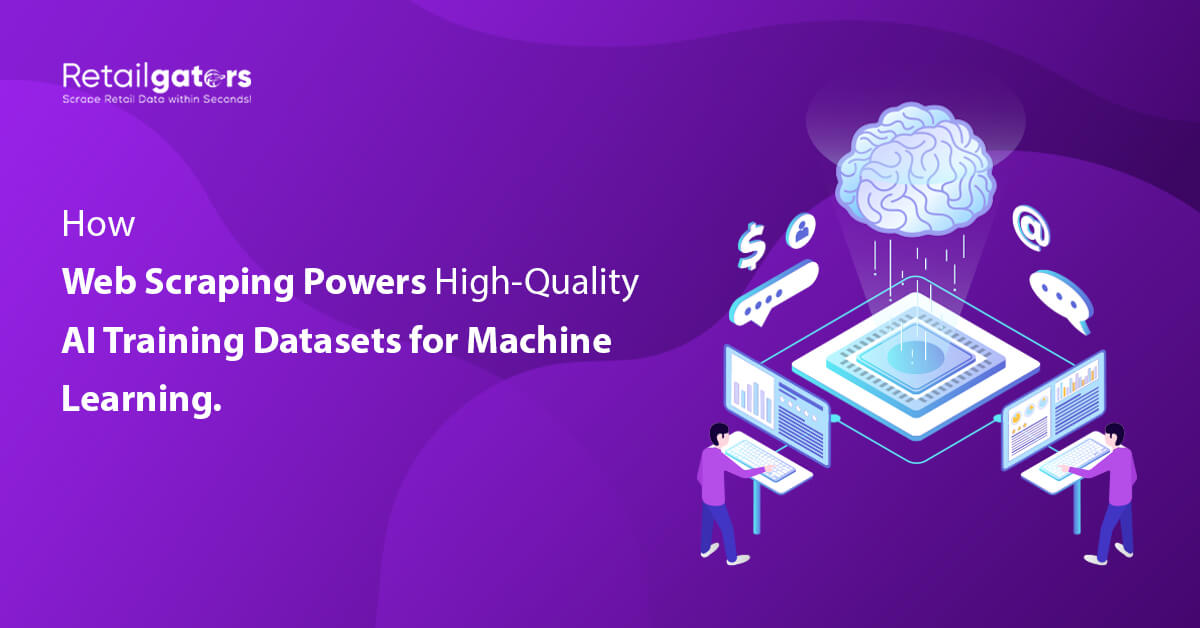
Artificial Intelligence (AI) is changing the world by allowing machines to learn, adapt, and perform complex tasks formerly accomplished by humans. From natural language processing to recommender systems, relational databases to complex statistics, AI is driving digital transformation everywhere. But it often comes down to the quality of the training data that determines the quality of an AI model. Without clean, relevant, and sufficiently diverse training data, even the best algorithms will fail. That is where Web Scraping for AI Training Data becomes essential. By automating the data-gathering and organizing process from the internet, web scraping enables the development of comprehensive datasets with scale.
Why Quality Data Is The Essence of AI?
AI can only be as intelligent as the data that is provided to it. Picture a child being trained to identify animals with only cats and dogs shown to them. The child would never recognize a giraffe or a horse, for instance. An AI model trained on this small amount of data would also be limited in “real-world” conditions. A competent chatbot trained only in formal English will be unsuccessful at trying to understand and respond to more casual slang terms. A fraud detection model built using outdated historical transaction data may not recognize more current methods of fraud.
Self-driving cars trained on images taken only in sunny weather during daytime hours may fail when driving in the rain or snow. These constraints are why using solid training data, especially to build an AI model, is so essential. Building AI models with Quality data means more than quantity; it needs to be accurate, diverse, and representative. One benefit of web scraping is that it provides extensive, multi-sourced data at scale. It helps train AI to behave reliably across diverse conditions. With fresh, structured information, the AI can continue to make adjustments for its environment and ensure it continues to perform consistently in its results.
What Is The Role of Web Scraping in Collecting AI Training Datasets?
Collecting AI training datasets by hand is not practicable when faced with millions of reviews, articles, or multimedia files. The simplicity of web scraping lies in its ability to automate and achieve data collection at scale. Scrapers are capable of fetching information within hours that would otherwise have taken years to compile. The advantages are clear: speed, because you want a vast amount of datasets quickly; diversity, because you want to collect from multiple sources to reduce bias; freshness, because you’ll be able to update databases continuously; and customization, because you can get precisely what you want, such as reviews, forum discussions, and product libraries. For example, NLP developers may scrape blogs, forums, and news sites to grow a reproducible and fair dataset of text.
In contrast, computer vision projects would likely scrape e-commerce sites for labelled product images. Web scraping truly lowers the costs, as it not only drives down pricing for datasets, but it can also democratize access to valuable datasets, so both smaller businesses and independent researchers can develop scalable and fair AI models. By ensuring continuous fresh content, web scraping enables the training of reliable AI.
Machine Learning Data Scraping: Beyond Simple Collection
Machine learning data scraping involves much more than capturing raw web material. The entire workflow takes unorganized data and prepares it for machine learning, ultimately creating structured AI-ready datasets. The scraping process begins with identifying relevant data sources such as a webpage, API, or repository.
Automated crawlers then gather that data, but even after it’s been collected, the raw web content that crawlers scrape often has unnecessary noise, inconsistencies, or duplicates. After the data has been transferred, it is best practice to perform cleaning, where unnecessary information is stripped away. At the same time, modifications (and normalizing) can ensure that the format of data is consistent—for example, date format or unit of measurement.
Annotating labels in supervised learning can also follow a cleaning process, assigning labels to text, images, or audio. To make this more straightforward, consider when we scrape data from e-commerce reviews. We need to capture not only the text string of a review and its star ratings, but also the review’s timestamps and the product it belongs to. Adding these labels to our datasets allows us to add context to the data itself, enabling us to power machine learning models like recommendation engines or sentiment analysis tools more effectively.
By combining extraction, cleaning, and labeling, machine learning data scraping can effectively produce structured datasets that enable high-performance artificial intelligence initiatives. Without this data workflow, the scraped data would remain chaotic and unappreciated, hindering an organization’s ability to turn its real-time and historical data into an asset.
Data Extraction for AI: Converting Raw Content to Structured Datasets
Web-scraped data is often already saturated with unnecessary information that detracts from the ultimate goal of deriving value from it. Data extraction for AI is the second step in dealing with web-scraped data. Data extraction converts messy, unstructured data into structured data, regardless of the format (CSV, JSON, or database), as long as an AI can consume it.
For example, extracting clean article text from news company websites involves reducing unwanted raw material such as advertisements, navigation menus, or unrelated content. Data extracted for computer vision involves scraped images, but we must attach bounding boxes or descriptive tags. For numerical tasks, such as extracting financial reports or weather statistics, one must clean the data into a consistent table structure.
Machine learning algorithms cannot learn from raw HTML input; they require clean, structured input-output relationships. Data extraction eliminates unnecessary information (noise) while retaining only relevant data that can help improve model performance. Data extraction simplifies raw content gathered from the internet, turning it into usable training datasets for various applications, including natural language processing, computer vision, and predictive analytics. Without data extraction, this collected information would remain disorganized and chaotic, providing little to no value for AI.
Automated Data Gathering for ML: Efficiency at Scale
Looking ahead to the modern types of AI, we need to gather data in a way that’s fast, continuous, and scalable. What makes acquiring data for machine learning contemporary is the fact that we can distribute the work using automated data, with scrapers indexing at all hours of the day.
Automated data collection provides you with a continuous data feed, so you have the confidence that your models have the most recent available content. It offers obvious benefits in domains such as finance, where stock prices can fluctuate significantly with the hour and relevant economic news, or in social media monitoring or sentiment analysis, where changes can occur rapidly and opportunities can emerge and vanish in an instant. Automated collection also means scaling may not be an issue; we can scrape hundreds of sites at one time with minimal effort.
Automated scraping systems also provide error handling functionality to help account for layout changes, CAPTCHA, when a site is down, or to help reduce any lapse between data collection. For instance, there are AI models that predict stock price movement, using automated scrapers to collect financial articles, filings, and exchange data, which are updated at least once a day to identify insights and trends. It’s nearly impossible to collect that much data with the same accuracy and speed without automated collection.
Overall, automated web data collection enables organizations to develop AI systems capable of handling the complexities of the real world in terms of speed, scale, and resilience.
Preparing Training Data for AI: The Final Step
Raw scraped data is not usable “as is”. Preparing the training data for AI assures the accuracy, balance, and suitability of the datasets for machine learning. The preparation process involves cleaning the data from duplicates, irrelevant entries, or spam; tagging the data (if needed) for supervised tasks as well; balancing the training dataset by not letting some groups be skewed because they have been over-represented; splitting the datasets into training, validation, and test datasets; and performing quality checks to assure the accuracy of your datasets.
For example, social media datasets scraped to perform sentiment analysis would be high-quality datasets if the spam was cleaned, the sentiments tagged (labeled) correctly for the sentiment category, and it was not skewed. There was a good balance of positive, negative, and neutral labels. It was split into appropriate sections for training and evaluation. You could have large datasets at your disposal, but without following these steps, you may receive biased or incorrect results.
Performance-prepared models, after the data preparation phase, are likely to generalize well and therefore be fair, accurate, and complete when deployed in the real world. This final preparation phase converts the raw scraped content into a framework to build a learning machine capable of high performance.
What Are Real-World Use Cases of Web Scraping for AI Training Data?
Web scraping aids AI development across all sectors by providing a custom training dataset.
- E-commerce: Utilizing web-scraping to extract product descriptions and customer reviews, building recommendation engines for personalized shopping experiences.
- Healthcare: Web-scraping clinical research papers and clinical trial results to train AI tools for diagnosis, treatment recommendations, and disease predictions.
- Finance: Web-scraping market data, financial statements, and news feed; algorithmic trading; portfolio optimization; and risk analysis.
- Social Media: Web scraping posts, comments, and hashtags for sentiment analysis, trends, brand monitoring, and customer sentiment analysis.
- Autonomous Vehicles: Utilizing web scraping to collect images and videos of diverse roads, thereby training AI vision systems to enhance navigation, decision-making, and safety on board a vehicle.
- Education: Utilizing web scraping of academic articles, journals, and open resources, AI systems are powered to evaluate performance, tutoring, and areas of study within a curriculum, providing adaptive learning paths for students.
Not only does web scraping facilitate the development of AI models with high-quality data, but it is also essential for innovation, enhancing progress, and unlocking potential efficiencies and competitive advantages across various real-world applications, regardless of the industry or sector.
What Is The Future of Web Scraping and AI
The future of web scraping development is tied to the improvement of AI. AI models are becoming more demanding for bigger and diverse datasets. Scraping will have to innovate to meet these needs. AI web scrapers can travel to a web page and, with less human guidance, adapt to changes.
When scraping for datasets becomes familiar enough that we have integrated pipelines with web scraping (data scraping), data cleansing, data labeling, and data balancing being functional processes that design a dataset and use algorithms that are systematic workflows, this process will be more straightforward. At some point, some web scraping projects will use synthetically generated data, particularly to balance or rectify scraped data when the amount of real data cannot be garnered, not supervised, or not for unrestricted use.
Additionally, with these improvements, regulatory bodies will increasingly seek ways to enforce regulations on data scraping, prompting organizations to prioritize transparency, data privacy (including consent), and ethics (source). We can expect more strategic partnerships and collaborations between organizations involved in data scraping and AI creators, aiming to license high-quality datasets or forge similar alliances in the future.
All these trends will help ensure organizations can still build AI models with quality data, even as the backdrop of data fairness, scale, and compliance becomes increasingly complex. The future of web scraping development may focus on improving not only efficiency but also on trusted ecosystems of data that help create quality data for AI.
Conclusion
Web scraping is an essential foundation for the AI training data of any AI, it allows mass, diverse, and continuous data collection enabling a sound basis for machine learning models.
These days, the processes of data scraping for machine learning, data extraction for AI, and automated data aggregation for ML all mean that unstructured data found online can be converted to structured datasets ready for AI. Although it is essential in preparing training data for AI, it is also essential to ensure these datasets are fair, balanced, and consistent to minimize the risks of bias or inaccuracy.
In the end, the legitimacy of AI is dependent on building AI models with quality data. The experts like RetailGator will always be one of the most powerful service providers of web scraping. As long as we act ethically, strategically, and thoughtfully, web scraping will facilitate advancements in many areas of AI across various industries for years to come.