Introduction: Why Sentiment in Product Reviews Matters
Customer reviews are the voice of your audience, expressing pertinent observations about the successes and failures of a product. With millions of new customers writing reviews across multiple online platforms every day, evaluating and understanding customer sentiment is no longer a choice but a necessity. Whether you are a small entrepreneur selling on Amazon or a massive retailer with thousands of SKUs, product review sentiment analysis can unlock actionable intelligence for your business.
When a prospective customer visits a product detail page, they often browse reviews to decide whether the product is something they want to purchase. For businesses that want to analyze their reviews, the time required and the overwhelming volume of reviews can make this task unfeasible. That’s where sentiment analysis comes into play. In particular, sentiment analysis through product review scraping services can help businesses scale the data-gathering process while also filtering and analyzing vast amounts of review data into useful insights.
This blog will cover all aspects of product review sentiment analysis, from data scraping and processing through real-world sentiment analysis applications, challenges, and advanced techniques.
What is Product Review Sentiment Analysis?
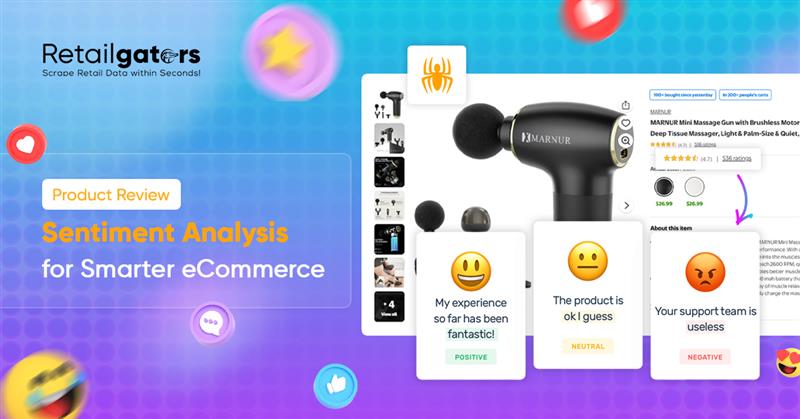
Product Review Sentiment analysis is the application of processes using natural language processing (NLP) and machine learning to analyze feelings and opinions in online product reviews. The primary goal with sentiment analysis of product reviews is to measure and classify whether the reviews are positive, negative, or neutral and identify either themes or sentiments.
For instance, a customer review stating, “This vacuum cleaner is very powerful; however, the battery dies really quickly.” A sentiment analysis model could recognize both a positive sentiment (powerful) and a negative sentiment (battery life) from the review. This would give brands an understanding of exactly what users liked or disliked from product reviews.
RetailGators provides companies to automate the full process. We have built in the entire pipeline from scraping review data at scale all the way to feeding the scraped review data into optimization and sentiment models. So, we are able to create believable accounts of user sentiments, without the time drain of manual processes.
How Sentiment Analysis Works?
How Sentiment Analysis Works?
Step 1: Web Scraping Using Product Reviews
First, let me start by saying reviews are plentiful. Our goal is to get a large and diverse dataset of reviews. RetailGators specializes in scraping review data from major platforms. The relevant data you can collect includes:
- Product name and ID
- Reviewer name & Review title
- Star rating
- Full review text
- Date when reviewed
- Verified purchase indicator
- How many people found the review helpful?
RetailGators designs scrapers that are custom-built to pull historical reviews and real-time reviews. We make sure the scrapers follow each platform’s terms and conditions while retrieving reviews. We also provide API access for implementing reviews into your analytics system.
Step 2: Data Cleaning and Preprocessing
Before you can analyze your review data, it has to be cleaned. Review data should be cleaned as follows:
- Filter out punctuation and stopwords: for example, words such as “the,” “and,” “is,” etc.
- Lowercase everything to eliminate repetitions.
- Tokenization: Split review sentences into words.
- Lemmatization: This will change the word representation back to its root word (e.g., running = run).
Step 3: Sentiment Classification
We can then take the cleaned reviews and put them through sentiment analysis models. The models will categorize each sentence or phrase as
- Positive
- Negative
- Neutral
The most common models are as follows:
- Lexicon-based models: They use lists of words that have sentiment.
- Machine learning models: They are trained on labeled datasets using algorithms like Naive Bayes, logistic regression, or SVM.
- Deep learning models: They use LSTM-based architectures or transformer-based architectures (like BERT) for contextual accuracy.
For sentiments classified in every industry, businesses will either utilize pre-trained models or request their models to be trained on their industry language products.
Step 4: Visualization and Dashboarding
Finally, once the sentiment classifications are completed, it is time to visualize the results:
- Pie chart displaying sentiment classifications
- Time series graphs tracking sentiment over time
- Word clouds of terms used in positive or negative reviews
Aspect-based dashboards separating sentiments based on features of the product (e.g., battery, camera, delivery, etc.)
RetailGators can report projects in Excel or JSON or engage results in BI tools like Tableau, Power BI, or Looker.
Why Sentiment Analysis is Essential in E-Commerce
Gaining insight into sentiment can provide an edge for e-commerce players. Here are some examples of what e-commerce players can do:
Improve Product Listings
By determining what features customers rave about, sellers can proactively know how to develop better product descriptions and bullet points. If many reviews positively use the phrase “lightweight design,” sellers ought to be featuring that in the listing title and associated images.
Improve Product Design
If many reviews note that the buttons on the product are difficult to press or that instructions were unclear, sellers may choose to think about the consumers’ feedback when developing the next version of the product.
Improve Customer Support
Sentiment analysis will also tell you when the negative sentiment spikes, which can allow your support staff to personally reach out or send instructions before the situation escalates.
Evaluate Competitors
RetailGators can also scrape and analyze competitor product reviews to allow businesses to know whether they had weaknesses, gaps they missed, or were cognizant of market opportunities.
Reduce Returns
There are gaps in expectations when the consumer voice is negative in product reviews. If you can start to look towards addressing negative sentiment on product review sites in the seller’s listing or in decisions for future product design, it can result in less product returns/refund needs.
What Are The Sentiment Analysis Use Cases By RetailGators?
Use Case 1: Home Appliance Brand
A home appliance business leveraged RetailGators to scrape and analyze over 20,000 product reviews from Amazon and Flipkart. Through their analysis, they found that 70% of complaints were in regard to heating issues in their electric kettle. After redesigning it, the complaint rate decreased by 60%, and positive reviews increased.
Use Case 2: Fashion Ecommerce Retailers
A fashion brand discovered from sentiment analysis that customers loved their fabric quality, but there was inconsistent sizing. After deteriorating the size chart and images, customer satisfaction scores improved dramatically.
Use Case 3: Health Supplement Store
An online supplement store used their aspect-based sentiment analysis to compare reviews of similar products across vendors. While the brand excelled in sentiment for the product itself, competitors were being negatively viewed for their packaging, which the brand optimized to differentiate themselves.
What Are The Advanced Sentiment Analysis Techniques?
Aspect-Based Sentiment Analysis (ABSA)
Instead of making a generalization over the whole review, ABSA ties the product review to the component attributes of that product:
“The picture quality is great, but the remote did not work just well.”
ABSA assumes that “picture quality” was positive and “remote” was negative, therefore allowing a more actionable way forward.
Emotional Detection
In addition to sentiment and emotion detection, AI can also be used to look for emotional tones that reflect emotions of:
- Happiness
- Anger
- Frustration
- Gratitude
Review Summarization
Using AI models, RetailGators can also summarize hundreds of reviews into a short summary for quickly deciding how to sort out executive-level decisions.
Real-Time Feedback Monitoring
With RetailGators, clients can continuously monitor customer perceptions as they fluctuate over time. Analyze customer sentiment in real-time and:
- Detect bad batches or bad shipments.
- Implement targeted campaigns addressing recent issues.
- Validate the efficacy of product updates by analyzing review trends.
We notify you of negative sentiment that crosses thresholds, allowing brands to immediately act on customer issues.
Combining Sentiment with Ratings, Price & Competition
Sentiment analysis becomes even more powerful when combined with other scraped data:
- Ratings: Explore textual sentiment and star ratings for concealed dissatisfaction.
- Pricing: Understand how markdowns to original prices influence customer sentiment.
- Competitor Trends: Compare competing products’ review sentiment next to each other.
RetailGators offers end-to-end solutions that incorporate all these datasets into powerful business intelligence.
Conclusion: Make Smarter Decisions with Sentiment Data
Product reviews offer some of the deepest data available to e-commerce companies. Sentiment analysis unwraps the value hidden in the meaningful language of customers and converts it into strategy. Whether your goal is to improve product listings and descriptions, resolve user pain points, outdo competitors, or anything in between, customer emotions is where to start.
RetailGators catalyzes the brand in utilizing the necessary tools and data in order to conduct review sentiment analyses comprehensively at scale. From scrapping and processing reviews through insights and reporting, we help customers convert reviews into forward looking action.
Are you ready to see what your customers actually think about your products? Connect with RetailGators to get started in converting reviews to revenue.